Pentagon in talks with Venezuelan mogul for massive oil deal
Published in News & Features
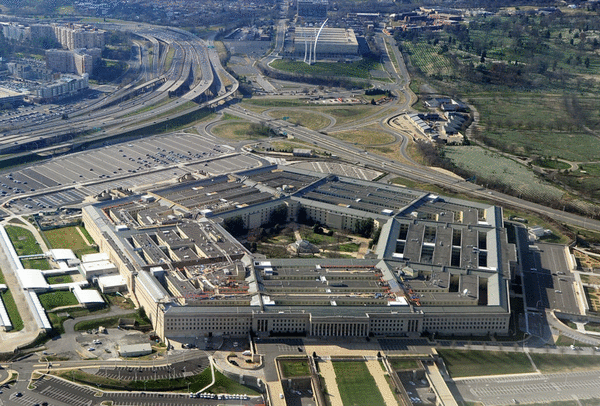
WASHINGTON — The U.S. government is pursuing a major stake in Venezuelan oil reserves via a potential partnership between the Department of Defense and Alejandro Betancourt, a controversial energy investor who has become a key middleman between the two countries.
The negotiations are focused on as many as 17 oil fields that span Venezuela’s main petroleum basins, according to people familiar with the matter.
The Pentagon’s Office of Strategic Capital is being discussed as the potential agency to oversee the investment, some of the people also said. The OSC was established by President Joe Biden’s administration in 2022 as part of an effort to develop critical technologies with the help of private capital. The Trump administration has tapped the OSC to address supply chain gaps.
The White House and Pentagon declined to immediately comment. A press official for Venezuela’s Information Ministry didn’t immediately respond to requests for comment. North American Blue Energy Partners, Venezuela’s leading independent oil producer that Betancourt controls, didn’t immediately respond to a request for comment.
The Pentagon potentially taking direct control of energy reserves in a foreign country is the latest remarkable and unorthodox detail to emerge about U.S. efforts to tighten its grip on Venezuela’s oil sector. One possible arrangement under discussion would see the U.S. take a 100-year lease.
Since ex-President Nicolás Maduro’s capture in January and his replacement by Delcy Rodríguez, U.S. President Donald Trump has touted rebuilding Venezuela’s battered oil industry, which was once the largest in Latin America. Washington now effectively controls Venezuelan oil sales and has eased sanctions to allow U.S. companies to do business in the country.
Still, Venezuela’s oil production has only increased marginally this year, and the influx of new investment from foreign investors has been a slow process. In the meantime, the U.S. war with Iran and the disruption to Middle Eastern supplies has pushed up global energy prices, underlining the potential benefits of a speedy revival of Venezuelan output.
While major U.S. oil players ExxonMobil Holdings Corp. and ConocoPhillips have stayed on the sidelines to wait for a more favorable political and investment climate in Venezuela, Betancourt has moved quickly to shore up his oil interests and become a fixer for both the U.S. government and risk-tolerant wildcatters who are hunting for deals.
The oil fields under discussion between the Pentagon and Betancourt include the Junin area in the Orinoco heavy oil region and fields around Lake Maracaibo, the birthplace of Venezuela’s oil industry more than a century ago, according to the people and a list of properties reviewed by Bloomberg.
The Trump administration’s direct entry into Venezuelan oil through the Department of Defense is likely to raise legal and political questions in both countries.
Unlike the U.S. International Development Finance Corp., which Congress created to invest in developing nations and foreign infrastructure projects, the OSC doesn’t have the explicit ability to take direct equity stakes in projects, raising questions about the legal foundation of the administration’s plan.
The move “would transform the U.S. position in international oil markets, its leverage in Venezuela and its stake in the county’s future,” Evan Ellis, a senior nonresident fellow at the Center for Strategic and International Studies and former staffer at the State Department, said in a text message.
“But the magnitude of the deal, the speed at which it is moving, the instrument being used, and the partners and legal framework on the Venezuelan side naturally present concerns,” he said.
Strong reactions to the potential deal are already emerging on the Venezuelan side.
“An illegitimate interim government with an illegitimate hydrocarbons law has no legitimacy to strike this unconstitutional deal,” said Harvard University professor and former Venezuelan planning minister Ricardo Hausmann in a post on X.
_____
(With assistance from Peter Millard and Eric Martin.)
©2026 Bloomberg L.P. Visit bloomberg.com. Distributed by Tribune Content Agency, LLC.




Comments