Kohberger files motion to disqualify judge who called him 'a faceless coward'
Published in News & Features
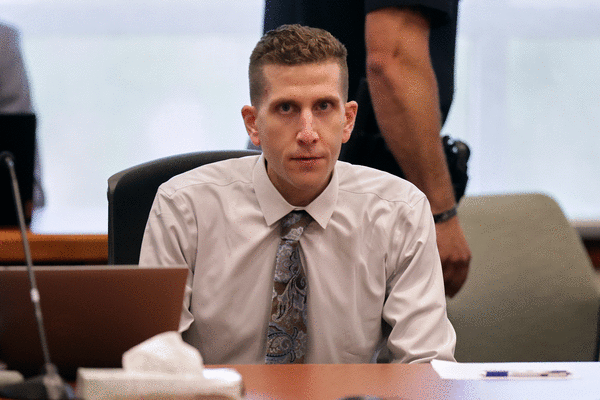
BOISE, Idaho — Bryan Kohberger’s new attorney has filed a motion to disqualify the judge in his case and has asked for a change of venue for his post-conviction proceeding.
The motions, filed Thursday by attorney Gregory Rauch, come after Kohberger last month in his first media statement since being convicted of the first-degree murders of four University of Idaho students claimed he is innocent and blamed his defense team for leading him to make a false confession.
In the motions, Kohberger asked for Fourth Judicial District Judge Steven Hippler to be disqualified and for his post-conviction proceeding to be moved out of Ada County.
Earlier this week, Hippler scheduled an evidentiary hearing for June 17, 2027, on Kohberger’s request for a trial.
“This motion does not rest upon one adverse ruling, one harsh statement, or the mere fact that the judge who presided over Bryan Kohberger’s criminal case has been assigned to his post-conviction proceeding,” the motion seeking to disqualify Hippler said. “It rests upon the extraordinary convergence of all of them.”
Kohberger admitted as part of a plea agreement to stabbing to death University of Idaho students Madison Mogen, Kaylee Goncalves, Xana Kernodle and Ethan Chapin after breaking into their off-campus home on Nov. 13, 2022. He was sentenced to four consecutive life sentences with no possibility of parole as part of the deal.
He asked to be granted a trial as part of a petition for post-conviction relief — even though that could return the death penalty to the table. The legal avenue initiates a civil proceeding whereby someone convicted of a crime can sue the state over allegations that their punishment violated the law. It’s also an approach someone takes when questioning the effectiveness of their attorneys — something Kohberger has now done.
Rauch was appointed to represent him in the post-conviction proceeding.
Motion argues for ‘neutral forum’
The motion to disqualify Hippler argues that he rejected concerns over the “constitutional adequacy” of Kohberger’s lawyers’ preparation. According to the motion, Kohberger’s lawyers said discovery review and their investigation were unfinished and that they weren’t prepared “to proceed under the existing capital-trial schedule.”
“They warned of ineffective assistance,” the motion said.
Hippler concluded that the investigation “already appeared professionally adequate,” attributed the defense’s complaints to “tactical delay” and denied more time, according to the motion to disqualify.
“The State continued to seek death. The trial remained imminent. Six days later, there was no trial,” the motion said. “Now the constitutional validity of the plea that eliminated that trial is challenged.”
The motion also points to some of Hippler’s statements about Kohberger at sentencing, including those calling him a “faceless coward” and the “worst of the worst.” At one point, Hippler questioned if Kohberger “was even ‘capable of speaking the truth’ and predicted that any explanation from him would consist of ‘self-serving and aggrandizing untruthful bits,’ “ the motion said.
“Those statements are fundamentally different from believing Kohberger committed terrible crimes or deserved severe punishment. They are forward-looking judgments about his credibility. And credibility may now be at the center of this proceeding,” the motion said.
It later added: “The question is not merely whether Judge Hippler has formed strong views about Kohberger. The question is whether an informed and reasonable observer could question the impartiality of having the same judge.”
The motion argues that Kohberger is not looking for a favorable judge but rather an “unquestionably neutral forum for adjudicating claims that may implicate his former counsel’s performance, his own credibility, and the constitutional validity of the proceeding that resulted in his conviction and sentences.”
“Where the appearance problem is substantial and the remedy is simple, the better course is to remove the problem — not spend years explaining why the law might have permitted it to remain,” the motion said.
Motion asks for change of venue
In a second motion filed Thursday, Kohberger asked for his post-criminal proceeding to be moved to Latah County.
The criminal charges originated in Latah County, the motion argues, and the petitioner’s and respondent’s counsel have their offices in Moscow. Other attorneys “whose conduct and advice are expected to be material to the ineffective-assistance and plea-related claims” are also in North Idaho, the documents said.
The motion also argues there is precedent for this kind of move.
“Kohberger thus requests this Court to adhere to the common practice of having a PCR case adjudicated in the county where the charges in the criminal case first originated,” the motion said. “Transfer is warranted in a case like this where ‘the convenience of witnesses and the ends of justice would be promoted by the change.’”
Kohberger also objected to the Nov. 13 amendment deadline set by the court’s Aug. 26 order and asked for the court to modify the deadline and hold a scheduling hearing “with enough time to evaluate the file, so that an informed amendment deadline can be established after counsel has had a meaningful opportunity to assess the extraordinary underlying record.”
_____
_____
©2026 The Idaho Statesman. Visit idahostatesman.com. Distributed by Tribune Content Agency, LLC.






Comments