Demuth and Tafoya would make history in Minnesota, but race and gender aren't their pitch
Published in Political News
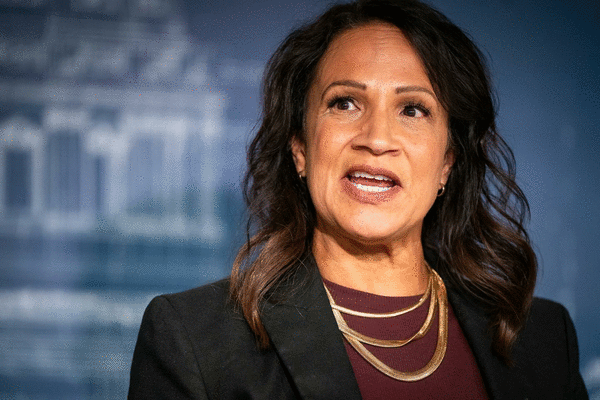


MINNEAPOLIS — On a rainy April afternoon, hundreds of Republican activists sat on folding chairs in Albert Lea’s middle-school gymnasium as House Speaker Lisa Demuth explained how racism in central Minnesota shaped her youth.
Some in the small city of Paynesville did not welcome the daughter of a Black father and white mother, who now, decades later, is running for governor.
“I was called the n-word almost every day of first grade,” Demuth said. “Had a phenomenal family, but it was a difficult place to be. We moved to the metro.”
In May, Demuth’s campaign had a much different message about race for thousands of conservatives at the Minnesota GOP convention in Duluth.
“The pundits will say, ‘Vote for Lisa because she’ll be the first Black female governor in the history of America,’” said Demuth’s running mate, Ryan Wilson. “I say, ‘No, we don’t believe in identity politics.’”
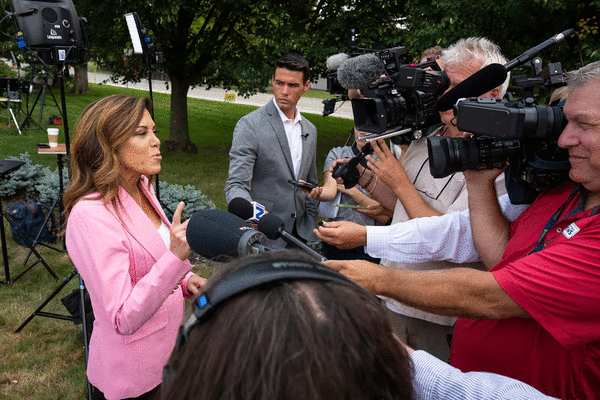
The two scenes illustrate the careful, particular and sometimes inconsistent ways Demuth and her counterpart in the U.S. Senate race, Michele Tafoya, have talked about race and gender in their campaigns.
Though each would make history if elected — Demuth would be the first woman to be governor of Minnesota, and the first Black woman to lead any state, while Tafoya would be the first Hispanic senator from Minnesota and the first Republican woman — both have also been selective about when and how they talk about issues of identity.
The candidates speak publicly about racism and sexism at times, and their trailblazing careers could broaden Republican appeal in left-leaning Minnesota. The GOP has often struggled to win over women and minority voters in Minnesota, one reason the party has not won a statewide election since 2006.
At the same time, Tafoya and Demuth have also mostly resisted the idea that voters should pick a candidate because of identity, especially as they represent a party that has campaigned against identity politics, DEI policies and “woke” ideology.
Both declined to comment to The Minnesota Star Tribune for this article.
Demuth made political history years before running for governor. The legislator from Cold Spring was the first woman and person of color to lead Minnesota House Republicans in 2022. Then, after the House was locked in a partisan tie in 2024, she became the first Black woman and first Republican woman to be House Speaker.
In 2022, Demuth said it was her qualifications, not her race, that earned her the job. In 2025, she also said the milestones were an honor. “I look forward to the day that it will no longer be a surprise or an unusual thing,” she said.
Since announcing her campaign, Demuth has not shied away from speaking about racism as an obstacle — at least early in life.
She often mentions that when she was born in February 1967, interracial marriage was legal in Minnesota but not everywhere in the U.S.
Demuth, 59, tells the story about leaving Paynesville for the Twin Cities. She also says central Minnesota is a better home now.
“We moved back to the Paynesville area and then the Cold Spring area where we’ve been in the same house almost 30 years,” Demuth said during a primary debate for governor in March.
Demuth has also grappled with her gender on the campaign trail, notably after one of her rivals in the Republican primary, Kendall Qualls, declared “the boys are back in town” after he won the state GOP endorsement. In response, Demuth said that type of mentality would be “horrible” against DFL nominee Amy Klobuchar.
Like most other Republicans, Demuth has argued the left’s focus on race and gender has gone too far in many aspects of society. She has clashed with Democrats over what is the best type of government policy to help historically underrepresented communities.
During a March Republican primary debate in Apple Valley, Demuth said Minnesota should get rid of “the woke ideology” in education and return “back to the basics of reading, math, science, just the basics of education.”
When asked by reporters in June if it was important for Republicans to run a woman against Klobuchar, Demuth responded: “You know I am not (about) identity politics.”
“The best qualified candidate is the one that Minnesotans will choose,” Demuth said. She continued, with a laugh: “I am the best qualified candidate, and I happen to be, and I feel like we’ve said this multiple times, I happen to be a woman. If you want me to go there early, a Black woman. Is that helping so you don’t have to ask the next question? That will be historic.”
Even more than Demuth, Tafoya is known for breaking race and gender barriers during her rise to stardom in sports broadcasting. The field was made up mostly of white men when Tafoya joined the industry in the 1990s.
Before running for office, Tafoya often told a story about how she went by Mickey Conley — her mother’s maiden name — at an early radio job at a station in North Carolina. The station manager felt Tafoya sounded too “ethnic.”
“Can I tell you how much I hated that?” Tafoya quipped to the Star Tribune in 2011.
Tafoya’s Hispanic identity has been a point of personal significance. When Tafoya struggled with infertility issues, she adopted a daughter from Colombia to pay homage to her heritage, she told conservatives in Lakeville this year. In August, Tafoya used her ethnicity to rebut people who argue opposition to transgender athletes in female sports is racist.
“I’m brown,” Tafoya said. “I have a very brown daughter.”
Tafoya, 61, has described her Hispanic father as “the son of immigrants” who grew up scrimping and saving because he was born during the Great Depression and had a deep love for the U.S.
Over the years, Tafoya dealt with leering fans and boorish behavior as she built a reputation as one of the country’s best sports broadcasters. One landmark came in 1996: Tafoya was the first woman to call TV play-by-play in the NCAA men’s basketball tournament.
In the course of her career, Tafoya has tended to focus on her work ethic and talent when asked about being a woman in sports.
Tafoya told the Star Tribune in 2017 she knew “I’d be one of the few, few women in this business.”
“I was determined to think of myself as a sports reporter, not as a female sports reporter,” she said. “I just wasn’t going to make a big deal about that.”
In the Republican primary this year, Tafoya ran against a field largely made up of men.
She invoked identity politics at the time, telling GOP voters that being a woman was a political asset to disarm critics of Republicans when Democrats would nominate either Lt. Gov. Peggy Flanagan or U.S. Rep. Angie Craig.
“It’s going to be a female, it’s going to be a woman on the other side of the (debate) stage,” Tafoya told conservatives in Mahtomedi in April.
“I think it’d be really smart to have a woman take it to that woman,” she said. “I will not have to pull any punches, they can’t call me a misogynist.”
Still, Tafoya has not emphasized her race or gender nearly as much as Flanagan, who routinely pitches voters on the idea of sending a Native American woman to the U.S. Senate as an act of representation for a minority community.
In an interview with Larry Kudlow on Fox Business in August, Tafoya was asked about Flanagan’s focus on being Native American.
“I think identity politics writ large is a distraction,” Tafoya said. “Someone asked me the other day are you Hispanic or Latina? And I thought, ‘OK, that’s a distinction without a difference.’ ... Why does it matter?”
“How about this? How about I’m just a professional trying to do a really damn good job at whatever it is that I do and let’s leave the identity out of it.”
©2026 The Minnesota Star Tribune. Visit startribune.com. Distributed by Tribune Content Agency, LLC




































Comments