German protests turn violent as activists clash with police
Published in News & Features
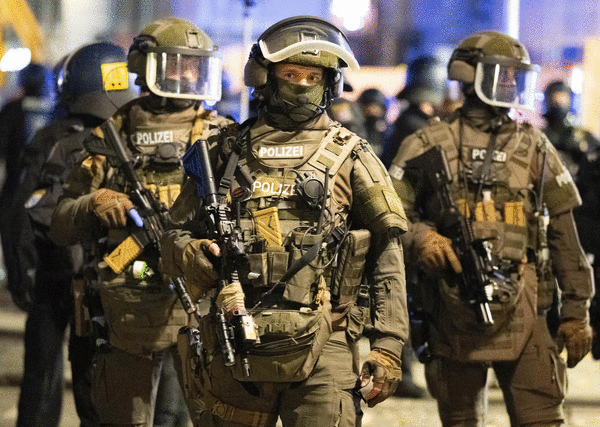
Mass demonstrations in Germany that passed largely peacefully on Saturday erupted in violence as night fell and rioters faced off against police in Frankfurt, Cologne, Hamburg and Berlin.
Authorities blocked off Frankfurt’s main shopping street Die Zeil and arrested more than 30 people after demonstrators smashed shop windows and made off with streetwear and other goods. Officers arrested one person suspected of breaking into a gun store and stealing two weapons, which were retrieved.
Police used water cannons to break up the crowds as protesters threw Molotov cocktails and set off fireworks. By early Sunday, the streets had emptied, while police maintained a visible presence.
Several thousand mostly young people gathered at the Main river embankment on Saturday afternoon before weaving their way through the financial district and toward the European Central Bank in the city’s east. Red flags flew over a diverse crowd, with some wearing hammer and sickle motifs and others bearing rainbow flags and traditional Middle Eastern scarves.
One protester dressed as German Chancellor Friedrich Merz became an instant selfie magnet while others called for him “to resign.” Banners read: “Eat the rich,” "Your housing market is making us homeless,” “Send Merz to the frontlines” and “We can’t feed the poor but we can fight a war?"
The protests were organized by a group known as “Gen Z regelt” — loosely translated as “Gen Z sorts things out” — which had stressed in the run-up to the protest that it wouldn’t tolerate any form of violence against people or property. The crowds fell short of the more than 150,000 participants initially expected across more than 30 cities. The group said it plans another countrywide protest on Nov. 14.
“We are young people who no longer want to watch decisions being made about our future without us,” it said in a post on its website, calling on people of all ages to join the demonstration “for education, health, climate protection and an affordable life.”
Authorities had feared a repeat of the violence that swept through France last month, when blockades and marches morphed into nationwide cost of living protests that drew more than half a million people and descended into riots, arson and looting.
“I have repeatedly signaled that we must expect left-wing extremists with a potential for violence to infiltrate this demonstration, and that is exactly what has happened,” ARD television’s Tagesschau cited the interior minister for the state of Hesse, Roman Poseck, as saying.
In Berlin, a mass gathering at Brandenburg Gate proceeded with little incident, but police made almost 60 arrests in other parts of the city for property damage, assault, resisting law enforcement and violations of the Weapons and Explosives Act.
The unrest in France has emboldened activists in other parts of Europe, including Zurich, where several hundred people, masked and dressed in black, gathered around Langstrasse and Helvetiaplatz in the city center for an unauthorized protest on Saturday night. Participants erected barricades using rubbish containers and other objects, setting some of them on fire. A car was set alight in nearby Zwinglistrasse. Police used water cannons and rubber bullets to disperse the crowds.
Youth-driven protests have erupted across Europe in recent weeks, from Belgium and Portugal in the west to Serbia and Albania in the east. Although grievances are slightly different in each country, the prevailing sentiment is one of anger over affordability, crumbling infrastructure and inequality. Students in France began to demonstrate in mid-September to denounce overcrowded classrooms, teacher shortages and outdated buildings.
After the violent unrest in France, authorities rolled out tougher security measures and pledged aid for businesses and shop owners that suffered damages. In Italy, Premier Giorgia Meloni’s government passed new security measures aimed at stemming violent protests, including tougher penalties on minors after a series of incidents across the country.
More than 300,000 people joined a fresh protest wave in France on Saturday that sparked renewed violence, although on a lesser scale than the mid-October riots. Paris deployed about 70,000 law enforcement officers, similar to the force used during demonstrations last weekend. Police arrested 779 people, authorities said, adding that five officers were injured in Paris.
Images circulated by the National Gendarmerie showed one officer being hit by a Molotov cocktail, an attack Interior Minister Laurent Nunez described as “attempted murder” in comments to journalists late on Saturday. France has launched an attempted murder investigation after the incident, Agence France-Presse reported on Sunday.
Student unions have called for blockades at high schools and universities this week and urged students to join a major cross-sector strike scheduled for Nov. 5 across the country.
_____
(With assistance from Christoph Rauwald, Allegra Catelli, Claudia Cohen and Anand Katakam.)
_____
©2026 Bloomberg L.P. Visit bloomberg.com. Distributed by Tribune Content Agency, LLC.





Comments