Canada's retaliatory tariffs poised to hit Michigan manufacturing
Published in Business News
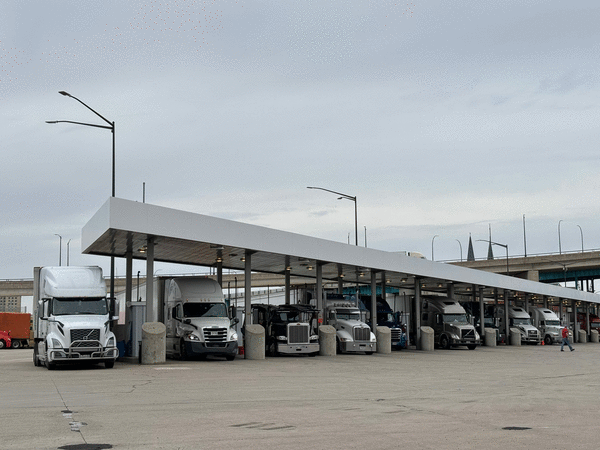
Canada's retaliatory tariffs on U.S. goods could constrain about $1.5 billion worth of Michigan exports, according to a Detroit News analysis of federal trade data.
The tariffs, ranging from 15% to 50%, are set to take effect Sept. 8 and will apply to more than 700 items, including iron, steel, aluminum and derivative articles made from those metals. Michigan's manufacturing sector is especially vulnerable to import taxes on those products.
"It would have a dramatic impact, and it's not just automotive," said John Walsh, CEO of the Michigan Manufacturing Association.
He added: "The retaliatory impact is on the building blocks of almost any item manufactured. When you're talking about metals, plastic, steel and aluminum, it's in everything: cars, airplanes, equipment."
The Canadian tariffs are meant to affect $20 billion worth of U.S. exports, matching the dollar amount from President Donald Trump's latest levies on a list of goods including cement, wine, dairy and hockey sticks. That reciprocal impact, according to Canadian officials, will purposefully target key sectors and states — like Michigan — with particular economic and political importance in the United States.
"We are also targeting products that will target states in the U.S.," said Melanie Joly, Canada's industry minister, on Aug. 25 as she announced the tariffs. "And so we're being wise and strategic to put political pressure, and that's why we think it's the right thing to do right now."
Michigan exported about $23.6 billion worth of goods to Canada over the past year, with nearly $1.5 billion coming from product categories on the country's new tariff list.
Michigan ranks seventh among U.S. states in potential tariff exposure, The News' analysis found. Seven of the top 10 are Midwest states and/or ones that share a border with Canada.
American Foundry Society CEO Justin Scott said in an email that Michigan "sits at the heart of one of the most integrated cross-border manufacturing relationships anywhere."
"The Detroit-Windsor corridor is the busiest commercial crossing in North America, and a casting poured on one side of the border may be machined on the other before it goes into a finished vehicle," he said. "That integration has been a strength for decades, which also means Michigan feels tariff friction faster than other regions."
The analysis provides an estimate of state-by-state exposure, not a detailed accounting of all outgoing goods. It relies on the most recent 12 months of U.S. export data for products included on Canada's tariff list. Amounts may be overstated in some cases due to differences in product classification codes between the two countries, or understated due to some goods leaving the United States without a documented state of origin.
Pennsylvania, notably, ranks first at about $2.6 billion. Michigan border states and fellow industrial hubs Ohio, Indiana and Wisconsin rank fifth, sixth and ninth, respectively.
Michigan companies that typically export to Canadian counterparts will either need to absorb the cost of tariffs or find new business partners domestically or abroad.
Early indicators suggest that Michigan businesses have engaged in less international trade amid Trump's multi-front, global tariff push. The state's exports to Canada fell from $24.6 billion in 2024 to $23.2 billion last year, per federal data. Michigan exports to all countries dropped from $62.8 billion to $60.3 billion.
Walsh said in a phone interview that Trump's tariffs, and retaliatory measures from other countries, ripple throughout the economy. He gave the example of a telephone pole.
"That's metal. Somebody's making that. I can't tell you it comes from Canada, but there's a pool of suppliers," he said. "If one large supply base, Canada, for example, is being hit, then that affects the entire pool. It's not like one supplier of steel can just hold their prices when there's an issue elsewhere in the supply chain. There's an adverse impact across the board."
Walsh said manufacturers in Michigan are angry and frustrated by the challenges associated with tariffs over the past year.
"The uncertainty is driving costs higher. The ability to plan is right out the window," he said. "It means more costs and new supply chains, temporary or otherwise. It's more work. They've got other things to do and other priorities to pursue."
Foundries — factories that melt and shape metal into castings — are "capital-intensive businesses that make long-term commitments," Scott said.
"The uncertainty is as damaging as the duties themselves," Scott said. "Members on both sides of the border are telling us the same thing: They need predictability. Foundries can adapt to a changing trade landscape, but adapting takes time and capital, and a landscape that shifts week to week makes it very hard to, quote, work, plan capacity and invest with confidence."
Michigan midterm impact
The 2026 midterm elections will feature key races across the states most impacted by Canada's new tariffs, though perhaps none more pivotal than Michigan's U.S. Senate contest featuring Republican Mike Rogers against Democrat Abdul El-Sayed.
The winner of that race could determine which party controls the U.S. Senate, and whether Democrats in Congress will gain new ability to check Trump's power.
Some Canadian leaders, including Ontario Premier Doug Ford, have suggested they would work to get Democrats or other anti-Trump politicians elected in November.
"Your own people, President Trump, don't even like you. And they're gonna speak loud and clear in the midterms. If I was allowed to, I'd be down there door-knocking," Ford said on Aug. 24.
Trump's escalating trade war with Canada could be a political problem for Republicans, especially in states like Michigan with close cultural and economic ties to the neighboring country.
El-Sayed of Ann Arbor went after Trump and Rogers directly in an Aug. 26 statement: "Donald Trump is launching this trade war for his own vanity, and he’s asking Michigan families to pay the price ... Trump has been failing Michigan through these chaotic tariffs and bad trade deals for far too long. Mike Rogers won’t do anything but rubber stamp them.
"When I’m in the United States Senate, I’ll fight for real, fair trade deals that create good-paying jobs for Michigan workers and prioritize our families over billionaires and corporate greed."
He added that night at a campaign event: "Canadians are the only people I know who will preemptively apologize for something they never did ... You gotta be an a------ to pick a trade war with Canada. I'm so sorry, like, they're like the nicest people on Earth."
Rogers of White Lake Township issued a statement Aug. 29 giving qualified support for Trump's trade policy toward Canada and criticizing Michigan's two Democratic senators.
"President Trump is right to put America First — and tariffs are necessary, but are not a one-size-fits-all solution," he said.
"Elissa Slotkin and Gary Peters are missing in action," Rogers continued. "Michigan deserves a Senator who will work with President Trump to broker a trade deal with Canada that supports our farmers and gets the best deal for Michigan autoworkers and manufacturers."
Some Republicans in competitive races, like Maine U.S. Sen. Susan Collins, have broken with Trump.
"Imposing new tariffs on Canada is a mistake,” Collins said while campaigning on Aug. 24, according to News Center Maine.
Hardest-hit Michigan industries
The top Michigan exports facing new tariffs from Canada include sheet steel, fasteners, tooling equipment and industrial robots — all products that play a role in the automotive industry and other manufacturing sectors.
"A casting often crosses the border more than once before it ends up in a finished product, so when tariffs apply in both directions, the costs compound," Scott said.
Another example is sheet steel, which is stamped into car body panels during the automotive production process. Fasteners include items like screws, bolts, nuts and washers that are crucial, if often unseen, components in vehicles and appliances. All of those items will be tariffed at 50%.
Overall, iron and steel products represent the biggest Michigan product category subject to the tariffs. The state exported more than $800 million worth of such goods to Canada between July 2025 and June 2026, the most recent 12 months with available data.
Scott said he sees the competitive threat to the U.S. metalworking industry coming from outside North America as "unfairly traded imports built on illegal subsidies and massive overcapacity, increasingly routed through third countries to evade U.S. enforcement."
He's calling for an end to the trade war with Canada.
"The fastest way to strengthen North America's industrial base is to resolve U.S.-Canada frictions quickly," Scott said, "and keep enforcement focused where it belongs."
©2026 www.detroitnews.com. Visit at detroitnews.com. Distributed by Tribune Content Agency, LLC.










Comments