Commentary: Brazil's elections appear to be another win for Donald Trump
Published in Political News
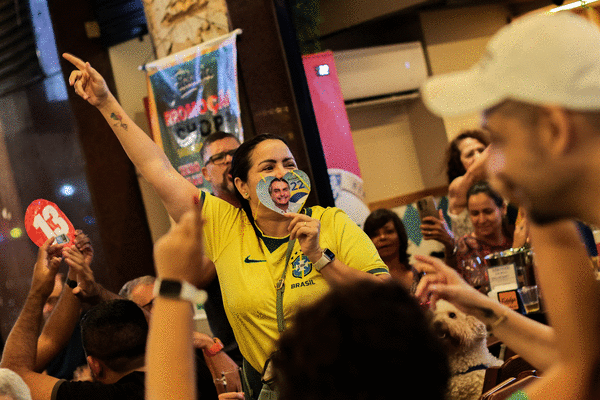
If there’s anything President Donald Trump likes more than campaigning for Republicans, it’s watching his preferred candidates win their elections. In Latin America, he’s having remarkable political success.
Over the last year and a half, right-wing candidates have won seven presidential elections in a part of the world Washington euphemistically refers to as its backyard. Some of those elections, such as in Honduras, involved a heavy hand from Trump, who all but threatened to cut off U.S. aid to the Central American nation if his preferred politician didn’t win last year. In others, such as in Argentina, Trump dangled the promise of a $20 billion currency swap as a reward for voters giving Argentine President Javier Milei more allies in the legislature.
Trump is clearly happy with himself, marveling last month that “everybody I’ve endorsed has won … a lot of wins; we’re winning a lot.”
After this weekend, he’s a step closer to another win in the region. In Brazil, Latin America’s largest country and wealthiest economy, tens of millions went to the polls to cast their ballots for president. Flávio Bolsonaro, the elder son of former Brazilian President Jair Bolsonaro, won 47.03% of the votes to Brazilian President Luiz Inácio Lula da Silva’s 45.16%. Since none of the 12 candidates in the running reached 50% (plus one), a second round will be held on Oct. 25 between these two men. Bolsonaro, however, is the clear favorite; many of the other presidential candidates were right or right of center, and their supporters will likely throw their hats behind the scion of Brazil’s most influential conservative family. Unless Lula, who’s running for a fourth term, magically attracts some of the moderates and disenchanted voters who stayed home, Trump will have another ally in a high place.
It’s difficult to put into words how rocky the U.S.-Brazil relationship has been in recent years. Joe Biden’s administration didn’t exactly get along with Jair Bolsonaro during his four years in power. The Biden White House was petrified over Bolsonaro’s destruction of the Amazon, was aghast at his divisive rhetoric against traditionally marginalized groups in the country, and grew concerned when the far-right populist increased Brazil’s trade ties with China. Biden at one point sent his CIA director to Brazil to warn Bolsonaro about stealing his reelection. (Bolsonaro was eventually sentenced to 27 years in prison for a coup attempt.)
Trump’s interactions with Lula, the region’s most famous left-winger and a man who played a role in the downfall of Brazil’s military dictatorship in the mid-1980s, hasn’t been any better. The country-to-country relationship isn’t broken, but it’s not healthy either. Much of this can be chalked up to competing national priorities as well as a clash in personalities. For starters, the Trump administration makes a point of saying that the Western Hemisphere is America’s region to lead. However for Lula, this kind of sentiment smacks of arrogance and imperialism. Brazil, he has long stated, is for the Brazilians and nobody else. Whereas the United States is operating through the prism of great-power competition, Lula’s foreign policy focuses on promoting multi-alignment and strengthening relations with all of the world’s major states in order to lessen Brazil’s dependence on any single country, increase its geopolitical flexibility and bolster the collective weight of the so-called Global South.
It didn’t take long before those two interpretations smacked into each other. Trump wasted little time leveraging America’s economic tool kit in an attempt to free his old friend, Jair Bolsonaro, from investigation. In July 2025, he slapped 40% tariffs on some Brazilian products, justifying the move as punishment for what he called the Brazilian justice system’s “persecution” of Bolsonaro. Lula used the tariffs to his political advantage, calling them an intrusion into Brazilian affairs and an attempt by Trump to coerce the country into meeting Washington’s demands. In the end, the tariffs had the counterproductive effect of pushing the Brazilian government toward more trade deals with China to compensate for the added expense of accessing the U.S. market. Months later, Trump eventually dropped some of those tariffs on Brazilian food products to get a hold on Americans’ high grocery costs.
This year hasn’t been pretty either. As Brazil’s election season was in full swing, the Trump administration made decisions that many regional analysts and Lula himself viewed as malicious moves to influence the race. In May, after meeting with Flávio Bolsonaro in Washington, Trump designated Brazil’s two biggest criminal groups as foreign terrorist organizations. In July, Trump issued more tariffs on Brazil. That same month, two U.S. State Department officials were scheduled to travel to Brazil to talk about election integrity, which the Brazilian government suspected was a not-so-subtle effort by the Trump administration to cast doubt on the country’s electronic voting system. (Brazil blocked the two officials from entering.) And in August, Washington stripped the Brazilian ambassador in Washington of her visa in retaliation for Brasília stonewalling Trump’s own ambassador to Brazil. In short, there’s no love lost between Trump and Lula.
While Trump didn’t explicitly endorse Flávio Bolsonaro, there’s no doubt he would much prefer a 45-year-old far-right Brazilian president to an 80-year-old member of the political left. Indeed, Bolsonaro has promised a whole slew of policies that the Trump administration backs, from joining Washington’s Shield of the Americas anti-cartel coalition and building a system of mega-prisons to reorienting Brazil’s foreign policy toward the West.
Ultimately, Trump wants in Brazil what he currently has in Venezuela: a puppet willing to happily take his orders. But Brazil’s next president will have far more power than Venezuela’s Delcy Rodríguez ever did and thus more room to defy U.S. diktats.
Trump might end up being disappointed regardless of who wins the second round later this month.
____
Daniel DePetris is a fellow at Defense Priorities and a foreign affairs columnist for the Tribune.
___
©2026 Chicago Tribune. Visit at chicagotribune.com. Distributed by Tribune Content Agency, LLC.










































Comments