Push to restrict 'jawboning' advanced by Senate Commerce panel
Published in Political News
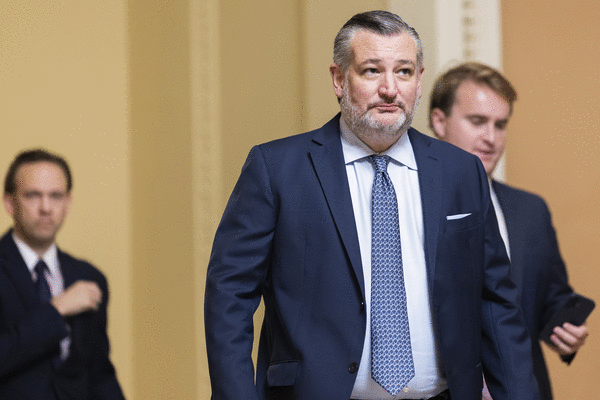
WASHINGTON — The Senate Commerce Committee on Wednesday approved, 18-10, legislation by Chairman Ted Cruz that would limit government coercion of broadcasters and online platforms, despite concerns about its impact on conversations with artificial intelligence platforms.
Sens. Brian Schatz, D-Hawaii, Edward J. Markey, D-Mass., and Jacky Rosen, D-Nev., voted with the committee’s Republicans to advance the bill.
Members of both parties have complained of indirect censorship, known as jawboning. Republicans often point to the Department of Homeland Security’s Cybersecurity and Infrastructure Security Agency conversations with social media platforms about COVID-19 and the 2020 election.
Democrats have raised concerns about Federal Communications Chair Brendan Carr’s frequent threats to revoke broadcast licenses based on television programming.
Cruz, R-Texas, sponsored the measure alongside Sen. Ron Wyden, D-Wash. It would allow individuals or the broadcasters and platforms to bring civil actions against agencies or employees if the government used coercion to alter or remove speech.
It would also require a public database of the government’s communications with broadcasters, platforms and AI providers.
Cruz said the bill would give standing to individuals who believe their speech was harmed.
“It doesn’t give the government an excuse to trample your First Amendment rights and take down disfavored opinions under the expansive and phony pretense of safety or national security,” Cruz said.
Ranking member Maria Cantwell, D-Wash., said she supported a remedy for those whose speech was limited by government action, but brought up other concerns about the bill.
She offered an amendment that she said would have removed references to communications with AI providers.
The bill includes an exception for communications that are part of an investigation or enforcement under a federal law. Cantwell said that because there aren’t federal standards for AI, the jawboning bill could sweep up more communications about AI than intended.
“If an employee at the Department of Energy asks a company to stop its model from explaining how to enrich uranium, that is content action with no existing federal law behind it,” Cantwell said. “That means that communication could be illegal under this bill, and the employee could be sued.”
Cruz said he disagreed with Cantwell’s interpretation but committed to working with her on the bill’s application to AI after the bill moved out of committee.
Cantwell’s amendment also would have removed the bill’s portal for government communications and required that any consent decree in a case brought under the bill be found by a judge to be in the public interest. The amendment was defeated, 15-13.
The committee adopted Cruz’s substitute amendment in the same vote as the bill itself. It narrowed the bill’s exemption for actions pursuant to an investigation or law enforcement to only federal laws, rather than federal or state.
Sen. Eric Schmitt, R-Mo., noted that Cruz committed to including a bill Schmitt sponsored related to jawboning at the committee’s next markup. That bill would remove protections for social media platforms under Section 230 of federal telecommunications law if a platform made content decisions based on government communications, unless those communications were for legitimate law enforcement or national security purposes.
Section 230 of the law makes online hosts of user-generated content not liable as publishers.
Tech industry group NetChoice celebrated the committee’s work on the bill. The markup “moves us one step closer to giving platforms a genuine legal remedy to defend their right to make editorial decisions, free from backroom pressure by government officials,” said Zach Lilly, NetChoice’s director of government affairs, in a statement.
Columbia University’s Knight First Amendment Institute also praised the bill.
Nadine Farid Johnson, policy director at the institute, said in a statement that the legislation would “create an important mechanism for accountability when government jawboning crosses the constitutional line.”
©2026 CQ-Roll Call, Inc., All Rights Reserved. Visit cqrollcall.com. Distributed by Tribune Content Agency, LLC.






































Comments