Still on the House agenda? Tension with the Senate
Published in Political News
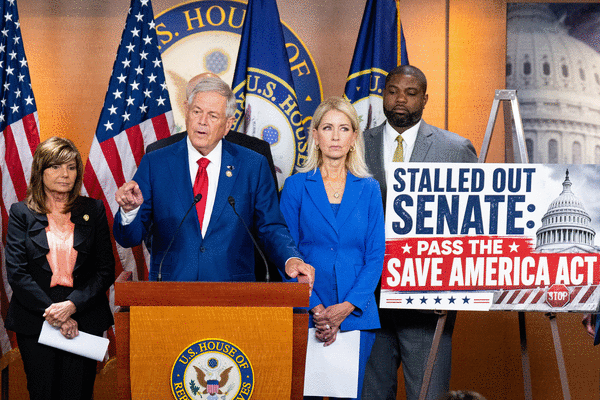
WASHINGTON — The House returns from its August break with a short to-do list: squash the possibility of a government shutdown so members can focus on the looming midterm elections.
So far, so good, if they can stick to the plan of quickly clearing a Senate-passed spending stopgap this week.
From there, Republicans will waste no time in starting their midterm messaging blitz, bringing a resolution denouncing “socialism in all its forms” to the House floor. It’s meant to paint Democrats as increasingly radical and out of touch with ordinary Americans.
But it also contains language calling for enactment of the so-called SAVE America Act, the sweeping voter ID package backed by President Donald Trump that has caused inter-chamber feuds and headaches for party leaders.
It’s a reminder that even as some House members remain hyperfocused on the bill — which would require proof of citizenship to register to vote and photo ID at the polls — the effort has hit a seemingly immovable wall in the Senate.
“I’ve been very clear about the prospects for the SAVE America Act,” Senate Majority Leader John Thune told reporters earlier in August. “It seems to me sometimes I’m the only one who can count to 50 in this town. But we don’t have the votes to get rid of the filibuster, and we aren’t flipping 10 Democrats to vote for the SAVE America Act.”
The bill has been a point of ire between the chambers for months, with House conservatives reserving their fiercest criticism not for Democrats who oppose the package, but for their Republican counterparts, lobbing insults and complaining that senators are “lazy.”
And they are continuing to threaten to muck up the House floor and stand against any Senate bills until the other chamber passes the voter ID bill.
Rep. Anna Paulina Luna, R-Fla., posted earlier in August: “Aside from Reconciliation and a fixed version of the NDAA, the Senate will not get any legislation passed in the House because there are Members of Congress in the House that will vote against anything they send over based on the fact that they are refusing to pass the SAVE America Act and Voter ID.”
“Every single one of these Senators that’s claiming to champion this issue could be holding their leadership accountable or finding new leadership,” she wrote. “Lip service is no good.”
That threat from Luna came a day before the Senate wrapped up for its own summer break. She doubled down after they left town, adding: “No senate originating bills should pass the House until save America is passed.” Reposting a video of Sen. Rick Scott, R-Fla., who vowed he wasn’t “giving up” in his chamber and would “figure out how to get this done,” she praised him while slamming other senators: “He is one of the few good ones.”
Luna’s office did not immediately respond to questions about what her threat will mean for this week or the rest of her party’s pre-midterm agenda. Earlier in the summer, she had boasted that 24 of her GOP House colleagues were committed to standing “firm” and led a revolt over SAVE that stalled the House floor and prompted leaders to send members home early for the July Fourth recess.
Socialism resolution and more
The sponsor of the socialism resolution, Rep. Jeff Crank, R-Colo., is not one of those House hardliners threatening to block bills. But he’s amplifying his party’s anti-socialism message as he faces a competitive reelection race that Inside Elections rates “Lean Republican.” His resolution seeks to condemn “socialism in all its forms” while forcing Democrats to take a politically difficult vote, as the Democratic Socialists of America (DSA) have notched a series of recent wins, like with the election of New York Mayor Zohran Mamdani.
Some moderate Democrats running for reelection in the House have also lost their primary bids to DSA-backed candidates; Rep. Adriano Espaillat, for example, recently fell short in New York’s 13th District to organizer Darializa Avila Chevalier.
Tucked into the resolution is language acknowledging that the House, unlike the Senate, has already passed various versions of the voter ID bill and urging its enactment “to ensure election security, increase public confidence in America’s voting system, and close loopholes in order to prevent noncitizens from voting in elections.”
Another brewing feud between Congress’ two chambers could come in the form of a Senate-passed bill to impose sanctions on Russia and Iran. Advocates are urging the House to take up the bipartisan legislation, but it is not on the current schedule for this week.
Sen. Richard Blumenthal, D-Conn., one of the bill’s stewards alongside the late Sen. Lindsey Graham — whom they renamed the bill in honor of — urged the House to advance it this week, describing a “moment of extreme urgency” in Russia’s war on Ukraine.
“This kind of sanctions bill, throttling the flow of revenue to (Putin’s) war machine, could undercut completely his ability to wage this brutal, murderous war,” he told CBS’ Face the Nation.
But top Democrats in the House, including Foreign Affairs ranking member Gregory Meeks, had voiced skepticism, saying in a July statement he wouldn’t support “handing President Trump a Trojan horse for tariff authorities he has repeatedly abused.”
On Monday, Meeks and others released a statement urging Trump to “use his broad, existing sanctions authorities to target” those “propping up a Russian war machine that continues its deadly attacks on Ukraine.”
“Congress does not need to greenlight new tariff authority for the President to impose those sanctions on Russia today,” they wrote.
As the weeks wane before the midterms, Republican leaders in the House have another task, too: Weighing diminishing returns.
Barring any unexpected developments, they are expected to easily pass the stopgap spending bill this week under suspension, which requires two-thirds of the House to vote in favor. That will give them a win as they fend off the perennial specter of a government shutdown in the fall, sending a CR to the president’s desk at the earliest point in decades.
But with growing intraparty tensions, expected poor attendance and not much time left before November, leaders face speculation that the House may not stay in session for all three of the scheduled September voting weeks that follow the upcoming Labor Day recess.
_____
(Paul M. Krawzak, Aidan Quigley and Nina Heller contributed to this report.)
_____
©2026 CQ-Roll Call, Inc. Visit at rollcall.com. Distributed by Tribune Content Agency, LLC.












































Comments