Chip export bill advances in House Foreign Affairs
Published in Political News
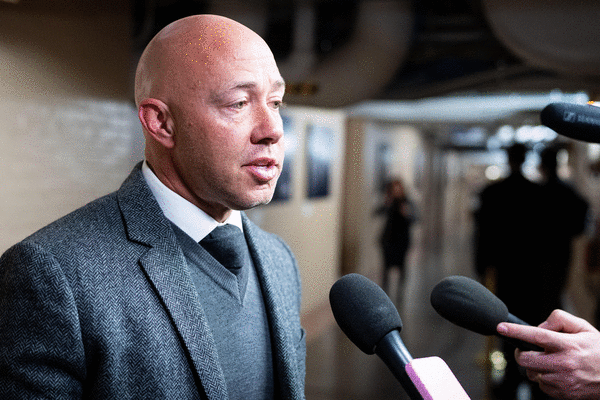
WASHINGTON — A House committee took a step on Wednesday toward restricting exports of certain artificial intelligence semiconductor chips to China, a policy proposal that has a prominent opponent in the Trump White House.
The House Foreign Affairs Committee voted 42-2, with one member voting present, to advance a bill that would call for the Commerce Department to require a license for the export, re-export or in-country transfer of certain chips. On a 47-0 vote it approved another bill that would commission a report on China’s AI capabilities.
The markup came after the Trump administration said it will allow sales of Nvidia H200 chips to China and, as President Donald Trump noted in a social media post, “$25% will be paid to the United States of America.”
White House Special Adviser for AI and Crypto David Sacks voiced his opposition to the export license bill on the social platform X. Last week, he shared a post that said the bill “would restrict the President’s ability to restrict AI chip export controls. It handicaps Trump’s ability to strategically position the USA favorably against China,” adding in his own post, “Correct.”
The post Sacks quoted also alleged that the bill was “being orchestrated by a several notable Never Trumpers and Obama/Biden former staffers.”
It acknowledged the bill was sponsored by House Foreign Affairs Chair Brian Mast, R-Fla. Fifteen other Republicans joined the bill as co-sponsors.
Mast in turn quoted Sacks’ post on X, framing his bill as supporting Trump’s existing actions to limit the sale of the most advanced AI chips to China.
“I’m going to work to continue that momentum. You can advise him to sell H200 chips to China if you want, I advise the opposite. That’s your prerogative,” Mast wrote.
The moves come after a provision to require chip companies to prioritize sales to U.S. firms before selling chips overseas was removed from the fiscal 2026 defense authorization law, known as the NDAA. That provision had supporters on both sides of the aisle but was opposed by Nvidia.
The bill to require export licenses would set two thresholds for chip power — one after which a license would be required and one after which exports to countries of concern would be prohibited. It would also allow Congress to prevent the granting of a license through a joint resolution.
Mast said the bill would implement restrictions on AI chip exports similar to those placed on foreign sales of military equipment.
“If we were just talking about war games on Xbox, then (Nvidia CEO) Jensen Huang can sell as many chips as he wants to anybody that he wants, and I should have absolutely no business having a say about whether he wants to do that,” Mast said. “But this is not about kids playing Halo on their televisions. It is about the future of military warfare.”
Mast also said his substitute amendment, adopted without objection, was based in part on “technical assistance” from the Trump administration.
The panel’s ranking member, Rep. Gregory W. Meeks, D-N.Y., praised Mast’s work to find a bipartisan compromise on the legislation.
Meeks expressed his own concern over the administration’s plans to approve the sale of H200 chips to China.
In December, Meeks introduced a bill that would prohibit the sale of the most advanced AI chips, including H200s, to countries of concern. That bill was referred to the House Foreign Affairs Committee but has not yet received a markup.
Meeks applauded the addition of the “restricted” tier in the bill, which he said would stop the sale of Nvidia’s Blackwell chips for at least two years.
“While I wish the bill before us today directly prohibited the sale of H200s, it nevertheless puts in place robust guardrails that would delay those sales and allow for congressional review and oversight going forward,” Meeks said.
Call for revisions
Rep. Darrell Issa, R-Calif., said he hoped that the bill could be revised in consultation with the administration.
“The way this bill is currently structured, it begins to put us into the position of being a regulator. Let me assure you: Congress is not a good regulator,” Issa said.
Issa specifically urged changes to ensure that the congressional review requirement would not delay production of chips. He suggested that the review could be moved to the beginning of the application process rather than the end.
Some Republican members of the committee responded to the social media conversation around the bill, including the assertion that the bill was pro-China and anti-Trump.
Rep. Bill Huizenga, R-Mich., alleged that sentiments against the bill are manufactured.
“Much of that is tied to... paid programs where people are going out and they’re literally being paid to go and hold these opinions,” he said.
The committee rejected along party lines an amendment from Rep. Gabe Amo, D-R.I., that would have added a sense of Congress section to the bill to state the importance of H200 chips and that the sale of such chips to China endangers U.S. national security.
Mast said the amendment would “disregard” the national security conditions placed on sales under the bill.
On the roll call vote to approve the measure, Reps. Andy Barr, R-Ky., and Rich McCormick, R-Ga., voted no, while Issa voted present. Neither Barr nor McCormick spoke at the meeting to explain their votes.
Del. James C. Moylan, R-Guam, sponsored the bill to require an annual report on China’s AI capabilities and said the report would not be “narrowly focused” but would assess the entire AI ecosystem in China.
“The challenge we are confronting here today is beyond just economics. Unlike the past, PRC is not just seeing the bulk of global market share. What they want is supremacy in a modern military power and the ability to lead the world in most advanced emerging technologies.”
_____
©2026 CQ-Roll Call, Inc., All Rights Reserved. Visit cqrollcall.com. Distributed by Tribune Content Agency, LLC.













































Comments