Supreme Court to hear arguments on Trump firing of Fed member
Published in Political News
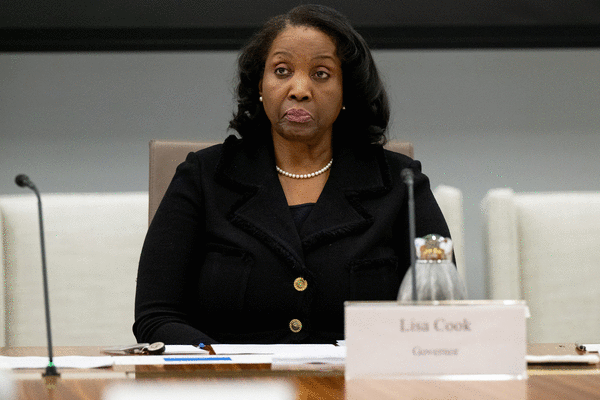
WASHINGTON — The Supreme Court is set to hear arguments Wednesday over how far President Donald Trump can go in removing a member of the Federal Reserve Board, in a case that experts said puts on the line the stability of the nation’s economy and balance of power between government branches.
Federal Reserve Board member Lisa Cook has challenged her firing, which the Trump administration says was because she allegedly misrepresented her primary residence in mortgage paperwork before she was nominated to her position. Congress gave members “for cause” protections in the law creating the Fed, and lower courts agreed that the firing was likely unlawful and reinstated Cook.
The Trump administration has argued in its Supreme Court filings that the president should be able to remove Cook for the alleged violations. Although they don’t involve her conduct in office, Cook’s paperwork “at a minimum exhibited gross negligence in financial matters that rendered her unfit to help manage national financial matters,” the Justice Department said in court filings.
On its face, the arguments Wednesday are just about whether Cook can stay in her job while the rest of the lawsuit plays out. But experts and the parties said the case could resonate far beyond just that issue, to whether courts have a say in removing a member of the Fed, and whether Congress can structure an agency to have any internal limit on presidential power.
Andrea Katz, an associate professor of law at Washington University in St. Louis, said there are major risks for congressional power in the case. “This is not just about good governance. This is also about Congress delegating powers and trying to keep checks for itself on how that power would be used,” Katz said.
Although members of the Supreme Court have previously said the Fed’s independence is different than other federal agencies, experts said exactly what that looks like will depend on the outcome of the Cook case.
In an order last year, the Court’s conservative majority ruled that Trump could fire members of the National Labor Relations Board and Merit Systems Protection Board. But they also wrote separately to state that the Federal Reserve could be treated differently.
“The Federal Reserve is a uniquely structured, quasi-private entity that follows in the distinct historical tradition of the First and Second Banks of the United States,” the order said.
The Trump administration and Cook both agreed in court filings that the Constitution allows some protection against firing except “for cause.”
The administration argued that although the president doesn’t have unlimited ability to remove Cook from office, the courts have no say in what that might mean. The administration argued that the law doesn’t lay out a specific process for a Federal Reserve Board member’s firing, which means the court should default to deferring to the president.
“But — critically for this case — when, as here, the President provides a cause, courts may not review his factual findings or his application of the for-cause standard to the facts, or otherwise second-guess his judgment that the removal is justified,” the brief said.
Cook’s attorneys argued in filings that the Trump administration argument would be no different than letting the president remove Cook at will, something Congress didn’t intend. Cook argued that the court should handle the “for cause” language in the way it treated similar language in the law creating the Federal Trade Commission that would require a court hearing.
“The President’s insistence that his removals are not subject to judicial scrutiny would eviscerate Congress’s choice to safeguard the Board’s independence and protect Board governors from arbitrary removals,” Cook’s brief said.
At the same time, many of the arguments from Cook and her supporters leaned on some of the same precedents that the justices indicated they may jettison this term. That includes a 90-year-old precedent known as Humphrey’s Executor, which upheld a law that limited the president’s ability to fire officials from the FTC and similar agencies without cause.
Josh Chafetz, a Georgetown Law professor who specializes in the power of Congress, said the Cook case is likely to be tied up with the challenge FTC Commissioner Rebecca Slaughter made to her firing. The justices heard arguments in that case in December.
During those Slaughter arguments, a majority of the justices seemed to lean toward allowing Trump to fire Slaughter despite the precedent. “In some sense the bigger hit to congressional power is going to be the Slaughter case, which is basically going to tell Congress they can’t structure agencies the way they want,” Chafetz said. “They’ve basically already told us they’re going to come up with some sort of magical Fed carve-out for that.”
Powell play
The Trump administration threw a wrench into the case earlier this month after starting a Justice Department investigation into Federal Reserve Chair Jerome Powell. Powell himself announced the probe in a video statement calling the subpoena for records tied to his testimony to the Senate Banking Committee a “pretext” to target him for resisting Trump’s calls to reduce interest rates.
Chafetz said the public reporting around the probe into Powell makes it hard to avoid in the oral arguments. He said that’s because one of the issues in the case is not just Trump’s ability to fire a Federal Reserve member, but how much cause is needed to do so.
“It will be interesting to see how much the justices talk about Powell. Do they make the subtext text, or is it going to be something that hovers unspoken in the background?” Chafetz said.
Chafetz also said the investigation into Powell makes it more likely that the justices do not just resolve whether Cook can stay in the job while the case plays out, but affirmatively lay out the standard for the Federal Reserve members’ “for cause” removal protections.
“I think, if anything, they made it much more likely that the court will sort of write an opinion in Cook that basically says not only the ‘for cause’ removal protections, but these allegations, don’t cut it,” Chafetz said.
Sen. Thom Tillis, R-N.C., who vowed not to support any new Fed nominees until the investigation is resolved, said he felt like a congressional check on the president played an important role in keeping markets “reasonably calm” in the days after Powell’s announcement of the investigation.
Tillis also said he would have a problem with the court allowing Trump to remove a member of the Federal Reserve for the “pretty petty” reasons cited for the investigation into Powell.
“That would suggest that there’s a fairly low bar for going after members that don’t share the priorities of the administration. They’re an independent agency for a reason. They annoy us all for different reasons, but that’s how the process works,” Tillis said.
Sen. Elizabeth Warren, D-Mass., in a call with reporters, said the efforts to fire Cook and investigate Powell were part of a strategy to place “sock puppets” on the Federal Reserve Board.
In addition to having power over federal lending rates, Warren said a Trump-controlled Fed could use access to the Reserve system as a cudgel.
“Nothing would stop him from yanking privileges of banks who refuse to do his bidding,” Warren said.
Columbia University law professor Lev Manand said on a press call that if the Federal Reserve starts acting on behalf of the president, it could take steps that undermined Congress’ power over federal spending. The board’s power over monetary policy would allow it to buy or sell bank assets that support the administration, allowing it to effectively sidestep Congress.
“A central bank with control over the monetary levers can undermine the check by the power of the purse,” Manand said.
The case is Donald Trump v. Lisa Cook.
©2026 CQ-Roll Call, Inc., All Rights Reserved. Visit cqrollcall.com. Distributed by Tribune Content Agency, LLC.















































Comments