'La Bola Negra' review: A beautiful, heart-wrenching tale of love and memory
Published in Entertainment News


Watching “La Bola Negra,” the award-winning Spanish historical drama directed by Javier Calvo and Javier Ambrossi, is like standing in a museum, gazing at a vast work of art. You see beauty, you see unexpected details, you’re a bit overwhelmed by the enormity of its world, the choices of color and light, the interconnectedness of its stories. It’s a movie I wished I could have watched a second time before reviewing, to better absorb its intricacies and its meticulously braided triple-timeline structure, but it’s a beautiful, heart-wrenching world to get lost in.
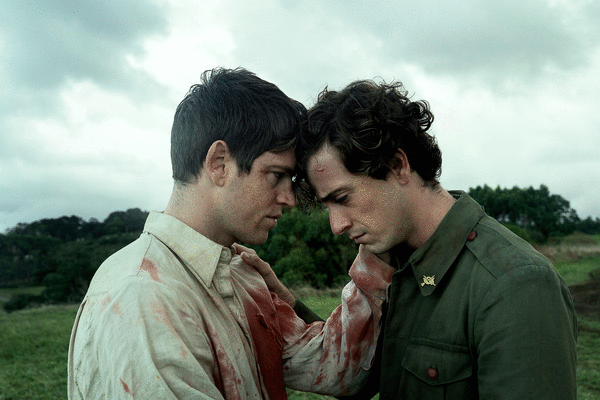
Inspired by the play “La piedra oscura” by Alberto Conejero and by several works by Federico García Lorca (including a mysterious unfinished play called “La bola negra,” which translates to “the black ball”), the film unfolds in three stories of gay men in different periods of Spanish history, and it takes some time before we begin to realize how they interconnect. Sebastián (sad-eyed Spanish pop musician Guitarricadelafuente, in his screen debut) is a young man devastated by the bombing of his village by Italian troops in 1937; he subsequently joins the Nationalist army and is tasked with guarding a prisoner, Rafael (Miguel Bernardeau), with whom he finds a forbidden love. Carlos (Milo Quifes, in another screen debut), in 1932, is a young man from a wealthy family who’s denied admission to an exclusive club (he’s blackballed) due to rumors about his sexuality. And in 2017, historian Alberto (Carlos González) gets a call telling him of an unspecified inheritance from his estranged grandfather, leading him to confront his mother, Teresa (Lola Dueñas), about the family’s buried secrets.
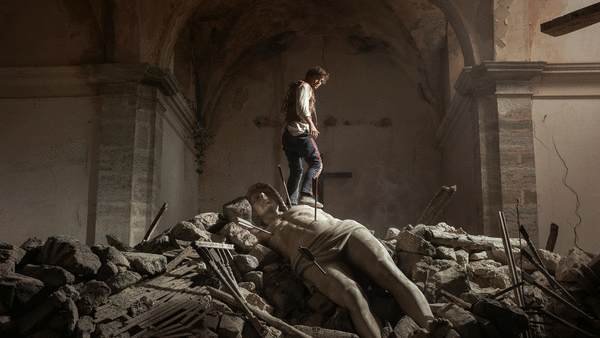
Calvo and Ambrossi fill the screen with both wartime devastation and painterly beauty (most will likely stream this film on Netflix, but it looked glorious on a big screen); some scenes, such as Sebastián climbing to the top of a mound of broken statuary in a destroyed church or some late sequences taking place on a snow-covered mountain, have an uncannily magical light. All of the actors do beautiful work (particularly Guitarricadelafuente, a real find), and unexpected performers pop up: Penélope Cruz practically leaps off the screen as a chanteuse who comforts Carlos, and Glenn Close, speaking entirely in Spanish, brings her trademark intelligence to the role of a Lorca scholar in the Alberto timeline. And the film makes some startling visual swerves in its final third that only add to its artistry and its blend of literary mystery and haunted sadness.
At its heart, “La Bola Negra” is a tale of love and memory, of how a hand from the past can reach out to touch the present, of hard-won rights and the never-forgotten shadows of war. In Spain, a character sadly observes, there are “too many love stories, buried in the fields.”
———
‘LA BOLA NEGRA’
(In Spanish with English subtitles)
3.5 stars (out of 4)
MPA rating: R (for violence/bloody images, graphic nudity, sexual content and language)
Running time: 2:35
How to watch: Now in theaters and streaming on Netflix Dec. 2
———
© 2026 The Seattle Times. Visit www.seattletimes.com. Distributed by Tribune Content Agency, LLC.











Comments