Review: 'The Greatest' deftly captures the evolution of Cassius Clay into Muhammad Ali
Published in Entertainment News
I pay no attention to boxing. It exists at the corner of my eye in advertisements and feeds, but I'm never tempted to look its way. Clearly there are plenty of people who do, and plenty of money changes hands in and around it.
Neither am I a fan of biopics, though I watch them professionally, which tend to squeeze the nuance out of a life in pursuit of entertainment. But here again, they often prove to be quite popular. Audiences eat them up. Actors like the "challenge" of inhabiting a person famous enough to be the subject of one, and they often scoop up awards when that season rolls around.
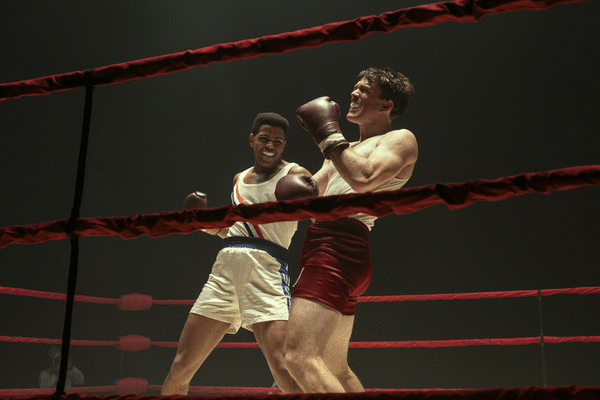
Which brings us to "The Greatest," a series premiering Wednesday on Prime Video, and by "the greatest," even a person with no affinity for the sweet science, as it's strangely called, should understand we're talking about Muhammad Ali, who gave himself the nickname and repeated it until everyone else, on solid evidence, agreed. (It follows Will Smith's 2001 "Ali" and a 1977 oddity, also called "The Greatest," in which the champ played himself.) Ali, of course, was more than a boxer, he was a phenomenon, globally identifiable like Charlie Chaplin or Mickey Mouse. Even paying no attention to his sport, I seem to know a lot about him, but I would consider much of his life basic cultural knowledge.
And it's very good! Created and partly directed by Ben Watkins ("Cross"), with Ali's widow Lonnie Ali as an executive producer, it benefits from a relatively short timeline spread out over eight episodes, giving it room to breathe between the set pieces and fights and sundry historical landmarks. It begins in 1960, after Ali (then, and through the series, called Cassius Clay) has won the light heavyweight gold medal at the Rome Summer Olympics; it finishes in 1964, after — to the surprise and disappointment of many, the boxer being far from universally loved — he beats Sonny Liston in Miami for the world heavyweight title and unveils his new forever name to the public. Presumably reserved for subsequent seasons are his refusal to fight in Vietnam, activism, absences and comebacks, the Thrilla in Manila, the Rumble in the Jungle, Parkinson's — though this is a good place to stop, arc-wise and art-wise.
As Cassius, Jaalen Best — whose previous work consists of Hot Guy in an episode of "American Horror Stories," Teammate No. 1 in an episode of "Magnum P.I." and three episodes of "All American: Homecoming" — has the voice and enough of the look, the ego, impatience and self-importance, but also the softness and seriousness and occasional moments of doubt. It's good to remember that the fighter was just 22 when he won the heavyweight belt and announced his allegiance to the Nation of Islam. He was not merely baby-faced — he was obsessed with his prettiness — but still forming. (Much of the conflict has to do with who does or doesn't think he's ready to meet Liston; Ali himself was in a rush to become the youngest heavyweight champion in history.)
The production is relatively modest, but well-appointed in terms of period dress and furnishings and signage; the focus is on the actors, who, notwithstanding a few invented utilitarian minor characters, give dimension to their real-world analogs, in such a way that one wants to learn more about the person behind the character. This is especially true of Amin Joseph's Sonny Liston, a delicate portrayal of a figure easily reduced to a pair of big, powerful fists; for much of the time "The Greatest" is as much his story as Ali's, as the focus shifts between the two on their way to the ring. There is a lot of shouting, too, mostly by Clay, but the tenor of the piece is on balance kindly (though not uncritical).
Giovanni Ribisi plays trainer Angelo Dundee, telling Clay's family that "Cassius isn't a fighter, he's an artist; and you don't teach Michelangelo how to paint, you give him a paintbrush and you get out of the way." Reno Wilson is cornerman Drew Bundini Brown; Michael Ealy is Malcolm X; and wrestler Chris Jericho is Gorgeous George, the mouthy TV wrestler who inspired Clay's braggadocio. The invaluable Dana Gourrier plays Clay's mother Odessa, called Bird, with whom, in this picture anyway, he appears to have had a close relationship. There is a wonderful offhand quality to their scenes together. As Cassius Clay Sr., called Cash, Omari Hardwick draws a character familiar from family dramas (womanizer, sometimes violent drunk, sure he knows how to run his son's business), but handles the assignment well.
There are the usual customizations in the name of drama, and, of course, many invented conversations; there are speeches whose corniness the actors manage to mask. The accuracy of some events may be disputed. The songs chosen for the soundtrack are generally intrusive and often chronologically inappropriate, though scenes in which bands are onscreen playing bop and R&B get it right. There are some tricky visual effects to represent dreams, visions and memories that don't fit well with the casual naturalism of the bulk of the series. But none of this is unusual or fatal.
———
'THE GREATEST'
Rating: TV-14
How to watch: On Prime Video Nov. 4
———
©2026 Los Angeles Times. Visit latimes.com. Distributed by Tribune Content Agency, LLC.








Comments