Review: 'VisionQuest' explores themes of love and loss, though it's more intellectual than emotional
Published in Entertainment News
Regular readers of this space will know that I don't pay much attention to the Marvel Cinematic Universe, or the comic books that inspire it, there being way too much to remember, especially since they keep rebooting the timeline and redesigning characters, canonically, except as is necessary to review Marvel's television shows, which I greet with anticipation and watch with approval.
Where the movies are big, loud, overpopulated machines, the TV series are full of interesting ideas, weird notions and good comedy and give their characters room to breathe. IP cross-references aside, they can stand on their own. They don't always last long, even some of the best of them — that's show business, now more than ever — but you can be more or less sure that another will come along soon enough.
Premiering this week on Disney+, "VisionQuest" is a sequel to "WandaVision," the first of these shows — it began the MCU's Phase Four, if those words mean anything to you. It's not a bad idea to familiarize yourself with the former show to take the full measure of this one; there are also some elements of the spun off "Agatha All Along," which I had forgotten completely. It might answer some questions you'll have during "VisionQuest," but the dramatic intentions and character relations are plain enough.
As a story of artificial intelligence, "VisionQuest" has some currency, though past the idea that these systems can work for good or bad, it's not really about that — nobody is talking about guardrails here, which in this genre would just be a case of closing the pen after the electric sheep have got out. The androids, or synthezoids, here are presented for the most part in human form, which is easier on the eyes, the budget and the actors, and gives them room to act. (They don't act like robots, either.) The show's big themes are personal, not political: identity, love, loss, fathers and sons, family freedom, connection and being "real."
Anyway, I'm not going to pass on any series that features both Emily Hampshire (Stevie Budd on "Schitt's Creek") and Diane "Cunk" Morgan in its cast. (No offense to the rest of the cast. Everyone does their bit.) Also attractive was the fact the show was created by Terry Matalas, a director and showrunner on "Star Trek: Picard," another fine series about organic and synthetic life-forms, and creator of Syfy's "12 Monkeys" series (in which Hampshire starred).
To catch you up, Vision (Paul Bettany) is a synthezoid and the late lover of the witch Wanda Maximoff (Elizabeth Olsen). In "WandaVision," a grieving Wanda cast a spell on a New Jersey town based on a sitcom idea of perfection — the early episodes featured pastiches of "The Dick Van Dyke Show," "Bewitched" and "The Brady Bunch" — and installed a reborn Vision there as her husband; they had twins, Tommy and Billy. This didn't prove to be such a great idea (though it made for excellent television), and in the end she removed her hex on the town and Vision dissolved into the ether.
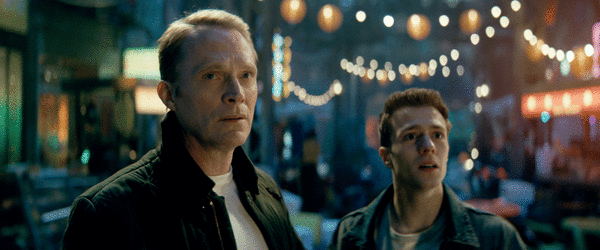
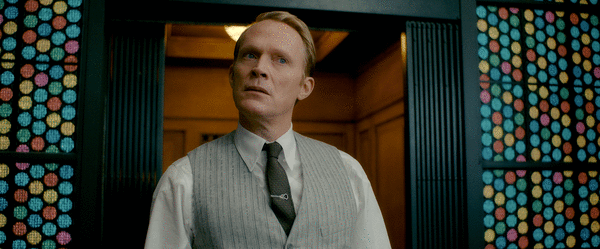
Somehow he has de-dissolved, and we find him working in an Edinburgh pub, looking like an ordinary Englishman, rather than a mechanical man. (A "W+V" inside a heart, carved into the furniture, remains from a scene in "Avenger: Infinity Wars.") Still, something is off: "I have his memories but not his feelings," Vision says of his earlier self. "I have his face, but not his virtue. All I can feel is the weight of him. His legacy, his worthiness, his name." But he's a caring sort, even if he's going through the motions, who believes that "integrity and respect and honesty are the key measures of character."
At the same time, he lives in a world inside his … I guess you'd call it his head … in a big house with a staff of avatars, "sentient autonomous AIs who have complementary personalities that are conducive to problem-solving," in the tradition of Doc Savage or the Impossible Mission Force or the animated emotions in "Inside Out." Their names are represented onscreen in capital letters, with periods, as though they were acronyms, but let's leave that alone; they read as people. J.A.R.V.I.S. (James D'Arcy) is the Alfred of the house, who reminds Vision that "I was created first and I can still tie a better Windsor knot" ("The older sibling card," says Vision, "it never gets old."). (Like Vision, he is very British.) F.R.I.D.A.Y. (Orla Brady), as in "girl Friday," possibly, helps with Vision's socialization and humor; E.D.I.T.H. (Hampshire) is an adventurer; she sees herself as "the fun one." D.U.M.-E. (Henry Lewis) and U. (Jonathan Sayer) are comedy "maintenance men," in the spirit of Laurel and Hardy, or Chuck McCann and Bob Denver in Sid and Marty Krofft's "Far Out Space Nuts." Some of them have appeared in Marvel movies.
Also in the house is, of all synthezoids, Ultron (James Spader), Vision's genocidal nemesis — frenemy would be the better word here — held as a sort of prisoner in a loft space filled with art and television sets. (Just what he's doing there is not explained, but the proximity is important.) Spader voiced the character in the movies, and you'll recognize the voice before the face, hidden by a big beard, looking a little like Paul Giamatti (or, when he wears a top hat, Dr. Demento). It's a very Spader-y performance, arch, ironic, low-key, recalling his scenes with William Shatner in "Boston Legal." But he's also a philosophical aesthete, who dreams of visiting the Louvre, and offers Vision some solid life advice. And he's lonely.
Meanwhile, out on the streets, young con artist Thomas Shepherd (Ruaridh Mollica) and pickpocket Lisa Molinari (Lauren Morais) are running petty scams. Thomas, you might realize, is Tommy Maximoff from "WandaVision," the son of Vision and Wanda, whose soul was transplanted into the body of a drowned London teenager, which he'll get around to understanding after a very mixed-up spell. Meanwhile, says Thomas, "I get to wake up every morning and be whoever I want to be," to which Lisa responds, very much in the spirit of the rest of the show, "If you don't ever get to be the real you, you might as well be invisible." (So true.) They're the series' lovable young lovers.
Eventually, after an arrest and escape alongside Lisa, Tommy will meet Vision, who will find his paternal instincts emerging ("I've noticed you don't use your indicator, and you haven't adjusted your rear view mirror," he tells his son). Complicating matters, Vision is being sought by one Paladin (Todd Stashwick), a relentless bounty hunter working for a mysterious client; Morgan plays his nameless remote handler. And there's a murder mystery, surrounding what the press has dubbed the Butcherbird Killer. (Vision's house is remodeled into a police station, with a murder board, and CCTV examined for clues. There's a "Scooby-Doo" reference, as well.) Another episode, set at a gala, has notes of James Bond. T'Nia Miller plays Jo Carrington aka Jocasta, about whom I can say nothing that won't register as a spoiler.
I found it highly entertaining and fun, if more intellectually than emotionally moving. (An observation, not a criticism — maybe even a compliment.) The inner and outer realities can get confusing, not that it particularly matters. It goes on a little long — well, most everything does these days — so that by the end the beginning may have grown blurry. (Take notes.) Points are made repeatedly; you will not be allowed to escape the references to "Pinocchio" and "The Wizard of Oz." (The working title for the series was "Tin Man.") Things go to the brink of disaster as often as a Pearl White serial.
But it's worth your time, even if you follow Marvel even less than I do. The production design is excellent, the humorous details of Vision's metaphorical manse and the externalization of computer processes clever. The show, which can certainly be tense, spends more time on being funny than violent. Enemies may often become allies — one of my favorite narrative tropes. Despite their intentional and collateral damage, even the bad guys get a break, which is to say, they may not be all that bad, by their own reckoning at least. They might even be allowed a measure of satisfaction. It's a kindhearted show. "I believe in second chances," says Vision, because people are complicated, and synthetic people are people, too.
———
'VISIONQUEST'
Rating: TV-14
How to watch: Disney+
———
©2026 Los Angeles Times. Visit latimes.com. Distributed by Tribune Content Agency, LLC.









Comments