Movie review: Palme d'Or winner 'Fjord' a thorny and complicated drama
Published in Entertainment News
Romanian auteur Cristian Mungiu now has two Palme d’Or prizes from the Cannes Film Festival under his belt. In 2007, he won the top honor from the festival for his searing abortion drama “4 Months, 3 Weeks and 2 Days,” which critically examined the reality of life in Communist Romania under Nicolae Ceaușescu and the grueling horror of obtaining an illegal abortion, inspired by a personal anecdote as well as the policies and social context of the the era.
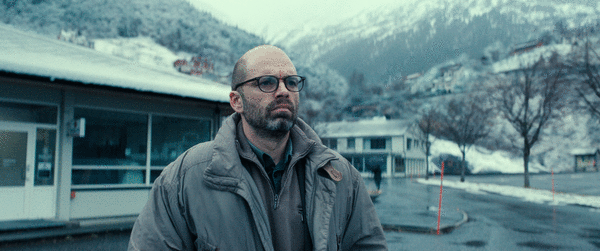
This May, he won the prize again for his film “Fjord,” which is also inspired by a real case, this time in Norway, but with a Romanian family at its center, caught in a custody battle predicated on child abuse allegations brought by the powerful child protection agency there. Once again, Mungiu brings his unflinching perspective to bear on how laws and closely held cultural beliefs can dangerously affect the material reality of family life, placing the war between conservatism and progressive values under a microscope that reveals the ugly truths of both sides.
With a focused efficiency, Mungiu lays out the situation, presenting evidence to the jury of film viewers without the audience even knowing what will eventually become damning testimony. We meet the Gheorghiu family as they arrive in their new home, in a small village in Norway.
Their connection to the country is Norwegian Lisbet (Renate Reinsve), who met her Romanian husband Mihai (Sebastian Stan) while doing mission work there. With five children, including an infant, they’ve relocated to Norway so that her mother can help with childcare while Lisbet works in a nursing home and Mihai, an aeronautical engineer, finds a job in IT. Devout evangelical Christians, they have a traditional, tight-knit family: playing music, studying the Bible, caring for their sheep. Their older kids quickly befriend the rebellious teen next door, the daughter of the headmaster at the village school.
The strains of “Amazing Grace” played simply on a piano open the film and the song becomes a running theme and point of contention throughout. It’s both a hymn that brings comfort to the family, and an alarming dog whistle to the progressive Norwegians who believe that religion should not be a part of public life.
When we first enter the Gheorghiu home, it’s in the aftermath of a family conflict, one that Mungiu carefully does not show us. Throughout “Fjord,” he withholds crucial information so that the truth remains abstruse, our judgment waffling with what we’re told. What we know is the chaos of a lively family home, how kids interact with each other, what they share with child protection, how those adults interpret that, and what the parents admit to. We also know that the family wants desperately to be reunited, and that the representatives from child protection feel a strong duty to protect those for whom they are responsible. We also see the ways in which certain biases and values put the Gheorghius on trial for their religious beliefs and cultural differences, as the case spirals into something much bigger and more dramatic than where it begins.
“Fjord” is a gripping drama, but not a thriller. It isn’t “patient” per se, but it merely unfolds in front of us with a kind of unadorned observation typical of Mungiu. Simple creative flourishes underline his commentary in a stark way: a giant Norwegian flag flapping outside the window during a long take as child protection representatives inform Lisbet they’ll be taking her small children and baby into custody; a digital ringtone playing “Silent Night” as Mihai pitches hay on a lonely Christmas, his otherwise secular neighbors singing the hymn on the holiday night. The dramatic landscape also dictates the themes — the vast expanses of the sea surrounding this fjord emphasize both their isolation and means of escape, while avalanches that threaten the local school suggest forces of impending doom that no human can control, only prepare for.
An ensemble of Norwegian actors including the spectacular Ellen Dorrit Petersen deliver quiet and excellent performances, while Stan and Reinsve have to embody the Gheorghiu parents’ restrained anguish. Mungiu effectively builds empathy for the family before he reminds us that we don’t actually know what happened in their home, that everything we know is built on assumption and bias.
The truth remains frustratingly elusive, in this thorny and complicated ethical exercise of a film, illustrating the pitfalls of progressive socialism, and the unknown dangers of isolated cultural sects in both directions. The slippery pendulum swing between freedom and protection is a constant political battle, but Mungiu is interested in the human reality of that, not theoretical questions. In “Fjord,” the answers are out of reach, but the questions that Mungiu poses couldn’t be more relevant.
———
'FJORD'
(In English, Norwegian, and Romanian with English subtitles)
3.5 stars (out of 4)
No MPA rating (mature themes)
Running time: 2:26
How to watch: In theaters Oct. 16
———
©2026 Tribune Content Agency, LLC









Comments