Review: Adrien Brody shines in the death penalty play 'Fear of 13' on Broadway
Published in Entertainment News
NEW YORK — Of all of the arguments against the death penalty, the strongest is that even one conviction of an innocent person is both irreversible and ethically untenable.
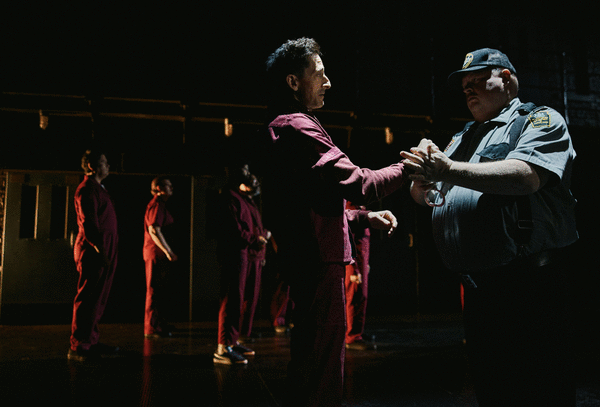
“The Fear of 13,” Lindsey Ferrentino’s docudrama featuring the Hollywood star Adrien Brody in his Broadway debut, focuses on an American named Nick Yarris, who was exonerated by newly available DNA evidence from charges of rape and murder before he was scheduled to be killed by the state.
But that was only after Yarris had spent 22 years on death row in a Pennsylvania prison.
A novel aspect of Yarris’ early-1980s case is that he had landed himself as suspect No. 1 by proactively contacting the authorities about the murder in an attempt to curry favor in the face of the lesser charges he was facing for a separate crime. When Yarris’s tip proved bogus, he was himself blamed, wrongly, for the murder. Another novel aspect is that Yarris escaped from custody in 1985, only to be quickly recaptured in Florida and sent back to death row in Pennsylvania.
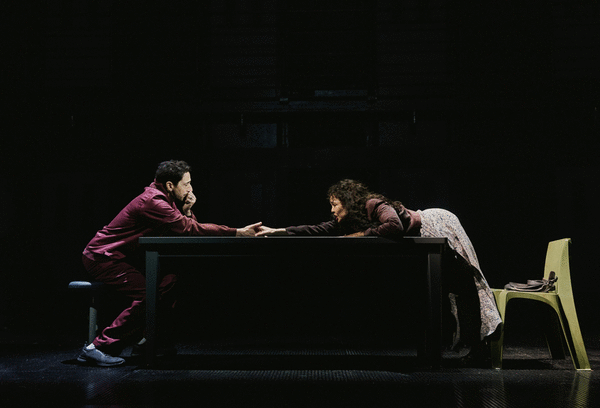
All of this became an unusually theatrical 2015 documentary from David Sington, wherein Yarris narrated his own story. Ferrentino’s play is faithful to its source, although the dramatic version has a company of 12 and also focuses on Yarris’ long-term relationship with a prison volunteer, Jacki Miles, with whom he became romantically involved and even eventually married (although they later divorced). She’s played by Tessa Thompson, also in her Broadway debut.
Yarris’ case is also familiar to many fans of Joe Rogan, since Yarris, who became an advocate for those who oppose the death penalty, sat for interviews just before the pandemic.
“The Fear of 13” was first seen at London’s Donmar Warehouse, where it got mixed reviews, but the show at the James Earl Jones Theatre is a new and very artful production from the longtime Chicago director David Cromer, who works here with his phenomenal lighting designer Heather Gilbert. Together, these two superb artists make much of Yarris constantly seeking the light, as Yarris searches for a way forward from the blackness of death row.
Cromer also makes much from the sound of silence, not to mention the thin line between life and death, given that Yarris was not allowed to speak by his guards for long stretches on death row, on the grounds that he was already a dead man, walking. Throughout the intermission-less, unsentimental show, which is careful not to veer into melodrama or to imply Yarris was an angel, you of course find yourself contemplating how anyone keeps on living in such circumstances, knowing they were innocent. Arnulfo Maldonado’s set makes for a whole world of shadows, with potential portals in the rear, suggesting the possibility of light creeping into this deadened life.
But Cromer focuses most on those 22 years. A very long time, given the human lifespan.
Ferrentino gave her play the structure of twin narrators, essentially telling the story of two lives from two perspectives, even as she also tries to broaden it all out so this story can represent all of the wrongly convicted on death row and those who love them. That burden, along with the conventions of the true-crime genre, not to mention that of theater in service of a political point, sometimes hampers the interpretive space of the actors and the creative team, who have to spend a lot of their time getting the facts and the history across. The scenes typically are brief and monologic, making it harder to build momentum. And I suspect Brody was worrying a bit too much about being true to Yarris himself.
It also goes without saying that this is not some escapist Broadway evening of fun and frolic.
But then Brody’s fans would not expect that from him. And I found this great American actor to be deeply affecting at the core of Cromer’s powerful production, his lean body and craggy features contorting into a complicated, scarred and fundamentally likable character who constantly has to motivate himself to draw another breath. Thompson, too, forges a sufficiently empathetic figure that you worry about her being drawn into this man’s horror-filled existence even as you admire her commitment.
She, at least, had a choice.
———
At the James Earl Jones Theatre, 138 W. 48th St., New York; thefearof13broadway.com.
———
©2026 Chicago Tribune. Visit chicagotribune.com. Distributed by Tribune Content Agency, LLC.











Comments