Why Louise Erdrich says her book 'Python's Kiss' took two decades to finish
Published in Books News
Louise Erdrich was getting help with her computer when her daughter discovered something on the hard drive.
A short story.
“‘Love of My Days’ was a forgotten file in my computer, and when I found it again, I was shocked,” Erdrich recalls, crediting her daughter for unearthing the piece about a man who returns to his prairie farm to find someone else there, claiming the place is his. “I know I wrote this; I remember that I wrote it… I just forgot the file.”
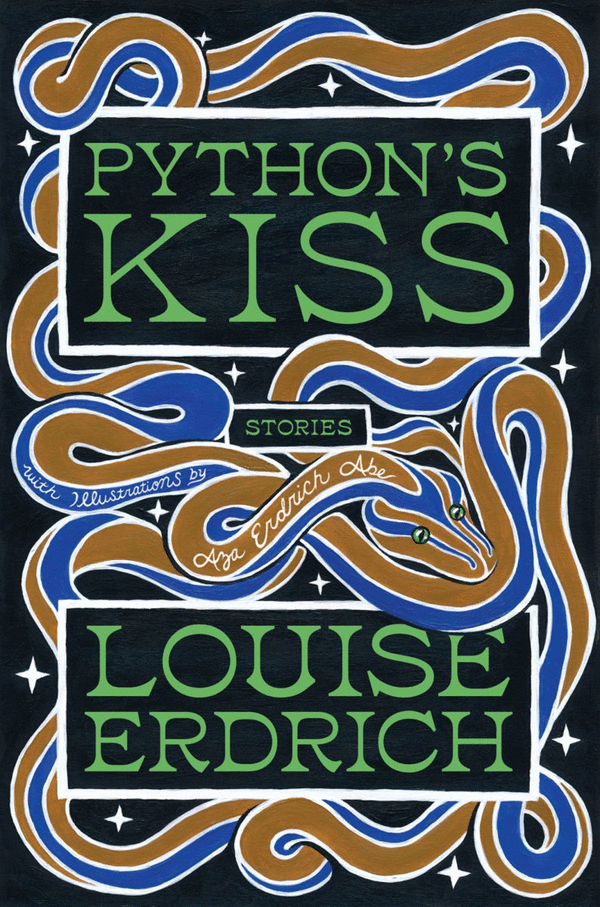
That story appears with 12 others in “Python’s Kiss,” a collection by the National Book Award and Pulitzer Prize-winning author, in stores now. Representing two decades of work, the book’s stories range from literary fiction to sci-fi with effortlessly engaging storytelling, whether about a bus full of children in a blizzard or a daughter seeking revenge on her late father in a corporately controlled afterlife.
Ann Patchett, the bestselling author of “Bel Canto,” “Tom Lake” and the upcoming “Whistler,” praised “Python’s Kiss” during an interview recently. “How good is that book?” said Patchett. “My heart just soars.”
Erdrich, who owns Birchbark Books & Native Arts in Minneapolis, was asked about the recent deployment of Immigration and Customs Enforcement, or ICE, into the city, which sent thousands of masked agents onto its streets, sparked protests by citizens and local officials, and led to the shooting deaths of Renee Nicole Good and Alex Pretti by ICE agents.
Calling ICE’s actions “murderous and grotesque,” Erdrich directed the conversation toward the good works her neighbors and community have done throughout.
“I think it’s hard for other cities to imagine how small and closely knit Minneapolis and St. Paul really are,” says Erdrich, praising the work of local businesses and bookstores, such as The Smitten Kitten, Moon Palace Books and Dreamhaven Books. “We’re engaging in a huge amount of mutual aid in support of people who still can’t come out of their houses and kids who still can’t go to school. … It’s good that we have so many good people here.
“But it shouldn’t be this way. It’s just wrong.”
Warm, thoughtful, and funny throughout a nearly 90-minute conversation, Erdrich, an enrolled citizen of the Turtle Mountain Band of Chippewa Indians of North Dakota, discussed her work, family, and the challenges of writing when her black chihuahua-terrier mix Yogi wants her to play.
“He loves for me to pretend to grab his toy gorilla, so he can run away and feel as though he’s a wolf bringing his kill to the den,” she says. “He does this many times a day.”
“I’ll be trying to write something, and he’ll be looking at me with his toy gorilla like, ‘I dare you,’” she laughs. “This has been my life. I’m always veering from one outlandish scene in some fictional world to pretending to steal a toy gorilla.”
The following conversation was edited for length and clarity.
Q. You worked with your daughter on this book; she provided the artwork.
I have had the joy of working with my daughter for many years on the covers of the books. So I have the luck of really loving to look at my books and sign them, because my daughter designed these covers that reflect both of our ideas about it. I’m not an artist. I couldn’t do what she does, but we talk things through — and then she does whatever she wants. [laughs] Isn’t that how it always is? You talk things through, and then your young person does whatever they want to do.
She lives nearby, and I get to work with her. I have another daughter who’s a manager at the bookstore. And each of my four daughters has something to do with something that’s going on in the family. It’s really so satisfying.
Q. These stories were written over the past two decades. Were they always intended to be stories, or did they begin as possible novels and change over time?
They start out their own way. Some of them have been stories that I started 25 years ago. For instance, ‘The Stone’ I started 25 years ago or so, and maybe wrote a page and then thought, ‘What am I writing? This is interesting,’ but then I just stopped writing it because I didn’t have any other ideas about where it was going. So I left it for years and then came back to it.
That’s true of several of the stories. And then a couple of them I wrote very quickly.
“Wedding Dresses” was actually based on a true moment where my pipes froze and water poured down, but then I invented this whole destruction and everything that would have happened. When I turned the book in, my editor at Harper Collins said, That story isn’t working, and I thought, Oh well, OK. I revised it and wrote the whole thing in a week. But it had a long, long preface of frustration.
Q. Is there a throughline to the stories in “Python’s Kiss?”
The gist of some of these stories is contained in the title of the book,” Python’s Kiss,” the getting of wisdom, the realization we have at some point in our lives that the things we didn’t notice become extremely important in retrospect — and even affect the outcome of what you’re doing in the present.
I’m glad I waited to finish this book around now, because I think I wouldn’t know some of these things.
Q. “The Hollow Children” is a great story that is, in part, about a part-time schoolbus driver ferrying a group of children through a white-out blizzard. Can you talk about writing that?
Oh, thank you. I like reading very old newspapers, and there was one line about a blizzard. And of course, I’ve been in blizzards all through my life. It’s a recurring theme. And in the book I’m writing now, there’s a blizzard. It was always a blizzard, or once in a while, a tornado or something. The weather is just so wide open in the North; I go back and forth to North Dakota all the time.
And so there was one line that said a bus driver had picked up the children on his route and driven all day just trying to find the schoolhouse. I don’t think it even says they found the schoolhouse, but they might have found a farm or something else. I know the place where it could have happened. I know all of the roads, everything around the Red River Valley. So I just imagined the extraordinary level of fear that a person with a bus full of children would have.
I’ve had children in a car when I got caught in a blizzard, and I’ve been terrified trying to find the road. So that comes out of experience. You have to open your senses during that kind of experience when you’re in a car and you’re driving blind.
One time, when I was doing it, I felt the shadow of a line of train cars on a road that I’ve driven many times — and just the shadow allowed me to get safely across this 20-25 mile space because I remembered it so well.
My God, I was happy when I was out of it. I have lots of weather apps on my phone now.
Q. “Borsalino” is a powerful story set in Venice, Italy, and it seems to reference elements similar to your life. Is that something you’d be comfortable talking about?
Well, I do have a hat. [laughs]
You know, it’s hard to talk about things in my life. For instance, the suicide of my husband in 1997, but I was able to talk about this through visits I’ve taken to Venice, with or without other people or family, and all the things that have happened.
I don’t know what I can really say about that, except that obviously I’ve lived the end of it. The other thing is that I’m not a memoir writer, so I have no idea how sometimes things will come out in fiction. … Sometimes I write things that are memoir-like, but it’s easier to write fiction for me. It makes more sense.
Q. We talked a lot about our dogs earlier; you also have dogs in your stories.
The dogs in “Python’s Kiss” are all based on dogs that I know, an array of dogs and dog behaviors. I can’t remember how many dogs there are in these stories; I didn’t bother to count. And snakes. there’s a lot of snakes.
Q. Yes, in the title story, there’s an unexpected moment involving a snake. I can’t imagine another author writing it in just that way.
Writing stories is so pleasurable because it feels as though, if I can keep returning to one, they eventually fit together. It’s harder to write a novel because it has to take place over a longer stretch. The middles of novels are very hard to write, but the middles of stories are where everything changes.
There’s always a place in the story where it’s like touching a magic spring in a lockbox, and all of sudden, you have the rest of the story. It shows you what’s going to happen.
And it always does that. If it doesn’t, then, of course, I don’t keep going with the story. But usually, when I keep writing pieces of the story, I get to that hidden button.
Q. In one of the stories, there’s also a pretty charming character who might be a ghost.
It feels very real to me. I think all the ghosts that show up in my work are real people.
Q. It’s rare to speak with someone who has won both the Pulitzer Prize and the National Book Award, and I wonder if it ever just pops into your head while you’re taking a walk or playing with your dog that your work has been recognized in this way.
Well, it means a lot to me. But at the same time, I can’t really let it interfere with me playing with my dog. [laughs]
©2026 MediaNews Group, Inc. Visit ocregister.com. Distributed by Tribune Content Agency, LLC.











Comments