'The pollution hides itself': Tijuana River sewage travels underwater to La Jolla before becoming airborne, study finds
Published in News & Features
SAN DIEGO — The sewage-tainted water from the Tijuana River is traveling farther north than previously suspected, suggesting communities beyond Imperial Beach may face potential health risks, according to a new study.
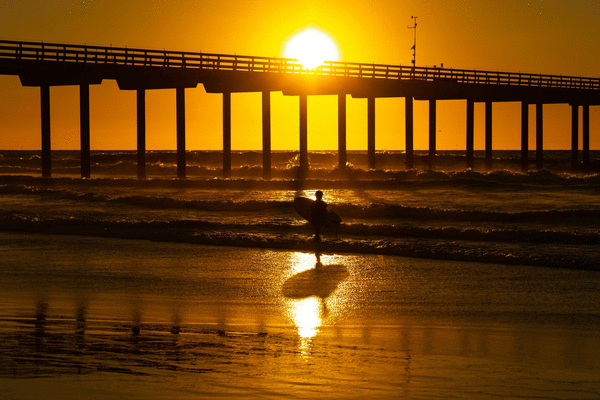
University of California, Riverside researchers, in cooperation with scientists from University of California San Diego’s Scripps Institution of Oceanography, discovered that the polluted water from the U.S.-Mexico border can flow roughly 22 miles up the San Diego County coast before releasing pollutants in the air near the pier at Scripps in La Jolla.
The study, published in the journal Scientific Reports, found that wastewater chemicals unable to survive that distance in the air instead remained in the ocean. Currents then carried them north before they escaped into the atmosphere near the pier.
“The only way something that reactive could have gotten all the way up to La Jolla was to be hidden in the water, and that’s what this paper shows,” Kimberly Prather, a UC San Diego atmospheric chemist and co-author of the study, said in an interview Thursday.
The research was led by atmospheric scientist Karolina Cysneiros de Carvalho, who conducted the work at UCR and the National Center for Atmospheric Research in Colorado. She worked with UCR atmospheric scientist William Porter, UCR and NCAR atmospheric chemist Kelley Barsanti, and Prather.
“It was already known that compounds from this waste could enter the air, but we didn’t realize until now how far it could travel underwater before emerging,” Cysneiros de Carvalho said in a UCR news release.
Researchers collected air samples in August and September 2024 at four sites stretching from the river to the Scripps pier. River flows typically fall to nearly zero during the summer dry season, but in 2024, roughly 160 million to 207 million liters of wastewater per day were entering the Pacific Ocean, according to the study.
“It’s important to recognize that these were unique conditions,” Prather said. “These were super-high river flows during what should be the dry season.”
The researchers note they do not yet know how far the pollutants travel under more typical conditions.
The team tracked dimethyl trisulfide, a sulfur compound associated with wastewater, and detected it even at the La Jolla site. Prather said the conditions in the Tijuana River produce that particular tracer, which distinguishes it from other sewage sources along the coast.
Because the compound breaks down quickly in the air, calculations showed most of it should have disappeared long before reaching La Jolla.
“We found pollutants far from the source that couldn’t be explained by just the wind,” Porter said in the release.
Modeling showed that at a depth of about 10 meters, up to 76% of the compound could survive the 35-kilometer trip underwater under the conditions examined. Ocean measurements near Del Mar also showed unusually fresh water, a sign of river discharge, extending along the coast during the period.
“That’s the key message. It masks itself. The pollution hides itself,” Prather said.
A change in river flow provided further evidence. When a pump station in Mexico began diverting wastewater southward on Sept. 10, 2024, dimethyl trisulfide levels measured in La Jolla dropped 86%, according to the study.
“Now we really understand how much those pumps in Mexico are controlling everything,” Prather said. “And now it turns out they’re controlling the air quality as far north as La Jolla, which is crazy.”
Prather said one possible explanation is that undersea canyons near La Jolla, which bring nutrients to the surface, may also bring the pollution up. She cautioned that “this is more of a hand-waving thing right now. We’re still trying to make measurements to back it all up and see how frequently it happens.”
The study did not examine whether the concentrations detected pose a risk to human health. Prather said her team is now taking measurements to better understand how far the pollution travels.
“There’s no reason it can’t go further. There really isn’t,” she said. “Now, the good news is, after it travels that distance, by the time it pops out, hopefully the concentrations are much lower.”
The findings add to growing scrutiny of air quality tied to the cross-border sewage crisis. In September, the federal Agency for Toxic Substances and Disease Registry released a draft report finding short-term hydrogen sulfide exposure near the river to be a public health hazard. It was the first such finding by a federal public health agency.
Days later, Gov. Gavin Newsom signed Senate Bill 58, which directs the California Air Resources Board to update the state’s hydrogen sulfide standard, first adopted in 1969. In June, the county contracted with UC San Diego for a study led by Prather to map residents’ exposure to airborne chemicals.
Porter said the findings show water and air pollution should not be treated separately.
“You can’t just shut down the beach and call it good,” Porter said in the release. “We need to clean up the water not just for swimming, but for breathing.”
Prather said the new research shows the crisis extends beyond the communities closest to the border.
“Before, it’s always been viewed as a South Bay problem and it’s been ignored for almost a hundred years,” she said. “But ever since people saw it gets in the air, now it’s a San Diego County problem. It’s a Del Mar problem. It’s an Encinitas problem. It’s everybody’s problem.”
©2026 The San Diego Union-Tribune. Visit sandiegouniontribune.com. Distributed by Tribune Content Agency, LLC.






Comments