Trump prepares for Iran escalation after US, Israeli elections
Published in News & Features

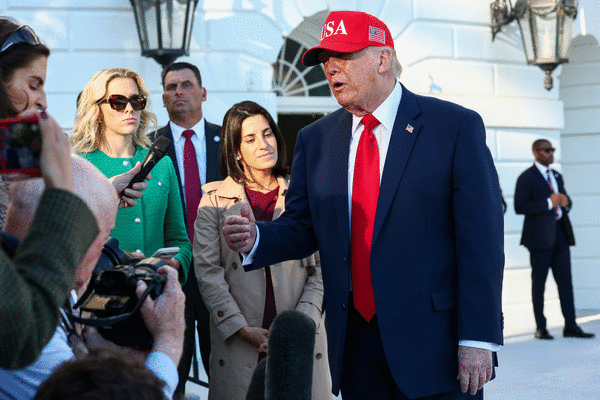

A Middle East war that President Donald Trump said would be over in a matter of weeks now looks set to escalate as it enters its eighth month.
Trump has repeatedly hinted that his forces in the Mideast would resume strikes on Iran after the U.S. midterm elections on Nov. 3. The president has already sent a third aircraft carrier strike group and 10,000 additional sailors and Marines toward the Persian Gulf to give U.S. commanders more options if he restarts hostilities.
This week, Defense Secretary Pete Hegseth also made an unannounced stop in Israel — which launched the war against Iran alongside the U.S. — where he met with Prime Minister Benjamin Netanyahu just days ahead of the Israeli leader’s sensitive reelection bid. Staffing at Mideast bases, which have been hit hard by Iranian counterstrikes, has reportedly been reduced.
This week the U.S. State Department ordered the departure of some diplomats and families in Saudi Arabia, following the Iran-backed Houthis expanding the conflict into Saudi Arabia. Houthis have pummeled the Riyadh airport and energy facilities with drones and missiles, killing dozens and wounding hundreds.
Iran preparing
Against that backdrop, Iran is now bracing for a fresh U.S. bombing campaign around the midterms and is preparing to retaliate across the Middle East, including against Israel and the United Arab Emirates, according to a person familiar with Tehran’s thinking.
The period between the U.S. election and when the new Congress takes office in early January will be the most difficult period, and the only way out of the current conflict is a deal that allows both sides to claim a win, this person said, declining to be named because they weren’t authorized to speak publicly.
Some Gulf-state officials have a high degree of confidence that violence will resume, and said they fear it could be worse than before the pause, according to a person familiar with the UAE government’s thinking.
“We’ve knocked the hell out of them — and we may do it a little bit further,” Trump told reporters Thursday, echoing that sentiment.
Meanwhile, Iran is attacking more ships in or near the Strait of Hormuz — and causing more severe damage — than earlier in the conflict as it deploys guided missiles rather than attack drones, according to shipping and maritime security officials.
“All indications point to a resumption of war and a major bombing campaign, although the timing remains uncertain,” said Aslı Aydıntaşbaş, an expert on the Middle East at the Brookings Institution.
Trump’s own comments suggest strikes are unlikely ahead of the midterms on Nov. 3, where his Republican Party faces the prospect of losing one chamber of Congress if not both, in part because of the war-related high fuel prices in the U.S.
Renewed fighting could help Netanyahu force political rivals into a national unity government, while strikes could help Trump project a “dramatic show of force to project strength at home,” according to International Crisis Group Mideast expert Ali Vaez.
“Both Trump and Netanyahu may see war with Iran as a political escape hatch,” Vaez said. “But both risk discovering that a war intended to rescue their political fortunes could end up burying them.”
The U.S. and Israeli elections are complicating efforts to stop the march toward war, and other nations must step up efforts to reach a deal before it’s too late, a senior European diplomat said.
The heated Israeli election — the first since the Hamas attacks in 2023 that sparked Netanyahu’s wars in Gaza and Lebanon — is Tuesday. If Netanyahu loses the election, his chief rival, Gadi Eisenkot, may not be as eager to begin his term restarting the Iran war.
Economic angst
In recent months, the White House has also added to a punishing naval blockade of Iranian ports by ramping up economic sanctions targeting Tehran’s remaining trade partners. While the sanctions campaign has underwhelmed experts, the naval blockade continues to have a real impact, though growing pressure may push Iran to strike out across the Gulf.
“The smart thing for the president to do would be to let the current strategy play out,” said Bradley Bowman, a foreign policy and defense expert at the Foundation for Defense of Democracies.
Recent attempts to wind down the war through diplomatic talks have failed. But Iran’s Foreign Minister Abbas Araghchi made a plea this week to return to diplomatic negotiations.
Writing in the Financial Times, Araghchi said, “Iran is prepared to give diplomacy another chance if we see strong evidence of a sincere desire on the part of the U.S. to achieve a just and honorable solution to permanently end this conflict.” But he added that “there is little reason to expect progress now.”
The war, which Trump initially said would be over in a matter of weeks, was unpopular with Americans from the start but has only gotten worse. Roughly two-thirds of Americans disapprove of the way Trump has handled the Iran conflict with roughly half expecting it to go on for more than another year, according to a Pew Research Center conducted from Sept. 28 to Oct. 4.
The conflict has disrupted energy flows from the Persian Gulf and pushed Brent crude, the global benchmark, up more than 80% this year. That’s caused U.S. gasoline prices to surge and fueled cost-of-living concerns at home that have upset the GOP’s election prospects.
The U.S. military has had some success helping ships through the Strait of Hormuz. But oil prices are rising once again on fears of military escalation in the region amid the attacks on Saudi Arabia. Brent futures are also rising as traders try to gauge whether the U.S. will escalate the war after the midterms.
“The Middle East feels eerily similar to its pre-Iran war state in February,” wrote Bloomberg Economics analysts Dina Esfandiary, Ziad Daoud and Becca Wasser in research published on Thursday.
“There are some differences, including approaching elections in the US and Israel, significant disruptions in Strait of Hormuz, and a more intransigent Iran,” they added. “Yet these point to a higher, not a lower, likelihood of renewed fighting.”
———
(With assistance from Jen Judson and Courtney McBride.)
©2026 Bloomberg L.P. Visit bloomberg.com. Distributed by Tribune Content Agency, LLC.






Comments