War in Ukraine escalates with drone strikes on cargo ships
Published in News & Features
Attacks on commercial vessels off the Black Sea’s western coast are on the rise, threatening already-choked trade flows in the region while testing NATO’s readiness to react.
Two general cargo ships were hit by air and naval drones overnight in the exclusive economic zone of Bulgaria, a member of the North Atlantic Treaty Organization, Prime Minister Rumen Radev told reporters on Tuesday. A commercial vessel loaded with rapeseed oil was also damaged by a Russian drone strike that killed one person on Tuesday, Odesa regional governor Oleh Kiper said on Telegram.
The overnight strikes are “absolutely unacceptable” and in violation of international law and maritime practice, Radev told reporters, without naming the source of the attack. “What is happening severely hampers shipping in the Black Sea, drives up insurance costs even further, and makes maritime operations extremely difficult.”
The strikes in NATO countries’ exclusive economic zones add to previous cases of drone incursions in countries such as Poland and Romania, helping Russia to test the alliance’s readiness to protect its borders while remaining short of full-fledged attacks on its territory.
They also reflect how the Black Sea is becoming an increasingly precarious corridor for agricultural trade, raising concerns over how crops from two of the world’s biggest exporters — Russia and Ukraine — will reach global buyers.
Ports along the Romanian and Bulgarian coasts, including Constanta, Varna and Burgas, have provided important alternatives for traders navigating disruptions elsewhere in the region. Growing risks around those routes threaten to narrow those options further, with potential consequences for freight costs and grain prices.
Radev said the strikes can’t trigger NATO’s protective clauses — including formal consultations and the principle that an attack against one member state is an attack against the alliance — on the ground that more serious incidents have happened in the past without such a forceful response.
He said it’s up to NATO’s leadership to to consider the nature and form of that response.
“Ships are constantly being sunk in the Black Sea, and there are frequent drone strikes against vessels,” he said at an event in Sofia later on Tuesday, warning that long conflicts tend to expand geographically.
A cargo vessel also caught fire and sank Monday in Romania’s exclusive economic zone, with two crew members found dead. The ship that carried corn was Turkish-owned and hit by two Russian drones, Ukrainian President Volodymyr Zelenskyy said.
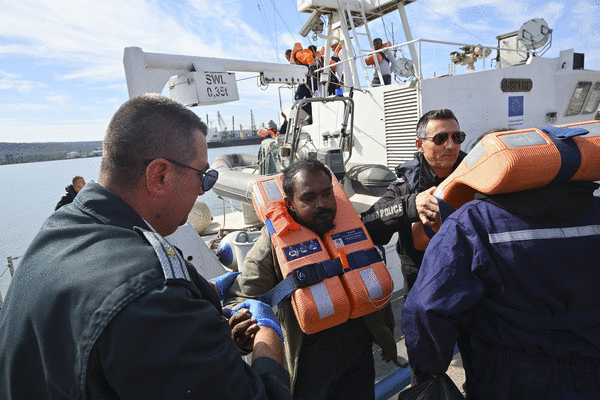
A passing Bulgarian ferry saved the 18 crew members of the ship sailing under the flag of Palau that caught fire, which Radev said was carrying wheat.
The other ship struck in the overnight attack sank with no information on its crew or its cargo. A search and rescue operation for the crew of the Togolese-flagged vessel is ongoing.
“Freedom of navigation becomes meaningless if Russia can make exercising it a matter of risking a civilian crew and vessel,” Ukrainian Foreign Minister Andrii Sybiha said in a post on X on Tuesday. “Russia should not be allowed to impose this hidden tax on international trade through violence and insecurity,” he said.
Bulgarian authorities are monitoring another ship drifting off the Bulgarian coast, hit in August and without crew, he said. Authorities may take action if it reaches territorial waters. President Iliana Yotova called a security council meeting to discuss on Wednesday the risks from Russia’s ongoing full-scale invasion of Ukraine.
Madeleine Overgaard, senior manager for agriculture data at Kpler, said that both vessels hit in the overnight attack were sailing to or from Ukrainian ports. There’s no clear evidence of a direct threat to ships using the major Bulgarian and Romanian ports, she said.
“Still, the attacks widen the high-risk area. Ships may now face greater risks as soon as they enter the Black Sea, rather than only when approaching Ukrainian ports,” Overgaard said.
—With assistance from Eleanor Thornber, Olesia Safronova and Pyotr Kozlov.
©2026 Bloomberg L.P. Visit bloomberg.com. Distributed by Tribune Content Agency, LLC.





Comments