A look inside María Corina Machado's secret efforts to return to Venezuela
Published in News & Features
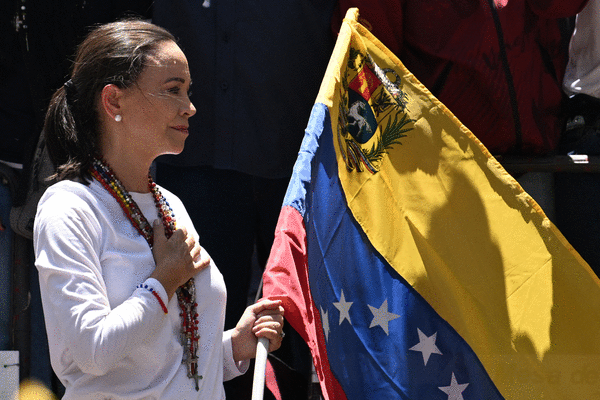
Venezuelan opposition leader María Corina Machado intends to make another attempt to return to her country after a series of failed efforts that have included a secret maritime operation from Panama, attempts to charter aircraft and trying to get on commercial flights, according to sources within her camp with firsthand knowledge of the operations.
People involved in the efforts say the popular opposition leader, who won the 2025 Nobel Peace Prize, remains determined to return and that another attempt could come later in October, although they cautioned that no date has been set and plans could change.
The accounts provide new details about what Machado’s team says have been at least seven attempts or proposed operations to return since she left Venezuela nine months ago, including three failed efforts on Sept. 22 that were previously reported by Reuters and the Spanish newspaper ABC.
One of the most elaborate operations called for Machado to leave Panama aboard a yacht accompanied by two journalists and travel toward Aruba, where she would transfer at sea to another vessel coming from Venezuela, according to people who participated in the operation.
The yacht never made the trip.
Hours before its scheduled departure, Machado’s team was informed that the vessel had developed mechanical problems, the sources said. The group subsequently turned to charter aircraft, but a plane intended to carry Machado was denied permission to depart.
The failed operations have fueled suspicions within Machado’s camp that information about her movements was being discovered in advance and that outside governments may have been standing in the way of her return. The sources could not establish who was responsible for stopping the various attempts.
But Curaçao’s aviation chief, Peter Steinmetz, has independently confirmed that his office denied landing permission for a Sept. 22 flight carrying Machado following a “request from higher up.”
Steinmetz, director of the Curaçao Civil Aviation Authority, told Dutch broadcaster NOS that his agency refused landing permission for the private aircraft, which was scheduled to fly Machado from Panama to the Cairbbean island.
Steinmetz did not identify who made the request.
According to Dutch News, neither officials in Curaçao nor the Dutch government have said where the instruction originated. Curaçao controls its own civil aviation, while foreign policy is handled jointly with the Kingdom of the Netherlands.
The uncertainty has left unanswered one of the central questions surrounding Machado’s repeated attempts to return: Who, if anyone, is preventing her from reaching Venezuela?
Venezuelan officials insist it isn’t them.
Interior Minister Diosdado Cabello on Wednesday dismissed Machado’s complaints as a “show” and publicly challenged her to return.
“What’s stopping her from coming back? Let her come!” Cabello said during his television program Con el Mazo Dando. “What’s the problem?”
National Assembly President Jorge Rodríguez made a similar denial days earlier, rejecting claims that Venezuelan authorities were preventing Machado’s return.
Secret sea route
Sources within Machado’s camp say the recent failures were only the latest chapter in an effort that began months ago.
For the Panama operation, Machado was to travel aboard a yacht with two journalists and members of her team, including a person with experience in navigation and satellite communications.
The plan called for the yacht to leave Panama with an officially declared destination of Aruba. Machado and the others would travel to a predetermined location near Venezuelan waters and transfer at sea to a vessel arriving from Venezuela, according to people who participated in the operation.
Machado’s team says the arrangements were designed so the yacht’s departure from Panama would be legal.
The sources said Panamanian authorities assisted with logistical aspects. The group formally processed the vessel’s departure and was trying to avoid violating Panamanian law.
The yacht was supposed to cross the Panama Canal before picking up Machado and the others at a marina in Colón, on Panama’s Caribbean coast. They expected to depart at about 4 a.m.
At about 1 a.m., however, members of the group received word that the yacht had broken down.
People involved in the operation found the timing suspicious but acknowledged they had no evidence establishing that the mechanical failure was deliberate.
The maritime plan was abandoned.
Charter flights
Machado’s team subsequently turned to charter aircraft, according to the sources.
Separate flights were arranged, with Machado traveling separately from some members of the group and the journalists in an effort to make her movements less conspicuous.
One charter flight intended to carry Machado was denied permission to take off, the sources said.
Separately, Dutch News reported that a private aircraft was scheduled to fly Machado from Panama to Curaçao on Sept. 22 but was denied permission to land. An effort to fly her to Aruba the same day also failed.
Journalists traveling with Machado initially said the flights had been canceled because of paperwork problems, according to the Dutch report.
Steinmetz’s subsequent account offered additional information about the Curaçao flight: The aviation authority had acted following a request from superiors.
The identity of whoever made that request remains unclear.
Dutch News reported that Curaçao Prime Minister Gilmar Pisas declined to comment, while the island’s transport minister, Charles Cooper, said the request did not come from him.
Dutch News, citing NOS, reported that the decision was made by the Kingdom Council of Ministers, which brings together representatives of the Netherlands, Aruba, Curaçao and Sint Maarten. Dutch officials have not publicly explained who requested that the flight be denied permission to land.
Manifest surfaces
Machado’s team soon learned that information about one of the charter flights had circulated outside the group. Sources said an image of a passenger manifest reached a journalist in Spain after the operation fell apart.
People present with Machado said members of the group learned about the document while they were together after she returned from the airport. The manifest disclosed the identities of people associated with the flight.
The episode reinforced suspicions within Machado’s camp that someone outside the group had obtained information about the operation.
The sources could not establish who initially obtained the manifest or who circulated it.
Questions about Washington’s role
The failed attempts have also unfolded against a complicated relationship between Machado and Washington.
Reuters reported that following Venezuela’s deadly earthquakes in June, U.S. officials had privately urged Machado to postpone her return and opposed her efforts to re-enter the country, citing people familiar with the matter.
The State Department did not respond to Reuters’ request for comment.
Dutch News also cited a July report by the Axios news site saying U.S. policy was officially neutral on whether Machado should return but that her repeated attempts had angered senior Trump administration officials.
Those reports do not establish that Washington ordered any of Machado’s flights stopped or was behind the request received by Curaçao’s aviation authority.
Machado’s team has discussed raising the issue directly with the Trump administration. A person involved in those discussions said Machado indicated that she intended to contact Secretary of State Marco Rubio through formal channels before making another attempt, although the source did not know whether that communication ultimately occurred.
The question comes as the Trump administration has developed a working relationship with interim Venezuelan President Delcy Rodríguez following the U.S. capture of Nicolás Maduro in January.
Trump met Rodríguez in New York on Sept. 22 on the sidelines of the United Nations General Assembly — the same day Machado made three unsuccessful attempts to return, according to Reuters.
In an interview with Time magazine published Thursday, Trump said Venezuela could eventually hold elections but indicated that he believed it was still too early to do so. He also described his administration as working well with Rodríguez and highlighted cooperation over Venezuelan oil.
A public return
Against that backdrop, people around Machado have begun discussing whether secrecy is still the best strategy.
One proposal would essentially abandon it.
Sources familiar with the discussions said Machado has considered attempting to return aboard an ordinary commercial flight accompanied by journalists and international political figures.
Instead of concealing her movements, Machado would arrive at the origination airport and attempt to board a scheduled flight, making any decision preventing her from traveling immediately visible.
One option discussed within the group was purchasing tickets on a Copa Airlines flight from Panama to Valencia. If Machado were prevented from boarding the Panamanian carrier, they would try an Avianca itinerary from Panama through Bogotá to Valencia later the same day, according to people involved in the discussions.
Machado did not immediately pursue the plan, the sources said, choosing instead to explore political and diplomatic channels.
Colombia option
Colombia has also figured in the attempts, according to sources familiar with the efforts.
A person directly involved said members of Machado’s camp traveled to Colombia and held discussions with a senior Colombian official about the possibility of helping facilitate her return.
According to that account, the official was initially receptive but later declined to assist with the operation and advised Machado’s representatives to wait.
The sources could not establish why the position changed.
Those episodes have led Machado’s team to consider other ways of returning.
Aruba and Curaçao have figured in the discussions because of the islands’ proximity to Venezuela and their potential use as transit points, while Colombia and Panama provide other possible routes.
The repeated failures have not changed Machado’s determination to return, the sources said.
Seven attempts
Machado’s camp publicly confirmed last month that there have been at least seven efforts to return.
Her adviser, Pedro Urruchurtu, said after the Sept. 22 failures that the sea and air operations were among seven unsuccessful efforts since Machado secretly left Venezuela nine months earlier. A Machado spokesperson subsequently confirmed his account to Reuters.
Sources familiar with the operations said the attempts and plans have involved different combinations of aircraft, maritime routes, Colombia, Panama and charter flights. They do not have the same degree of firsthand knowledge about every attempt, particularly some of the earlier operations.
But people involved in several of the most recent efforts say Machado has no intention of abandoning her plans.
The efforts are unfolding as Venezuela enters a new political phase following Maduro’s capture and as Washington develops a working relationship with Rodríguez.
Cabello, meanwhile, says nothing is stopping Machado from simply coming home.
Another attempt could come this month, according to people involved in the discussions, although they said the timing remains unsettled.
Machado’s intention, they say, is not.
“She is going to enter” Venezuela, one person involved in several of the operations said. “It is her goal.”
©2026 Miami Herald. Visit at miamiherald.com. Distributed by Tribune Content Agency, LLC.



Comments