US tightens Cuba embargo, limits travel, cuts bank access for entrepreneurs
Published in News & Features
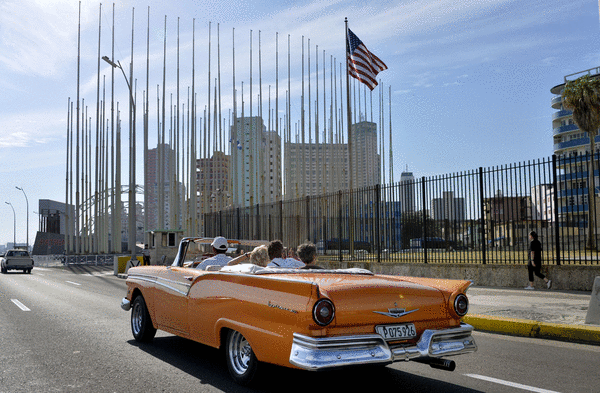
The Trump administration tightened the U.S. embargo against Cuba on Wednesday, further restricting travel to the communist-run island and access to U.S. banking for its private sector.
The new regulations, issued by the Treasury Department and taking effect Wednesday, also prohibits “indirect” transactions with sanctioned entities linked to the Cuban military and included in the Cuba Restricted List maintained by the State Department.
The rules also widen who can be included in that list. The Secretary of State may now add entities acting “for the benefit of” the Cuban military, intelligence or security services or personnel.
Under the new changes, banks under U.S. jurisdiction cannot open or maintain bank accounts for Cuban independent entrepreneurs. They also won’t be able to process so-called “U-turn” transactions, meaning transfers originating and terminating in third countries involving Cuban entities or Cuban nationals.
The new regulations prohibit travel to Cuba for professional meetings or conferences and eliminate group travel under a U.S. sponsor for “people-to-people” educational purposes. The decades-old U.S. embargo prohibits travel to Cuba for tourism, but it allows some exceptions, including travel to visit family.
Critics of the “people-to-people” category say it amounts to tourism. A Miami federal judge ruled in 2022 that cruise companies taking U.S. passengers to Cuba under that exception were engaging in prohibited tourism in a high-profile case involving confiscated property in Cuba. But the cruise companies appealed, and an appeals court is still considering the matter.
Left-wing organizations and activists have also traveled to the island under such exceptions, in controversial visits that have included meetings with senior Cuban government officials and events in support of the communist government.
State Department spokesman Thomas Pigott said Wednesday that Treasury amended the Cuban Assets Control Regulations “to close loopholes the Cuban regime has long exploited to engage in sanctions evasion, enrich regime insiders, and fund dangerous subversive and military activities which threaten the national security of the United States.”
Some of the measures were long expected because the rules implement a national security presidential memorandum issued in June 2025 and an executive order President Donald Trump signed in May. But cutting off the private sector’s access to U.S. banks marks a policy change.
So far, the administration had maintained a policy of supporting private-sector expansion on the island, by for example allowing sales of U.S. oil to private entities but not to the government. The State Department has been quietly revoking visas given to private entrepreneurs.
Recently, the Cuba Study Group, a Cuban American group based in Washington, urged the administration to issue clear guidance and guarantees to banks so they could open and maintain accounts for Cuban private business owners, which the Biden administration had authorized. Few banks acted on that authorization because of fear of sanctions and a lack of guidance on how to comply.
Even so, entrepreneurs on the island fear the new restriction will further complicate paying for imports and hamper growth.
“Although the number of existing accounts was small and the immediate impact of the measure might appear minimal, the signal regarding the future is clear,” said Osniel Castellanos, the founder of Auge, a consultancy that has helped hundreds of entrepreneurs to create businesses on the island.
Castellanos said in a Facebook post that the measure “creates additional obstacles” for private entrepreneurs to take advantage of a package of reforms announced by the Cuban government in June allowing private banking, because it shuts off “any possibility of banking connections (however minimal) with the U.S.” He notes that the United States is the primary market for Cuba’s private sector and the Cuban American community is ”a source of both seed capital and purchasing power within Cuba.
“It is to be expected that non-U.S. banks—which typically handle the bulk of private-sector transactions for purchasing goods and services from abroad—will now likely tighten and intensify their compliance and due diligence procedures,” he added. “This could create new hurdles and difficulties for the international payment processes carried out by the private sector, which underpins the importation of food, fuel and other products essential to national life.”
The Treasury Department’s Office of Foreign Assets Control issued new guidance on Tuesday to explain the changes, stating that the regulations still allow other Cubans to open accounts in U.S. banks— just not the entrepreneurs.
“For example, an author who is a Cuban national located in Cuba may open an account with a bank in the United States to receive payments for sales of their book,” the guidance says.
Cuban officials quickly reacted to the new rules, seizing on the bank restrictions to argue that the U.S. government is not truly supportive of the island's private sector, which the government has tolerated out of economic necessity but keeps under strict control.
“The new unilateral coercive measures approved by the U.S. government, in addition to further tightening the stranglehold on Cuba, unmask those who claim the measures are directed solely against the Cuban government and its enterprises,” Cuban leader Miguel Díaz-Canel said on X. “Those actions against the Cuban private sector clearly demonstrate that their sole intention is to inflict maximum suffering on our people and to limit the implementation of economic and social transformations.”
_____
©2026 Miami Herald. Visit miamiherald.com. Distributed by Tribune Content Agency, LLC.





Comments