Toxic mounds triggered a crisis in Florida. What's the state of cleanup?
Published in News & Features
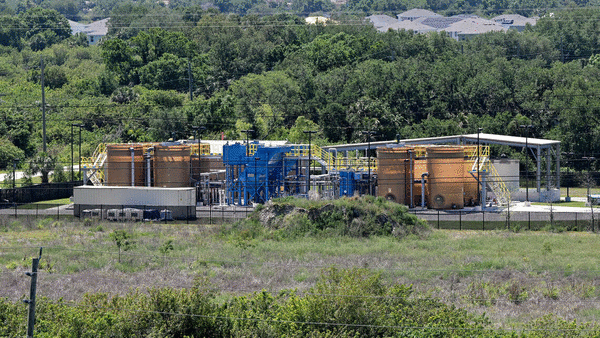
PINEY POINT, Fla. — The end may finally be near for cleanup of a toxic industrial site that triggered a public emergency and environmental crisis on Florida’s Gulf Coast five years ago.
Piney Point, an abandoned fertilizer processing plant in northern Manatee County on the edge of Tampa Bay, is approaching the end of a state-supervised remediation effort. The plan aims to address contamination that the phosphate industry left behind — and prevent it from ever causing another catastrophe.
In April 2021, a tear in the liner of the site’s largest holding pond threatened to breach and flood surrounding homes with a wall of polluted water up to 20 feet high. To prevent disaster, the state ordered an emergency discharge into Tampa Bay.
A different kind of disaster followed. The release of 215 million gallons of contaminated water into the fragile estuary fueled one of the worst red tide events in recent memory for the Tampa Bay area, researchers found — wiping out tons of marine life and striking a blow to tourism and other industries that depend on healthy waters.
The catastrophe marked a turning point. After decades of simmering issues, Piney Point spilled over into a problem that state and local leaders could no longer ignore.
‘Full speed ahead’
Five years ago, Piney Point was controlled by HRK Holdings, a small firm principally owned by a Wall Street executive and former hedge fund manager. The Florida Department of Environmental Protection allowed HRK to buy Piney Point out of bankruptcy in 2006, under an agreement that the company would manage the site responsibly and move it toward permanent closure.
Instead, HRK took on a risky business deal that led to a massive pollution spill in 2011 and bankruptcy the year following. Even so, state regulators allowed HRK to keep managing the property, where levels of polluted water and structural issues continued to build.
The problems culminated in 2021’s devastating spill. Court rulings later found HRK Holdings liable for nearly $259 million in environmental damage and cleanup costs. Despite that, HRK’s owners walked away from the mess without paying a dime, shielded by a bankruptcy declaration and state law that makes it extremely difficult to hold LLC owners personally responsible.
Florida taxpayers are now paying the bill. The cleanup project has cost about $180 million as of August, according to Herb Donica, a bankruptcy attorney and accountant who is overseeing the work.
In 2021, a judge appointed Donica, who had previous legal experience with Piney Point, to close the site “as efficiently and expeditiously as possible.”
The cleanup looks like this: Piney Point’s towering mounds of slightly radioactive phosphate extraction waste, known as gypstacks, are topped with four ponds. For years, they contained a mix of rainwater and “process water,” a polluted byproduct of phosphate production. Over 600 million gallons of that water have now been drained, treated to remove contaminants and pumped deep underground. After emptying, each pond is being carefully sealed to contain the contaminated earth that remains.
The entire site has also been reengineered to properly handle Florida’s wet weather — including hurricanes — so that water can’t build up to dangerous levels and threaten surrounding communities with a toxic flood as in the past.
As progress continues by the day, Piney Point’s temporary caretaker is setting his sights on the finish line.
“We are literally moving full speed ahead,” Donica said. “We believe we’re in good shape to get it closed out by the end of the year.”
What’s left for Piney Point’s cleanup?
On a spring morning, clusters of workers and construction equipment dot Piney Point’s lofty gypstacks and the network of dirt roads that connect them.
Over 130 people work the site on an average day, Donica says. Work is ongoing 10 hours a day, six to seven days a week.
“Every morning, one of our engineers sits down with a laminated map of the stack system, and he uses erasable markers and sketches out a traffic program for the day based on all the activities going on,” Donica said.
One of the site’s four gypstack ponds closed in 2023. Crews are simultaneously working to close the other three by the end of this year.
“All of the water that was originally in the ponds has been removed,” Donica said.
Now, workers in trucks move tons of earth to the gypstacks to fill and contour the former holding ponds. On the ground, others install drainage systems and use tractors equipped with machinery to sew panels of heavy synthetic liner across the bottoms of the ponds and seal away phosphate production waste.
In the distance, Tampa Bay glistens, the Sunshine Skyway Bridge and St. Petersburg skyline visible beyond — reminders of how close the contaminated site lies to a precious regional water resource.
Once it’s all done, the gypstacks will look like large, grassy hills with bowl-like tops.
“They’ll still resemble bowls, but they won’t hold water, because they all have drains,” Donica said.
After Piney Point’s cleanup is complete, it will likely take a few more months for state officials to inspect the property and determine that it’s ready to be “closed.”
If it gets a green light, Donica will receive a closure letter — an official document that marks the end of the remediation effort.
A late-season hurricane or heavy rain could extend the timeline slightly — Donica says an inch of rain generates almost 4 million gallons of water in the holding ponds. Until remediation is complete at Piney Point, any new water that lands in the holding ponds has to be regarded as phosphate process water and go through a strict treatment process.
Regardless of what the weather brings, Donica anticipates that by early 2027, Piney Point will be entering its next chapter.
The next chapter
Once all the gypstack ponds are closed, a new system will go into place for managing water.
Water that gathers above the protective liner on the stacks will be treated as regular stormwater and drain into Tampa Bay, Donica explained. Water that seeps from below the liner, where it has potentially had contact with mining waste, will continue to be treated as process water. It will be corralled into a separate drainage system that will take it across the street to a facility owned by Manatee County Government, where it is treated and disposed of down a deep injection well.
The county uses a private contractor to operate the water treatment facility and, in an agreement with the state, will assist in Piney Point’s long-term care period.
Manatee County Utilities Director Patrick Shea described the process to commissioners at a recent board meeting.
“There’s two stages. There’s the final closure of the gypsum stacks. And then there’s the long-term care period. So the groundwater, stormwater that will run off from the site for the next 50 years is the long-term care period that we will continue to monitor,” Shea said.
The county agreed to help with Piney Point’s closure after its own entanglement in the site’s problematic history. In 2007, the county government-operated Manatee County Port Authority struck a deal with HRK Holdings to dump dredge material from the creation of a new berth at Port Manatee into the largest holding pond at Piney Point. State regulators approved the plan, despite warnings from the U.S. Army Corps of Engineers that storing heavy dredge material in a fragile gypstack system was an untested and risky use.
Though county officials at the time said they were unaware of problems with the largest pond’s liner, the dredge material contributed to a 2011 spill of 170 million gallons of polluted water into Bishop Harbor, the Herald previously reported. A decade later, continued issues with the compromised pond would cause the 2021 emergency.
Recently, the county commission approved $1.3 million for repairs and system upgrades at its water treatment facility in preparation for Piney Point’s next chapter. That money is then reimbursed to the county through Donica’s receivership.
Donica notes that the mandated 50-year monitoring period for closed gypstacks is designed for sites that have only recently stopped processing phosphate. Since Piney Point has already been inactive for many years, he said it’s likely that the site could meet state standards to end monitoring sooner.
“If you can show that the seepage has gone down, you can maybe cut it short to 20 or 30 years,” Donica said.
Water quality experts weigh in on Piney Point’s closure
As Piney Point nears closure, local water quality advocates say it’s important to ensure that oversight remains strong to prevent further pollution to Tampa Bay.
In 2024, a lawsuit brought by Suncoast Waterkeeper and other groups resulted in the state agreeing to more strict regulations for stormwater that leaves Piney Point under the federal Clean Water Act.
According to the organization, monitoring so far has revealed a mixed picture, showing less pollution leaving the site in dry months, but water with high nutrient loads escaping into local waterways during rainy periods.
“As Piney Point makes progress toward entombment (aka closure) of the remaining stacks containing contaminants of concern, it will be important to monitor whether these changes reduce phosphorus concentrations in the ‘non-contact’ stormwater released via three permitted outfalls to Piney Point Creek, Bishop Harbor, and ultimately Tampa Bay,” the organization said in a statement provided to the Bradenton Herald. “Suncoast Waterkeeper will continue to track these discharges to monitor changes to water quality in the hope of a recovering Tampa Bay in the years ahead.”
With Florida accounting for more than 60% of U.S. phosphate production in recent years, according to the U.S. Geological Survey, managing waste from the industry will remain a challenge.
“It’s hard to fight phosphate, because of our pervasive reliance on it in fertilizer for food production,” said Justin Bloom, founder and board member of Suncoast Waterkeeper, in a statement to the Herald.
Bloom said it’s important to learn lessons from Piney Point so that the same mistakes are not repeated elsewhere.
“That disaster should never have happened,” Bloom said. “This happened under the Florida Department of Environmental Protection’s watch,” he said. “Time and again, they continued to inadequately regulate and enforce environmental laws.”
Reached for comment, FDEP officials said they are committed to closing the site and ensuring its long-term care according to state rules.
“As required by rule, a responsible long-term care entity will be identified; this entity will be responsible for maintaining the closed site in accordance with all applicable FDEP rules and site-specific regulatory permit requirements,” the department’s statement said.
Who will take over Piney Point?
According to Donica, one other major piece of the puzzle remains — figuring out who will take over Piney Point once remediation is complete.
“When I get the closure letter, it starts off a whole new chain of events,” Donica said. “Right now, I’m just a babysitter. I have to hand it off to a new custodian.”
Donica says the next caretaker could be a company or nonprofit organization backed by the state — or the site could go to a new private owner.
Ideas floated in the past include utilizing Piney Point as a public park, mountain biking facility or bird sanctuary.
But the site comes with a significant financial burden. Donica estimates that it will cost several million dollars a year to manage Piney Point throughout the long-term care period in accordance with state law.
“It’s not an asset, it’s a liability,” Donica said. “It’s got to be actively monitored. Samples have got to be drawn from the area to analyze water. You’ve got to have staff there to oversee it.”
Alternatively, the state could opt to hold onto the site. Donica said the gypstacks contain rare earth minerals that could be extracted one day with the proper technology, a proposal that university researchers in the state are actively working on.
FDEP officials told the Bradenton Herald that they expect to have a new caretaker in place sometime next year.
No matter who takes over next, Donica says it’s crucial that Piney Point never poses a threat again. He has offered to stay on for at least several months in a transition role as the long-term care period begins.
“There’s no way that I, or the department, wants me to lock the gate, throw the key and walk away, after all we’ve done,” Donica said.
While the process has taken longer than expected — closure was previously anticipated in 2025 — Donica and his team say the work at Piney Point has produced innovations that could help shutter other phosphate waste sites around the state.
“The amount of unique activity that’s going on here that could be tailored to other places is staggering,” said Ran Tamir, the construction manager for Piney Point.
Donica, whose connection with Piney Point goes back decades, has witnessed many shortcomings in the site’s management. But it doesn’t have to be like that anymore, the attorney said.
Looking ahead to Piney Point’s final chapter, Donica says the end goal is clear: “It’s about protecting the public, by doing the testing and continuing to understand what’s going on in the groundwater system underneath the stacks. That’s the important part,” Donica said. “Staying ahead of any problems.”
_____
©2026 The Bradenton Herald (Bradenton, Fla.) Visit bradenton.com. Distributed by Tribune Content Agency, LLC.






Comments