RFK Jr. announces $51 million in dental grants at San Diego area community clinic
Published in News & Features
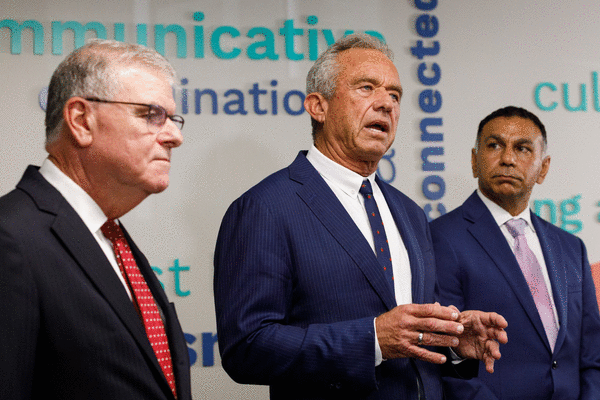
SAN DIEGO — Health and Human Services Secretary Robert F. Kennedy Jr. returned to San Diego County Wednesday, visiting a Neighborhood health center in Escondido to announce $51 million in grants to develop dental services for patients with neurodevelopmental disorders.
It was the secretary’s second visit in a little more than one month. Kennedy announced new homeless policy guidelines at San Diego Rescue Mission’s South County Lighthouse in National City on Aug. 12.
Neighborhood, which operates federally qualified health centers in San Diego and Riverside counties, with the bulk of its services in Escondido, is among 28 organizations nationwide that will receive up to $2 million in grant funding to offer dental services tailored to patients with neurodevelopmental conditions, including those on the autism spectrum.
Dental appointments, with their bright lights and often-noisy instruments, can be especially difficult for those with intellectual and developmental disabilities, creating a well-recognized deficit of preventive care that can lead to serious health consequences, especially infections.
Such conditions, Kennedy noted, have long been a focus of his family, with his aunt, Eunice Kennedy Shriver, founding Camp Shriver in 1962. The day camp, which Kennedy said he worked at as a child, was the precursor to what became the Special Olympics in 1968.
“I’ve been at the spear tip of the movement for rights and dignity and treatment for children with intellectual disabilities my whole life,” Kennedy said. “This is such a common complaint for these families and, for me, it’s a real privilege to be able to do something that is to solve problems for so many people.”
Camp Shriver documented the physical capabilities of kids with disabilities, leading to a formalized competition designed to fit what they could do rather than what they couldn’t.
It is a similar approach for the dental grants announced Wednesday. The idea is to explore ways in which dental care could be less jarring for patients.
Dr. Rakesh Patel, Neighborhood’s chief executive officer, said the new clinic will take a holistic approach.
“It’s having quieter drills; it’s having pre-dental visits so you can do some role-playing before you even have the actual visit,” Patel said. “Lighting’s a big part, sound’s a big part, and having a welcoming staff is a big part.
“The most important piece is actually having dentists and staff who are trained to take care of this population.”
Tom Engels, administrator of the U.S. Health Resources and Services Administration, visited with Kennedy on Wednesday and noted that this dental initiative will follow the traditional pilot project model, with results from the 28 grant recipients used to inform a broader national approach to care.
“We don’t want to dictate to them; we want them to look at innovations and determine how their patients and communities can be served,” Engels said. “They know what their patients need. What might work here in California may not work in other places.”
Wednesday’s announcement was far from the first time that Kennedy has made statements about dental care since Congress confirmed his appointment in early 2025.
However, many comments have been related to fluoride, the mineral proven to help prevent tooth decay that is routinely added to drinking water in most states.
The health secretary first publicly discussed directing the U.S. Centers for Disease Control and Prevention to stop recommending that communities fluoridate their water supplies in April 2025, though that change has not yet come to pass. But that has not stopped some states from taking quick action. Both Utah and Florida have already banned the practice over the vociferous objections from dentists and public health experts.
Kennedy has also pushed for limits on the use of oral fluoride formulations commonly used by dentists to supplement the intake for children who do not get enough through drinking water or other sources, such as toothpaste, to adequately prevent tooth decay.
On Halloween 2025, the U.S. Food and Drug Administration indicated that it intends to “take compliance action” against ingestible fluoride products on concerns of “emerging safety concerns when fluoride overexposure occurs.”
The American Dental Association has pushed back, indicating that research shows no such harms and that “daily use of fluoride tablets or drops at home are a safe and effective way to strengthen teeth and prevent cavities in children who are at high risk for tooth decay and whose water is deficient in fluoride.”
But fluoride is not only encountered in drinking water and oral supplements.
The ADA’s clinical guidelines recommend topical fluoride treatment — often painted on teeth during preventive office visits — for all children assessed to be at an increased risk of developing cavities.
Such treatments could be expected to be part of any new dental clinic funded by the federal grants announced at Wednesday’s event.
Given the secretary’s ongoing push to change nationwide fluoride policy, would this mean that clinics would be encouraged to skip topical fluoride treatments during office visits?
Asked the question at Wednesday’s announcement event in Escondido, Kennedy said no.
“I think there’s nobody who’s trying to restrict access to topical fluoride,” Kennedy said. “Topical fluoride is exactly where we ought to be going.”
_____
©2026 The San Diego Union-Tribune. Visit sandiegouniontribune.com. Distributed by Tribune Content Agency, LLC.




Comments