'A black box': Watchdog hopes to pry loose Hope Florida court records
Published in News & Features
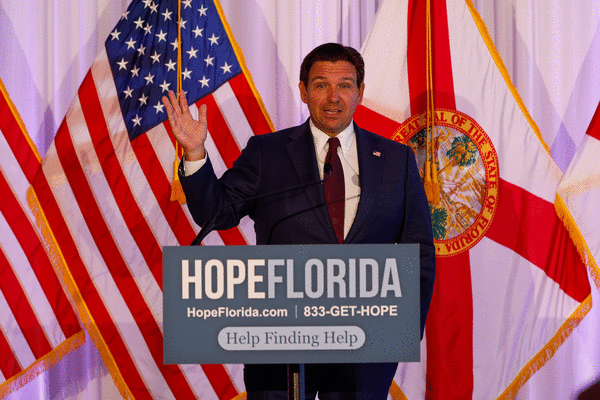
TALLAHASSEE, Fla. — Open government advocates spent the last six months pushing a Leon County circuit court for records related to the Hope Florida grand jury, convinced the state is covering up one of the biggest scandals in its history — the diversion of $10 million in Medicaid settlement funds to Republican political activities.
They are still pushing, despite the fact that the grand jury’s completed report was leaked to CBS News Miami and then reported on by the station and multiple other news organizations in August. The report placed high-ranking members of the DeSantis administration — including Attorney General James Uthmeier and Jason Weida, the governor’s chief of staff — at the heart of a “sophisticated scheme” to misappropriate taxpayer funds to fight a citizen-led initiative to legalize marijuana in 2024.
And while the report is now public, everything else about the grand jury’s proceedings, including any legal efforts by state officials to keep the report secret, is wrongly hidden in a “black box,” they say. Despite numerous legal filings — and the likelihood that a judge issued written orders about the report — court officials say they have no records to release.
There is no case number nor a docket sheet, the document that typically lists every legal filing in a case, so there is no public access to the fight newspaper attorneys and Florida Center for Government Accountability have been waging.
“We are staring at a black box and can’t see anything,” said Michael Barfield, executive director of the Florida Center for Government Accountability, which has been trying since February to gain access to the court records.
“We’re entitled to look into the black box and see what is in there,” he said days after filing the organization’s third motion related to the case on Sept. 10. “We’re going to press on this as far as necessary.”
When the Orlando Sentinel asked the Leon County Clerk of Courts for records related to the grand jury, it was told that the court could “neither confirm nor deny” that such records existed. The government accountability group, however, when requested provided its motions and related judicial orders to the newspaper.
Grand jury proceedings are kept confidential to allow people to testify freely without worrying about consequences and so that the subjects of an investigation are not unfairly tainted before the jury can decide whether to file charges against them.
The Hope Florida grand jury, despite castigating state officials for failing to conduct “due dilligence,” said it couldn’t find enough evidence to recommend criminal charges — mainly because it could not pinpoint who was to blame since no one would “take responsibility” for key decisions.
Barfield’s group acknowledges that “Florida law recognizes the confidentiality of grand jury proceedings and materials” but argues “that confidentiality is not self-executing as to the entire court file, progress docket, or related judicial orders.”
Since March, the organization has filed three motions with Judge J. Lee Marsh, the circuit court judge assigned to the grand jury, seeking to preserve records that would allow the public to know what went on behind closed doors and to discover what efforts, if any, Gov. Ron DeSantis and Uthmeier have taken to make sure the grand jury report and its associated records stay secret.
But at this point, Barfield said his group doesn’t know whether Marsh is done with the case, has issued an order sealing all the records or when to exercise its right to appeal.
“We are in this Alice in Wonderland situation, where they are hiding the fact they have been fighting to keep this hidden,” Barfield said. “We want to know why they are fighting so furiously to keep this hidden.”
Judges have a tricky balancing act when it comes to deciding what parts of a grand jury investigation to make public and what records to keep confidential, said Bob Jarvis, a law professor at Nova Southeastern University in Fort Lauderdale.
“We want our courts to be transparent, and we start from the preposition that everything should be open to examine,” Jarvis said.
And there is a strong argument in this case for making at least some documents public, Jarvis said.
The report has already been leaked, showing public officials funneling millions of dollars meant to provide healthcare to the poor through First Lady Casey DeSantis’ pet charity to dark money political committees run by Uthmeier, who was the governor’s chief of staff at the time.
“So there is a great public interest and reason for the public to be concerned,” Jarvis said. “And It appears many public officials didn’t do their job in vetting this deal.”
DeSantis officials have denied wrongdoing, and the governor said the only crime committed was the leaking of the grand jury report. He called the investigation and allegations of wrongdoing a “hoax,” and Uthmeier has called it a “nothingburger.”
The grand jury, however, said it could “plainly see” that taxpayer money was “missued” and said Uthmeier was in a “position of authority” over other DeSantis staff at the heart of the scheme.
The Hope Florida investigation began last year when Rep. Alex Andrade, a Panhandle Republican, held committee hearings on the transfer of the Medicaid funds to GOP-conrolled policial committees.
He delivered his findings to the state attorney’s office in Tallahassee, and a Leon County grand jury voted last August to investigate. The grand jury held hearings in October, and filed its report in January.
Attorneys for the Miami Herald and Tampa Bay Times tried, but were rebuffed, in February to get the complete docket sheet and any pending motions to repress or expunge the grand jury report, technically called a presentment, as well as any related pending judicial proceedings.
The news media’s lawyers argued that anything outside of the report itself should be open to the public, and that court rules do not permit a judge to seal “the case number, docket number or any other court number or any other identifier used by the clerk of courts to identify the case file is confidential.”
They also said past rulings have said newspapers have a right to intervene in hearings regarding the repression of grand jury reports, and that someone’s “exposure to criticism or recommendations unfavorable to their reputation” aren’t good enough reasons to withhold information from the public.
But Leon’s clerk of courts told their lawyers the court had no records responsive to their requests.
The government accountability group then stepped in seeking to preserve the public’s right to challenge any motion to repress or expunge the report. Marsh said the group could “test the correctness of the closure order (if any),” but denied access to the presentment or any motions filed about it.
The group still maintains any such motions and any judicial orders should be made public.
“The presentment may be confidential under the statute. The judge’s order is not,” Barfield said. “We are asking the Court to say which of its rulings are sealed, under what authority, and to give us the notice we need to exercise the right it already granted us.”
-------------
©2026 Orlando Sentinel. Visit at orlandosentinel.com. Distributed by Tribune Content Agency, LLC.





Comments