UCLA chancellor faces faculty outcry over 9/11 statement, a test of academic freedom
Published in News & Features
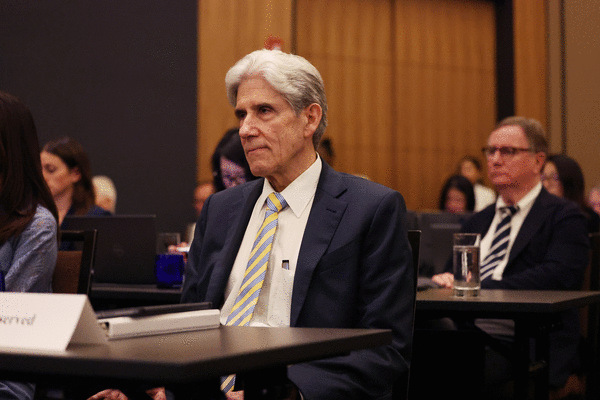
LOS ANGELES — A public message from UCLA Chancellor Julio Frenk distancing the university from a law school 9/11 symposium that included a lawyer for the alleged "mastermind" of the attack has ignited an intensifying outcry among UC faculty and hundreds of academics nationwide over what they see as a high-level infringement on academic freedom.
In letters to Frenk this week, dozens of UCLA School of Law faculty demanded a retraction and called Frenk's statement "not befitting of a leader." More than 200 signatories to a nationwide open letter that included professors at Harvard and Stanford also called for a retraction.
The influential leaders of UCLA's Academic Senate sent a more measured letter to Frenk about their "concerns and reservations," urging administrators and faculty to work together to uphold academic freedom.
The Sept. 10-11 symposium in question examined the legal consequences of the U.S. response to the attacks, including torture, detention and government surveillance. Right-leaning media criticized its inclusion of a Defense Department lawyer who represented alleged 9/11 mastermind Khalid Sheikh Mohammed and a speaker from the Council on American-Islamic Relations, a Muslim civil rights group.
Some members of the Jewish campus community also objected to the program's description of Israel's war in Gaza, launched after the Oct. 7, 2023 Hamas attack, as "genocide." International human rights groups have used the term, but Israel has disputed it, and major American Jewish leaders have said the accusation is antisemitic.
Faculty organizers said the event addressed questions central to the law school's mission, including the rights of defendants and limits on government power.
Frenk issued a statement about the symposium on Sept. 11 saying UCLA did not endorse the event: "We reject antisemitism and terrorism in all their forms and we believe our campus must be a place where the dignity of every member of our community is respected. Nothing about this event at the UCLA School of Law, which we do not endorse, changes or qualifies those commitments."
This week, faculty wrote that his words lent credence to false accusations against the symposium and wrongly suggested that the lawyer or the organizers supported her client's alleged crimes.
Frenk responded to the Academic Senate with his own letter.
He said his statement expressed the university's values and support for UCLA computer science professor Judea Pearl, who objected to the event and whose son was a victim of terrorism. Frenk emphasized the event "proceeded as planned, with its program, speakers and academic content unchanged."
"The key point of my statement is that we can uphold academic freedom while also expressing support for members of our community who are hurting," he wrote.
A dispute over academic freedom
The university dispute is notable because of its high-profile nature, involving top academic leadership at UCLA publicly facing off against their chancellor at one of the nation's top universities. At issue is a principle central to professors' work: the ability to research, teach and examine controversial ideas, including through invited campus speakers, without political or university interference.
The conflict is among many challenges Frenk has faced since taking the helm of the campus in January 2025 — including high-stakes funding battles with the Trump administration amid federal campus investigations, criticism of budget cuts and major shakeups within the athletic department.
Other professors defended Frenk's response.
Harvey K. Rosenbaum, an emeritus clinical professor of anesthesiology at UCLA's medical school, thanked Frenk for his "forthright statement" during public comment at this week's UC regents meetings.
"While academic freedom protects expression of repugnant viewpoints, it does not endorse them, nor does it defend the insensitivity in the conference's timing to those mourning the nearly 3,000 murdered on 9/11," said Rosenbaum, who said he spoke on behalf of the Jewish Faculty Resilience Group at UCLA.
Stanford law professor Orin Kerr also emphasized Frenk's support for Pearl on social media. "The statement seems to then be about how the chancellor respects and supports the UCLA professor, in addition to noting that speaking at UCLA is not endorsement or indifference," Kerr wrote, noting Pearl's objection to the participation of a lawyer who represented Mohammed.
Faculty and scholars object
The UCLA law school letter sent Thursday and signed by 52 faculty members — about one-fifth of the school's faculty count reported to the American Bar Assn. — said Frenk's statement amounted to an "assault on the law school, and what we as faculty, staff, and programs do to advance the academic mission of the university."
The UCLA law school signatories, citing federal investigations of universities, warned that Frenk's statement could expose the school to greater legal jeopardy.
"It is crucial that, at this moment, UCLA's leaders avoid statements that fuel the current assault on the rule of law and aid those who aim to undermine the university," they wrote.
In their Wednesday letter to Frenk, UCLA Academic Senate leaders did not demand a retraction, but said the chancellor's statement has "been interpreted as criticizing the law school event." The leaders emphasized university policy: "The principles of academic freedom protect freedom of inquiry and research, freedom of teaching, and freedom of expression and publication."
In his letter to the Academic Senate, Frenk defended his words, saying he had neither criticized the law school nor questioned the validity of legal representation for people accused of horrific acts.
A UCLA spokesperson directed The Times to Frenk's letter when asked further questions.
"The School of Law symposium operated within the protections of academic freedom and proceeded as planned, with its program, speakers and academic content unchanged," Frenk wrote. He said those protections did not constitute institutional endorsement of every speaker's views.
"Some subsequent accounts have characterized it as a condemnation, rebuke or repudiation of the symposium. A careful read of my statement will fail to find any of those words," he wrote.
UCLA Academic Senate Chair Tim Groeling said in an interview Thursday evening that the exchange required further attention.
"Senate leadership continues to be concerned about the implications of administrators selectively commenting on faculty activities and has asked UCLA's Committee on Academic Freedom to consider the issue," he said.
Speakers prompt criticism
The Washington Free Beacon and New York Post were among the outlets that criticized the symposium. They focused on a featured lawyer, Melanie T. Partow, who worked on Mohammed's case through the Military Commissions Defense Organization. The arm of the Defense Department provides legal counsel for people facing military tribunals.
Event organizers and the law school letter said her remarks focused on military adjudication procedures and made no reference to any particular client.
Among those who objected to the Council on American-Islamic Relations' participation was Pearl. His son, Wall Street Journal reporter Daniel Pearl, was killed in Pakistan in 2002. Mohammed confessed to the killing during a 2007 military hearing.
In comments to The Times last week, Pearl said Partow's participation was less troubling than CAIR's presence, which he called "despicable" and "hurtful." He accused the group of sympathizing with the 9/11 and Oct. 7 attackers, a characterization CAIR disputes.
Law school faculty said Frenk had neither consulted organizers before issuing his statement nor attended the event.
"We call on the chancellor to retract his statement publicly, or, at a minimum, state simply and unequivocally that he never had any basis for believing that this symposium promoted terrorism or antisemitism and never intended to imply that it did," they wrote.
LaToya Baldwin Clark, a UCLA law professor and faculty director of the Critical Race Studies Program, criticized Frenk in a personal statement on social media, separate from the letters. "To suggest that a LAW school should not host LAWYERS that happen to represent defendants, no matter how hated, shows that the Chancellor does not understand what we do here as a law school," she wrote.
Clark's program is one of five formal law school programs and centers that sponsored the 9/11 forum. The others were the International and Comparative Law Program; Institute for Technology, Law and Policy; Miñana Family Center for Immigration Law and Policy; and Promise Institute for Human Rights.
The national open letter, which included more than a dozen signatories from UC Berkeley and UC Irvine law schools, asked Frenk to reaffirm that the law school and its centers could invite speakers on a full range of topics.
"The implication in the chancellor's statement that the conference may have endorsed antisemitism and terrorism is not only inaccurate, but it also compounds the risks faced by lawyers and scholars engaged in work that is key to the functioning of legal institutions," the national letter said.
©2026 Los Angeles Times. Visit at latimes.com. Distributed by Tribune Content Agency, LLC.






Comments