After delay, ICE agent charged with shooting immigrant during Operation Metro Surge appears in court
Published in News & Features
MINNEAPOLIS — Standing handcuffed in an orange jumpsuit behind plexiglass, ICE agent Christian Castro appeared in a Minnesota courtroom Thursday after months of resistance and faced charges that he shot a Venezuelan immigrant during Operation Metro Surge and later lied about it to the FBI.
Castro’s alleged shooting of Julio Cesar Sosa-Celis in north Minneapolis on Jan. 14 created one of the most high-tension moments of the largest immigration enforcement action in the history of the United States. It set off a night of unrest and unleashed statements from Trump administration officials that Sosa-Celis and his roommates had attempted to murder Castro.
As the initial story of the shooting unraveled through video evidence and investigations, Minnesota officials charged Castro in May with four counts of assault and one count of falsely reporting a crime. He would be arrested days later in Texas where Gov. Greg Abbott spent 90 days trying to determine whether to extradite Castro to Minnesota. That led to a historic and ultimately unsuccessful federal lawsuit filed by the state of Minnesota to try and force Abbott to honor the extradition so Castro could face charges.
The issue was never resolved, but more than three months after his initial arrest, Castro appeared in court.
The room was filled with media and observers, including residents who bemoaned the fact that Castro didn’t look into the audience so they could glare at him. Castro’s wife travelled with him from Texas and was there in support of him. She declined to speak to the media, as did his attorney, Daniel Gerdts.
Hennepin County Judge Paul Scoggin said his chief concern in setting bail at $200,000 with conditions — state prosecutors had requested $350,000 — was the flight risk that Castro posed.
“Defendant does not have substantial ties to the state of Minnesota,” Scoggin said. “And the defendant has apparently voiced some interest in fleeing the national jurisdiction.”
Hennepin County prosecutor Joshua Larson argued that Castro made 394 phone calls to a person in Mexico while he was being held in a Texas jail while Abbott investigated Minnesota’s extradition request and that Castro, “discussed his intention to leave the United States, buy a house in Mexico and reside in Mexico.”
Larson also pointed out that Castro had a history of being untruthful, evidenced by the alleged lies he told federal investigators in the wake of the shooting of Sosa-Celis. The state also worried that Castro could try and communicate with other federal agents that were part of Ice Team 14 with Castro, many of whom lived near him and trained with him in Texas.
Gerdts argued that Castro lives on the border and has family in Mexico and did not flee at any time after the shooting took place or after charges were filed against him.
“He could have fled, he choose not to,” Gerdts said of Castro. “He voluntary turned himself into the federal authorities in the southern district of Texas.”
He also said that Castro did not oppose his extradition from Texas to come to Minnesota, but no one offered to have him sign a waiver while he sat in jail. He also said that Castro did not have anything to do with the battle between Abbott and Minnesota officials.
After Scoggin set bail, Castro pre-signed a waiver of extradition that would automatically return him to Minnesota if he were released from custody and arrested again. That signature and Castro’s appearance in court led the state of Minnesota to drop its federal lawsuit against Abbott over the extradition matter.
Castro’s next court date in Hennepin County was set for Nov. 3, but his legal proceedings will be bifurcated.
He was federally indicted by a Texas grand jury earlier this month on six counts of making “materially false statements to the FBI” about his role in the shooting. He is scheduled to appear in federal court in St. Paul on Friday morning to face those charges.
Castro’s state charges include falsely reporting a crime, but focus on his alleged assault for shooting Sosa-Celis and firing near three other people who were inside the home where Sosa-Celis lived. The federal charges against Castro do not include any allegations that he broke the law in shooting Sosa-Celis.
That shooting was one of several boiling points between protestors, local law enforcement and federal agents during Operation Metro Surge. The federal government’s decision to not share evidence or conduct a joint investigation of the shooting of Sosa-Celis and the killings of Renee Good and Alex Pretti also became an unprecedented situation that took months to resolve.
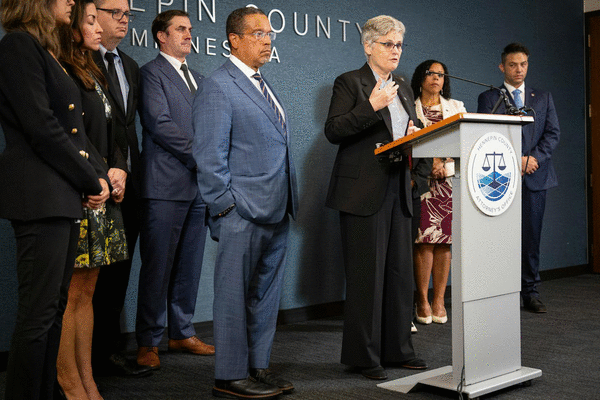
Hennepin County Attorney Mary Moriarty said at a press conference Thursday that his appearance in court was a “critical step in our efforts to hold him accountable for that shooting.” Her office, along with the Minnesota Bureau of Criminal Apprehension and the Minnesota Attorney General’s Office, has led the charge for nearly eight months to investigate the actions of federal agents during the surge for potential criminal charges.
Moriarty said those investigations remain ongoing, including for the killings of Good and Pretti, but no timeline is set on charging decisions.
Attorney General Keith Ellison said while the focus remains on Castro, it was important not to lose sight of the suffering endured by Sosa-Celis, the other people inside his house when the shooting occurred, including children, and “the people of Minneapolis and Minnesota terrorized by Castro and all of Operation Metro Surge.”
------------
©2026 The Minnesota Star Tribune. Visit at startribune.com. Distributed by Tribune Content Agency, LLC.




Comments