Pain, trauma and gratitude: 9/11 remembered by those who were there: 'It's the story of New York'
Published in News & Features
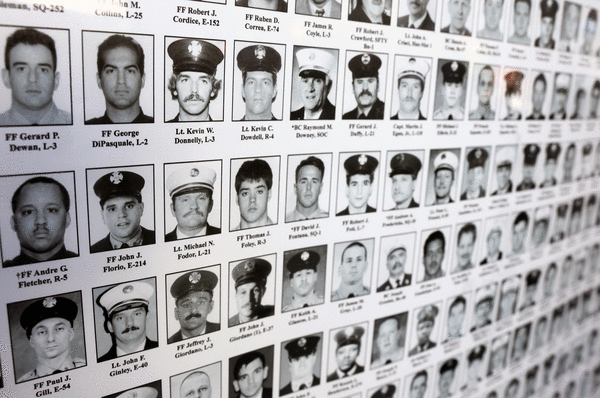
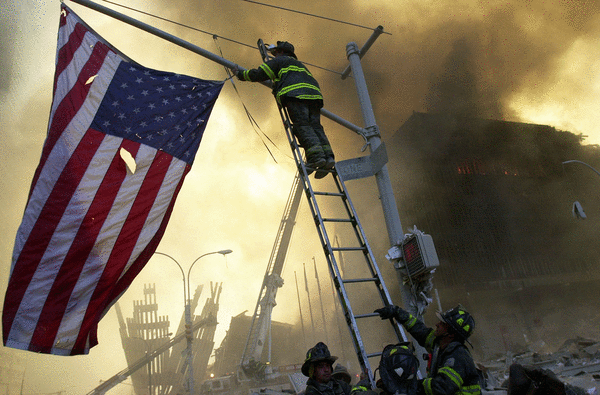
NEW YORK — When terrorists destroyed the World Trade Center, hundreds of thousands of first responders, workers and New York City residents raced to the towers. They bore witness to horror, devastation and heroism.
Their lives were forever altered.
Now, 25 years later, they remember that day and the years that passed with a mix of pain, trauma and profound gratitude as well.
Beauty amid devastation
For NYPD Emergency Service Unit Officers Gregory Welch and Everald Taylor, every day after 9/11 has been a blessing and a curse of sorts — a blessing to be still alive and on the job, and a curse because of those they lost along the way. The pair are just two of the four current ESU members who were working when hijacked planes tore into the World Trade Center and killed nearly 3,000 people, including 14 of their fellow ESU officers.
“I try to live my life one day at a time,” Taylor, 58, said about his approach to life and the job he still loves. “Stop and smell the roses and appreciate what I have no matter how little it is or how big it may be.”
Taylor doesn’t like to dwell on the past. But he can’t forget it, either.
Even now, when he catches a glimpse of the Twin Towers in an old movie or in someone’s photo album, the memories of how the city was changed forever come rushing back.
“Look at how beautiful they were. Look at how long they stood. I just have that wow feeling of how the city used to be.” he said. “That was New York. That was New York City. It’s different now.”
There are few people left in the unit who can tell the stories Welch and Taylor can tell.
Welch tells new members of ESU not to be afraid of fear.
“These young men are just as brave and selfless,” Welch said. “But they’re different. The generation is different. Even though you’re scared, you need to go in and do the right thing because nobody else is going to do it.”
He also tells them to find the joy — a lesson he learned from 9/11.
“What can we take out of 9/11? The best thing was 9/12,” Welch remembered. “We came together, and everybody in the country took up the job of supporting New York.
“It was a beautiful thing to experience,” he recalled. “There were American flags everywhere you looked. I wasn’t alone. The whole city, the whole country was on board. We saw it. And it was amazing.”
Illness and hope
Cheryl Hall, a retired Con Edison worker who helped bring back power to ground zero after the terror attacks, isn’t worrying about the 25th anniversary of 9/11. She’s impatiently waiting for another anniversary — one she’ll reach in 2027.
“Once I reach my five-year mark, I’ll be considered cancer-free,” Hall told the New York Daily News. She was diagnosed with the 9/11-related uterine cancer in 2021 and underwent surgery in 2022.
In 2023, due in part to her efforts, cancers of the uterus were officially added to the ever-evolving list of 9/11 illnesses, and she was among at least 50 women who worked as responders to receive full coverage for past and future treatments.
“I’m just glad that it was caught and it was added,” Hall said. “Maybe I was used so that people can get the help they needed.”
The 61-year-old told the Daily News that since cancers of the uterus were added to the federal list, she has received calls from others diagnosed. “They kinda thanked me. Don’t thank me. I just thank God.”
But she can’t escape the horrors she saw as she worked at ground zero.
“Sometimes I try not to think about it,” she said. “It was very sad. If you watch it on the news, it wasn’t the same as if you were there.”
Radical turned patriot
Harry Pincus, a SoHo artist and self-proclaimed radical and anti-war protester, saw his whole worldview change when jumbo jets slammed into the World Trade Center.
Over the last 25 years, his worldview hasn’t changed back.
“I suddenly realized that the world was an evil place,” Pincus told the Daily News. “I’d once thought that America deserved a comeuppance, but now I realized how much I love this country, in spite of our flaws.”
Pincus was raising two young children and struggling to get by in a gritty artists’ co-op when terrorists destroyed the World Trade Center.
“I had been a student radical, an anti-war protester,” Pincus, 74, recalled. “My next-door neighbor, Tuli Kupferberg, was a founding member of the Fugs, who wrote a famous song about how the CIA killed babies in their beds — and at the time, I agreed with him.”
Today, Pincus knows that America has its problems. But he says he knows something else.
“(But it) is better than the other countries that came here and attacked us and are still a threat to us.”
9/11 scar a badge of honor
For NYPD Chief of Transit Joseph Gulotta, the raised scar across his neck is a constant reminder of 9/11 — and that’s just how he wants it.
Years after the terror attacks, Gulotta was diagnosed with thyroid cancer linked to his time at ground zero. The scar is from the surgery to have the cancer removed.
“I had a doctor tell me once, ‘Hey, I can fix that – I can flatten it out.'” Gulotta said. “No. I said, ‘I want to remember.’ I said, ‘I don’t want that flattened out.'”
“Every time I look at it, I remember the people I lost, I remember friends, I remember that day,” Gulotta added. “It’s not something I want to let go.”
Gulotta, then a sergeant, was home watching cartoons with his toddler son on Sept. 11 when his mother called him, alerting him to the terror attack. He kissed his son goodbye, knowing in that moment there was a chance he’d never see his family again as the sound of military jets screamed overhead.
As the 25th anniversary approaches, he’s reminded not only how 9/11 affected him, but his son as well.
“Even though he was very young, I think it had a profound effect on him,” Gulotta said. “He became fascinated with the World Trade Center as a child, and where the Towers were. He would do sketches of the World Trade Center.”
Today, his son works with the Tunnel To Towers Foundation, the nonprofit that was established to honor a FDNY firefighter killed on Sept. 11 and is now a national charity providing housing and support for the families of deceased and wounded first responders and soldiers.
“He’s come full circle,” Gulotta said.
Fading memories and dusty shoes
Retired NYPD Chief Joseph Fox actually wishes he could recall even more about one of America’s darkest days.
“When something that traumatic happens, I guess your heart and your mind can only absorb so much,” he said. “There’s so much I remember that I’ll never forget, but yet there’s so much I don’t.”
As Fox was talking to the Daily News, a detail came to mind: His work shoes, covered in dust and contaminants from ground zero that he left outside each night when he returned home from the pile.
They’re cleaned up now, and somewhere in his home, he said.
“At some point, I’m gonna find those shoes because I remember saving them,” he said. “There was something about those shoes that just meant so much to me because they walked every step there.”
“I wish I could remember every single step I took, every single person I saw, every single feeling I felt,” he said.
Can’t shake the pain
Rookie police Officer Shaun McGill was the first NYPD cop on the scene on 9/11, and saw some horrible things, including a woman on fire in the lobby of the World Trade Center. But it wasn’t until he retired more than 20 years later that he decided to seek help for the personal and professional trauma he suffered that day.
”I didn’t talk about seeing jumpers and how close I was to dying. I knew I was going to die. I know how I faced it. I faced it with courage. I didn’t give up,” McGill said.
“With the 25th anniversary, it weighs more heavily on you.”
McGill has never suffered a 9/11 illness, but, after going through medical complications amid the COVID pandemic, he called it a career at 53. Still, he can’t shake the anxiety he feels about 9/11.
“When I see a low-flying plane, I’m always thinking, ‘Here we go again,’” he said.
Lives still being taken
For retired city Fire Commissioner Daniel Nigro, 9/11 will always be with him — in the form of a cancer many first responders are still fighting.
“That’s ironically the gift that keeps on giving to the Fire Department, where it just keeps on taking lives,” Nigro said about his 9/11 illness from his home in Queens.
Nigro, 77, was Chief of Operations on Sept. 11, 2001. He was at the FDNY headquarters in downtown Brooklyn when the first plane hit. “Chief Ganci yelled out to me, ‘Look out your window! A plane just hit the World Trade Center!’” he recalled.
“I felt it and I heard it,” Nigro said. He rushed in Ganci’s car across the Brooklyn Bridge toward the Twin Towers. “I said, ‘This’ll be the worst day of our lives’, which proved to be absolutely true.”
Chief Peter J. Ganci died in the attacks. Many friends and colleagues who survived have come down with a 9/11 illness, Nigro said.
“So, I was not surprised when diagnosed at all,” he said.
But so far, he’s doing well. Yet, every August, the memories of 9/11 flood back to him.
“A month before, the emotions start to build,” he said. “Whatever horror and sadness I felt then comes back to me every year and that’ll never go away.”
Remembering the humanity
NYPD Housing Chief Charles McEvoy’s divides his life into two distinct time periods — before 9/11 and after 9/11.
“There’s a lot of things I saw that I do not speak about,” said McEvoy, 58, who was a lieutenant when terrorists struck New York City. “I keep it in mind. I move forward. We mourn who we lost and we keep forward.”
But what sticks with him the most about those dark days was the humanity and the way New York and the nation came together.
Amid the dust and rubble at ground zero, McEvoy remembered running into a childhood friend, the Rev. Joseph Fonti, a Catholic priest with whom McEvoy served decades before as an altar boy. Fonti had also officiated at McEvoy’s wedding.
“We just went over and hugged each other,” he remembered. “Just seeing him there that night was inspiring and uplifting.”
The 25th anniversary of 9/11 is in many ways a full-circle moment for McEvoy, who spent 141 days at ground zero, leaving his wife at home with their 6-month-old daughter.
In a few weeks, his daughter is getting married. Father Fonti, he said, will officiate the wedding.
Never forget
For FDNY Chief John Esposito, the phrase “Never Forget” has carried a little more weight every year since Sept. 11, 2001.
“Twenty-five years is a generation, and I think it’s important that as we get further away from that day — with more and more of the adult population not being born back then — that we don’t lose memory of it,” Esposito explained.
Seven men from Esposito’s firehouse died in the collapse. On Friday, Esposito and his fellow firefighters will visit their gravesites, as they have done every year. They will remain there, together, for 102 minutes, which is the amount of time between the moment the first tower was struck and the time they both collapsed.
Now, 25 years later, Esposito said one of the things that still strikes him was how blue the sky was, recalling its “contrast with the pile of rubble and death and destruction.” The other is the smell, he said.
“Sometimes, you just can’t get it out of your head,” he said. “We get a break from it, but it doesn’t just go away.”
To that end, he and his fellow firefighters want to start promoting school lessons and educational outreach about 9/11 for future generations.
“Remember all those pictures of the towers going down? Our firefighters actually saw that. And they still went in there, and they still did their jobs,” Esposito said.
“I think it’s really important people know that,” he said. “It’s the story of New York.”
_____
©2026 New York Daily News. Visit at nydailynews.com. Distributed by Tribune Content Agency, LLC.




Comments