US-Iran clashes escalate as fears grow of extended conflict
Published in News & Features
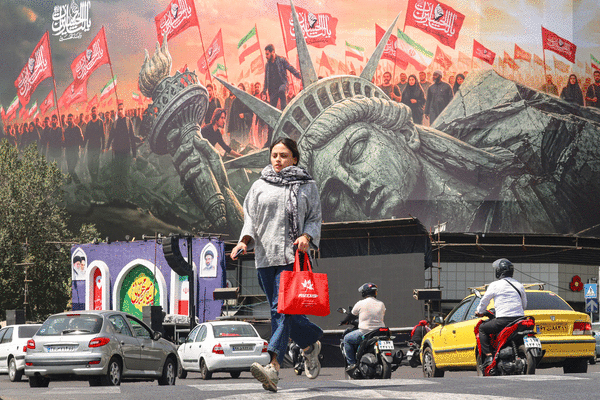
WASHINGTON — Fighting between the U.S. and Iran over control of the Strait of Hormuz intensified after a period of relative calm, triggering a fresh jump in energy prices as fears grow of an open-ended war.
The U.S. military carried out a second round of strikes in three days overnight, targeting radar systems and mine-laying capabilities along Iran’s southern coast. Iran retaliated with drone and missile volleys on U.S. bases across the Middle East, in line with a pattern used throughout the six-month war.
Tehran accused the U.S. of hitting a wedding ceremony in the southern coastal city of Sirik, with the Iranian Red Crescent Society saying at least four people died while about 67 were injured. The organization, which had previously put the number of fatalities at five, said the total may rise.
“The U.S. military never targets civilians,” said U.S. Navy Captain Tim Hawkins, a spokesperson for Centcom, which oversees U.S. forces in the Middle East.
Iranian officials likened the incident to a strike on an elementary school in the city of Minab during the early days of the conflict. That attack killed an estimated 120 children and is under investigation by the U.S. military.
“This cruelty cannot be separated from the chain of atrocities that preceded it in Minab,” Iran’s Foreign Ministry Spokesman Esmail Baghaei said in a post on X. “Iran will respond to these savage crimes with firmness.”
The resumption of hostilities brought an abrupt end to a month of subdued military activity, during which oil shipments through the Strait of Hormuz recovered to roughly half of pre-war levels. The improvement in flows risks being curtailed, affecting supplies of oil, gas and other commodities and boosting energy prices and inflation.
Brent crude rose to near its highest closing level in five weeks, trading at just over $95 a barrel. The international benchmark contract is up around 58% this year, raising fears about the knock-on impact as the northern winter approaches.
Natural gas prices also climbed, while U.S. diesel pump costs rose to their highest since hitting a peak in April during the initial phase of the war.
“Fighting drags on with no end — and no winner — in sight,” Bloomberg economists including Dina Esfandiary said in a note on Wednesday. “The wider Middle East is now an arena for war. And surging oil prices are taxing the global economy.”
Iran’s foreign ministry called on regional countries to stop letting the U.S. use their facilities and territory to carry out attacks. The American strikes hit telecommunication infrastructure in the Islamic Republic, it said.
Neither the U.S. or Iran have shown a willingness to come to the negotiation table since the collapse of an interim peace accord agreed by both sides in Islamabad in June.
Secretary of State Marco Rubio warned the U.S. will continue to target Iran over shipping attacks. U.S. President Donald Trump downplayed the chances of a new agreement on Tuesday, saying in a post on Truth Social that he’s “not trying to force Iran to the bargaining table.”
Centcom said the U.S. strikes followed attempted attacks by the Islamic Revolutionary Guard Corps against commercial shipping in the Strait of Hormuz and against American service members, according to a statement posted on X on Tuesday evening.
Within hours, Iran said its forces had launched a “decisive operation” against U.S. bases in the region, the semi-official Tasnim news agency reported. Tehran claimed attacks on U.S. military facilities in Kuwait, Jordan, Bahrain, Iraq and the United Arab Emirates. The UAE hasn’t commented, while authorities in the other nations said they intercepted incoming fire.
The U.S. military attacked two Iranian tankers under a new “tanker-for-tanker” policy approved by Trump, Axios reported, citing an American official it didn’t name. This came about a day after two oil supertankers attempting to exit the strait were hit in quick succession by projectiles, maritime security consultant Marisks said.
The U.S. had previously been focusing on stopping Iranian vessels from breaking a naval blockade.
U.S. Treasury Secretary Scott Bessent told reporters at the G20 finance ministers’ summit in Asheville that Iran’s leaders were “panicked” over the country’s economic problems and predicted at some point they would be ready to negotiate an accord to end the war.
While Bessent has vowed an “economic onslaught” against Iran and its trading partners, countries with ties to Tehran have so far shrugged off the threat and analysts have been underwhelmed by U.S. actions. The American naval blockade remains in place, however, stifling energy exports from the Islamic Republic.
Fighting is intensifying beyond Iran. Israel has been striking Hezbollah targets in southern Lebanon regularly this week, accusing the Iran-backed group of launching drones at its forces.
Hamas, meanwhile, said an already shaky ceasefire in Gaza risks collapsing after an Israeli raid deep into the Palestinian territory on Tuesday to capture a senior figure from the militant organization.
—With assistance from Eltaf Najafizada, Omar Tamo, Alexander Pearson, Peter Martin and Mike Cohen.
©2026 Bloomberg L.P. Visit bloomberg.com. Distributed by Tribune Content Agency, LLC.





Comments