Lindsay Clancy jury to return to deliberations after reporting impasse
Published in News & Features
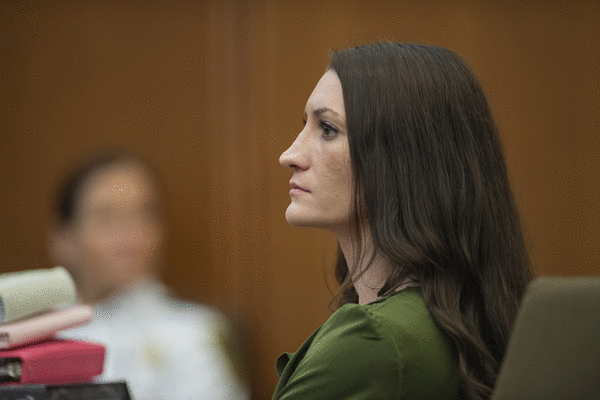
PLYMOUTH, Mass. — Jurors in the Lindsay Clancy trial asked to be sent home early Tuesday afternoon, after telling the judge they were deadlocked earlier in the day.
“After many hours of deliberations, we are unable to come to a unanimous decision,” jurors wrote in a note around 10:15 a.m.
There was a quiet gasp from people in the audience when Judge William Sullivan read the note aloud.
“I know this was a long trial,” Sullivan told the jury, mentioning the more than 80 witnesses and hundreds of exhibits in the case. “Because of that I am going to ask you to go back out, keeping in mind all the instructions that I gave you.”
Clancy was charged with three counts of first-degree murder for the deaths of her children, Cora, 5, Dawson, 3, and Callan, eight months, in January 2023. The Duxbury mom doesn’t dispute that she killed the children, instead, her attorney Kevin Reddington argued that she was suffering from postpartum psychosis at the time and can’t be held criminally responsible.
To convict Clancy of any crime, the jury has to find beyond a reasonable doubt that she was criminally responsible. The judge instructed on what the prosecution had to prove and the elements of first- and second-degree murder and manslaughter.
“My fallible prediction is that it is too early for a mistrial due to deadlock but that could change fast,” retired Judge Jack Lu told the Herald after the note was read in court, saying that the jury’s decision to voice an impasse now “speaks to the deeply emotional and controversial nature of this case.”
“‘Deadlock’ is a legal term, and a legal determination made by the judge not the jury,” he noted.
Sullivan has not yet given the Tuey-Rodriguez charge, a special instruction for when jurors can’t agree. After the judge decides to read it, he’s limited in how many times he can send the jury back to deliberate without their consent.
The jury didn’t come back with any more notes or questions for the rest of the day. Reporters camped out in the hallway, working on advance stories, preparing themselves for any sort of decision to come.
At one point, a priest who has been visiting Clancy arrived at the courthouse. A former coworker of Clancy’s, Margaret Hamp, who testified for the defense, also went into the courtroom in the afternoon.
“Lindsay loved being a nurse. She was really good at being a nurse, she was kind, she was passionate,” Hamp said of Clancy on the stand. “The kind of nurse you wanted to take care of you.”
Judge Sullivan called the jury back in around 3:30 p.m. Usually, they have been deliberating until about 4 p.m.
Plymouth County District Attorney Tim Cruz was present in the courtroom when the 12 deliberating jurors and six alternates came back in.
“My understanding is that you asked to be excused until tomorrow, 9 o’clock,” Sullivan said.
The judge thanked them for their hard work and commitment in this trial and sent them home. By the end of Tuesday, jurors had deliberated for about 23 hours.
Outside the courthouse, Reddington took questions during a particularly crowded and aggressive scrum.
When a few reporters crushed in the middle asked if everyone could take a step back, another person in the back yelled out, “Get a new job.”
Reddington was asked to turn this way, then that way, while answering questions and people with microphones and cameras jostled with each other to pickup what he had to say and keep him in their shots.
“The fact that they’ve said they’re not done is very heartening,” Reddington said of the jury. “They stayed at it, they kept at it… They spent another three or four hours trying to come to a decision.”
Reddington wouldn’t say what he and his client talked about during the day but reported that Clancy had a “flat affect,” and was “sad.”
“Do you think your client is emotionally prepared to do it again?” one reporter asked Reddington, and he replied, “No.”
Reddington and doctors who took the stand for both the defense and prosecution have said that Clancy is suicidal.
Another reporter asked if Clancy would ever plead to manslaughter or a lesser charge.
“You should ask Mr. Cruz that,” Reddington said, referring to the District Attorney. “It’s entirely up to the DA.”
Reddington noted that first-degree murder cases cannot be tried without a jury in Massachusetts, and the decision not to bring the charges down to second degree, to allow for a bench trial, is all up to Cruz.
If there’s a second trial, the defense attorney said he wasn’t sure what he would do differently.
“I’ll think about it,” he said.
Still, Reddington said he sees a way for the jury to come to a consensus in the case.
“I hope so,” he said of a potential jury verdict. “Then, we’d have closure.”
_____
©2026 MediaNews Group, Inc. Visit at bostonherald.com. Distributed by Tribune Content Agency, LLC.





Comments