The high-risk strategy in Tupac Shakur case: Defense says client is full of BS
Published in News & Features
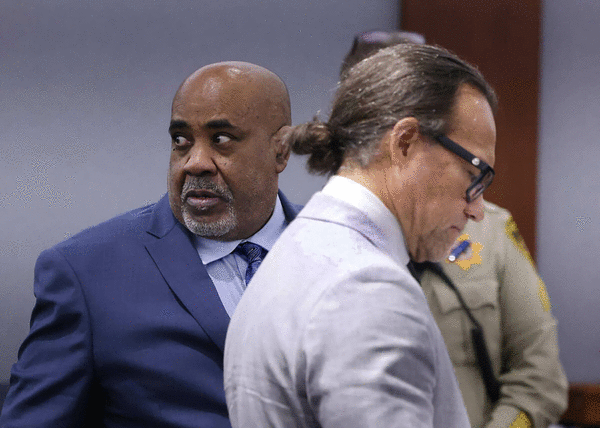
Michael Sanft, the attorney for the man on trial for allegedly orchestrating the murder of Tupac Shakur, finds himself in a position out of a “Law and Order” episode.
He must convince a jury to ignore incriminating statements his client made. With every word he speaks, Sanft argues that Duane Davis is a liar who cannot be trusted.
It started during opening arguments, when Sanft flashed the word “bulls—” on the screen for jurors, referring not to the prosecutors but to Davis himself. And it will continue as the Las Vegas trial comes to a close Monday.
Legal experts call it a novel tactic, but perhaps the best shot at getting the jurors to ignore numerous statements in police interviews and a documentary they heard in Davis’ own words.
There is actually a term of art for this kind of defense challenge: puffing, or claiming a criminal case is based on the client’s exaggerations.
“When your client submits to two police interviews and publishes a book making damaging admissions, he is either a liar or guilty; pick your poison,” said Glen Jonas, a defense attorney for high-profile clients. “It is about establishing reasonable doubt with what you have to work with within the confines of the truth.”
“Puffing” can be an effective tool when the prosecution’s case relies heavily on the defendant’s words rather than clear physical evidence or scientific evidence, Jonas said.
“It is very unusual for a defense attorney to argue that their client is a liar,” said Lou Shapiro, a Los Angeles defense attorney. “But sometimes the facts and circumstances call for it.”
Davis has been the star witness for Nevada prosecutors, who devoted large portions of their case to simply recounting things the murder suspect has said about the 1996 killing of the rap star during a drive-by shooting just off the Las Vegas Strip.
Davis has spoken extensively about his role in the case, including in interviews with Los Angeles police and the media, in a 2019 tell-all book and during several bragging interviews done to promote the publication.
In his memoir “Compton Street Legend,” Davis said he and his crew were in Vegas with plans to watch Mike Tyson fight Bruce Seldon. They learned that Davis’ nephew Orlando “Baby Lane” Anderson had been jumped by members of Marion “Suge” Knight’s Death Row Records camp while walking in the lobby of the MGM Grand.
Davis said he and his crew set out in search of Knight and Shakur. Davis wrote in the book that he tossed the gun he’d been given into the back seat of the white Cadillac in which Anderson and Deandrae “Dre” Smith sat. They spotted the Death Row caravan stopped at a red light, with Shakur waving to fans while hanging out of the BMW window.
“Tupac made an erratic move and began to reach down beneath the seat ... and that’s when the fireworks started. One of my guys from the back seat grabbed the Glock and started bustin’ back,” Davis wrote.
Jurors heard more than eight hours of interviews, including a 2008 LAPD federal task force recording. In them, Davis bragged about being in the Cadillac and said that, because he was on the far side as the front passenger, he handed the .40-caliber Glock to Anderson and Smith in the back seat as Terrence “Bubble Up” Brown drove.
“So, Orlando shot him across Dre?” an LAPD detective asked Davis.
“He leaned over on the window; he rolled down the window, popped,” Davis answered, saying he looked Knight in the eye as Shakur scrambled into the back seat.
The motive, he said, was revenge for the beatdown on his nephew at MGM. He isn’t believed to be the trigger man, but under Nevada law, helping to commit a murder is enough, prosecutors say.
“I’ve never seen a case where the prosecution wants to build up the defendant while the defense is trying to tear him down,’ said Neama Rahmani, a former federal prosecutor. “The prosecution is arguing that Davis was the shot caller and mastermind of a criminal enterprise. The defense is arguing that Davis was a lying BSer who is ‘full of crap.’”
The prosecution rested its case after 25 witnesses and several days of playing recordings. The defense called three witnesses, focusing on two main strategies.
One is to argue Davis was bragging to make himself seem important and cannot be believed. Davis has been speaking out about the killing for nearly two decades.
He broke his silence in 2008, when an LAPD federal task force investigating the 1997 murder in L.A. of Christopher Wallace, a.k.a. Biggie Smalls, questioned him, informing him they had him selling enough PCP to put him away for life along with some of his relatives. They let him do a proffer as a means to a lighter sentence as they pursued a racketeering case against the rap enterprises.
On Thursday, Sanft got a retired Las Vegas Metropolitan Police officer to testify that he interviewed Davis in 2009 after the LAPD arranged a meeting, and prosecutors opted not to charge him.
It was only in 2023 that Las Vegas prosecutors filed murder charges against him.
The second defense strategy is to question what other evidence the prosecution actually has besides Davis’ words.
Sanft called a retired Las Vegas Metro homicide detective to acknowledge there was no DNA, no forensics or eyewitness accounts, and he never got anyone else to say Davis was in the Cadillac besides Davis himself.
In Nevada, jurors can ask questions, and so the defense closed on it.
“Were you able to verify and confirm Mr. Davis was actually in the white Cadillac the night of Tupac’s murder?” a juror asked.
Retired Det. Dan Long replied, “By Mr. Davis telling me that he was in the white Cadillac on the night of the murder and that the shooting came from that same white Cadillac.”
The judge asked if Sanft had a follow-up question, and he asked, “Are there no actual facts outside what Mr. Davis told you?”
“No,” the detective replied.
Rahmani said this line of inquiry could bear fruit with the jury. He noted the prosecution hasn’t been able to corroborate Davis’ confessions with independent evidence — and the lone survivor in the two cars, then-Death Row records boss Knight, who was driving the BMW and seated next to Shakur, isn’t testifying.
“It is tough to prosecute a 30-year-old cold case based almost entirely on the defendant’s confession,” he said.
In the end, it might come down to how much the jury believes Davis before he became a murder defendant.
“Normally a defense lawyer does not want to tell a jury that his own client is a liar and destroy the client’s credibility. But in the Duane Davis case,” that might be the best strategy,” said Dmitry Gorin, a former Los Angeles County prosecutor.
If jurors are not willing to convict on Davis’ words alone, then the physical evidence — or lack of it — will be key.
“It needs one juror to vote not guilty to have a hung jury.”
©2026 Los Angeles Times. Visit at latimes.com. Distributed by Tribune Content Agency, LLC.


Comments