Central Florida's Dreamers lose Obama-era protections, then lose their jobs
Published in News & Features
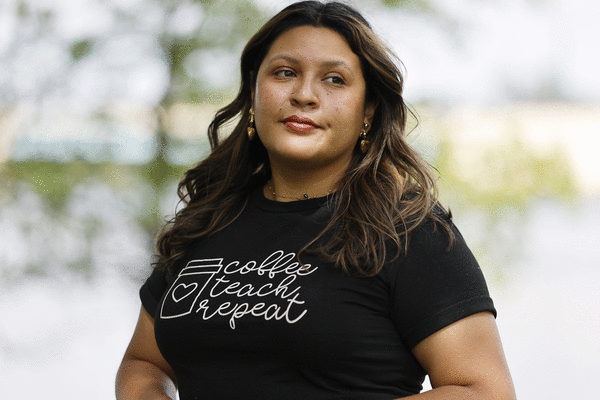
Lucas Da Silva was born in Brazil but came to the United States as a baby. His first language was English. He speaks Portuguese but only at home with his family. He’d like to visit his native country — but doesn’t want to move back for good.
“That’s like moving to a foreign country, like I don’t really know Brazil,” he said. “I’m as American as apple pie, as American as the American flag on July 4.”
But Da Silva, a 37-year-old Orlando resident, is not a U.S. citizen. And the benefits he had under an Obama-era program — one that protected him from deportation and allowed him to legally work — lapsed in December amid the Trump administration’s immigration crackdown.
He lost his job working in communications for nonprofits and now gets by with help from family, bi-weekly trips to the food bank and “living on a prayer, to quote Bon Jovi.”
Da Silva is a so-called Dreamer, an immigrant brought into the country illegally as a child and part of a group long considered among the most sympathetic of the country’s non-citizen residents.
Under a program President Barack Obama created as a way to help young people who are now “Americans in their heart,” he was able to obtain a work permit, get a Florida driver’s license and live free of the fear of deportation as long as he went to school, worked and avoided run-ins with the law.
As of September, there were more than 500,000 active recipients of the Deferred Action for Childhood Arrivals, according to the U.S. Citizenship and Immigration Services. Those DACA recipients must submit a renewal application every two years to retain those protections, and that process has now tripped up Da Silva and others.
DACA renewals used to take 30 to 60 days, with the new approval regularly coming before the old one lapsed. Now, the renewal process is taking six months or more, leaving Da Silva and perhaps thousands of others nationwide suddenly without legal standing — or fearing they will soon be — in the only country many of them know.
While there is no clear accounting of the number of Dreamers at risk, many in Central Florida and elsewhere are losing jobs and worrying about eventual deportation.
“This is where my life is, and all I want is to be able to live and work, and in the place that I call home,” said Da Silva, who was raised in New York before moving to Florida at age 13.
Once their DACA status lapses, recipients could be viewed as unlawfully present in the country, a potential barrier to applying for a “permanent form of immigration relief,” said Ignacia Rodriguez Kmec, the policy counsel at the National Immigration Law Center.
“There are serious consequences to even a one-day lapse in their DACA status,” she said.
Da Silva has been waiting since November for his renewal to be approved.
“I just feel exhausted, feel fatigued that you’re dealing with this for so long and I just feel hopeless,” he said. “My whole life has been haunted by this immigration issue…We got DACA, which was a hard-fought battle to get, and now here we are and it feels like we took 30 steps back.”
Melani Candia’s DACA status lapsed March 26, despite a pending renewal application submitted four months ago.
Candia, 32, who was born in Bolivia and came to the U.S. at age 6, has been a teacher in Central Florida for seven years, working for Orange County Public Schools and more recently for a local tutoring center.
She lost that job when her DACA protections ended. As the date of her DACA expiration crept up, Candia said she tried to prepare her students.
“The hardest part was for the kids that I work with,” she said. “It was them understanding ‘Wait, what do you mean you’re just not going to be here and you don’t know when you’re coming back,'” Candia said. “It was really hard to tell them.”
She and her husband, a U.S. citizen who works as a handyman, are getting by on his pay and on savings, though that isn’t a long-term solution. “Thankfully he has a good job that’s able to, kind of, hold us up for a little bit,” she said.
The couple are hoping she can get a green card, but the process takes years and she is fearful of getting deported before it’s complete, she said.
“How long and what do we have to do for us to finally get some permanency?” she said.
DACA was created by Obama when Congress did not pass immigration reform laws that would have permanently protected immigrants who came as children. His goal was to help those same young people.
“Imagine you’ve done everything right your entire life — studied hard, worked hard, maybe even graduated at the top of your class — only to suddenly face the threat of deportation to a country that you know nothing about, with a language that you may not even speak,” Obama said during a 2012 announcement about the new program.
Even President-elect Donald Trump bought that argument, saying in December 2024 that “we have to do something about the Dreamers” and blaming Democrats for failure to create sturdier protections.
DACA initially was meant to be a stopgap measure to allow for further, more permanent, immigration reform. But since then, no legislation has given DACA recipients a path to citizenship.
Congressman Darren Soto, a Democrat who represents Orange and Osceola counties, said his office is now hearing from DACA recipients who want help expediting their renewal applications. Twelve have come in in the last month, he said, but only one has been approved.
“I believe it’s intentional that they are slow rolling these applications because they don’t believe in the program,” Soto said.
But U.S. immigration authorities say they are right to carefully review DACA renewal applications.
The agency “is safeguarding the American people by more thoroughly screening and vetting all aliens, which can lengthen processing times,” said Matthew J. Tragesser, a spokesman for U.S. immigration services.
Whether DACA recipients caught in such delays now risk imminent deportation is murky.
In the first 11 months of the second Trump administration, 86 DACA recipients were deported by ICE, former Secretary of Homeland Security Kristi Noem said in a Feb. 11 letter to Congress. In total, 261 program beneficiaries have been detained by ICE, she said. But Noem did not address how those DACA recipients were selected for arrest and deportation, saying only that 241 of the arrestees had “criminal histories.”
The federal government is also now processing only DACA renewals, having stopped accepting new requests in 2021 following a court ruling that determined the program violated federal immigration law.
Critics argue that DACA encourages illegal immigration and that the program is an example of presidential overreach as it was created by Obama without congressional approval.
“Congress gets to decide the terms of who comes into the United States. The president simply can’t decide that,” said Ira Mehlman, a spokesperson for the Federation for American Immigration Reform, a national group that advocates for stricter immigration laws.
Mehlman said Dreamers who are already in the country should self-deport and apply to come to the U.S. through the legal immigration process.
“The only way to change that sort of behavior is to make it clear that ‘No, you’re not going to benefit. Your children aren’t going to benefit from breaking our laws,’” he said.
Orlando’s parents brought him to the U.S. from Venezuela when he was just one year old, hoping to give him a better education and future – and they “didn’t fail,” his mother said, speaking in Spanish.
Orlando, 25, went to high school in Central Florida and is a graduate of Seminole State College. He worked as a firefighter and paramedic for a department in Orange County for three years.
Orlando asked that his name and the name of the department he worked for not be included to avoid unwanted attention from immigration authorities, and his mother, who is undocumented, asked not to be named.
“I put a lot of time and effort to get where I’m at,” he said.
Last week, his DACA status expired and he lost his job, though his fire department’s chief sent a letter pleading with immigration authorities that Orlando’s work permit be renewed.
He’ll be relying on savings and hoping his DACA renewal application, pending since October, is approved soon. His fire department salary helped support his parents and a younger brother.
Now, he said, things will be “harder for everyone.”
New Florida laws make life even more difficult for some DACA recipients, “adding insult to injury,” said Gaby Pacheco, the president and CEO of TheDream.US, a program that provides scholarships for undocumented students.
The organization cut ties with four of Florida’s public universities – Florida Atlantic University, Florida International University, the University of Central Florida and the University of South Florida – last year after state lawmakers ended a policy allowing undocumented students to pay in-state tuition rates and required campus police to participate in an ICE training program.
“It became clear that our scholars would not only face financial exclusion but also potential risk to their safety and well-being on the very campuses meant to support them,” Pacheco said.
Alexander Vallejos, a computer science major, is still a UCF student. He lost his scholarship from TheDream.US but decided not to transfer to another school because he’d have to retake too many classes.
He has four more classes to complete, which now cost $5,000 each, so he can only afford to take one at a time, charging them to a credit card. Because he is a part-time student, he does not qualify for most other scholarships as they require full-time enrollment.
An Argentinian native who came to the U.S. as a baby, he hopes one day to work as a software engineer. His DACA status is valid until September 2027 but he knows that could be a challenge next year.
Though he is determined to earn his degree, feeling hopeful about his future is hard.
“It’s more than Trump, it’s the system,” he said.
_____
©2026 Orlando Sentinel. Visit orlandosentinel.com. Distributed by Tribune Content Agency, LLC.






Comments