Funding, false promises were part of Haiti president Jovenel Moïse's killing
Published in News & Features
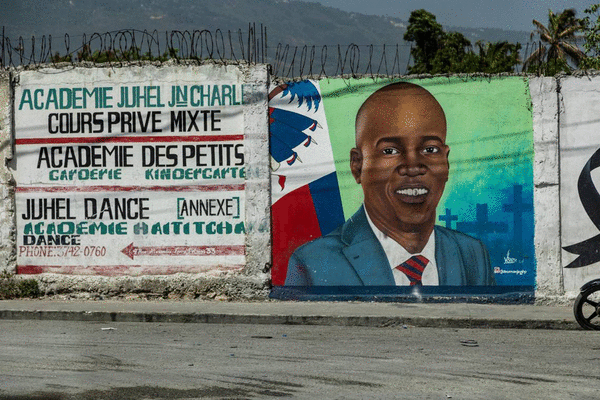
Haitian businessman Rodolphe “Dodof” Jaar provided more than $150,000 in cash and material support — including housing and semi-automatic weapons — to back the plot that ultimately led to the assassination of his country’s president, Jovenel Moïse, he told a Miami federal jury.
That support included $110,000 in bribes paid to members of the presidential security team — $80,000 to the General Security Unit of the National Palace and $30,000 to the Counter Assault Team — who were responsible for protecting Moïse on the night a squad of Colombian commandos stormed his residence in the hills above Port-au-Prince.
The full sums had not been previously disclosed. They emerged this week as Jaar, a convicted cocaine trafficker who has pleaded guilty in the conspiracy to kill and kidnap Moïse more than four years ago, testified about how he became involved in the scheme that ultimately ended with the 53-year-old head of state shot multiple times in his bedroom and his wife wounded.
Four South Florida men are on trial in federal court in Miami.
“When they contacted me,” Jaar said about the defendants in the case, “they never told me that they were going to kill him.”
Instead, he said he was led to believe that his support would grant him access to the United States and a new Haitian government expected to take power upon Moïse’s removal. He also believed it would offer him protection from Haitian gangs for his import-export business.
Jaar testified that he supplied at least four guns to the group of 20 former Colombian soldiers, who gathered at his mother’s house in Laboule on the night of July 6, 2021 hours before the middle-of-the-night July 7 attack. The sprawling mountaintop house was a 10-minute drive from the president’s residence, he said.
The weapons he provided included an AR-15 and a rifle he had purchased in the United States about 30 years earlier.
According to another government witness, Mario Antonio “Floro” Palacios Palacios, the AR-15 was given to members of a “Delta team” tasked with entering Moïse’s bedroom and killing him. A retired Colombian special forces soldier, Palacios was a member of the five-man team, trained in going after high-value targets.
Assassination plot
Both Palacios, 47, and Jaar have testified that they learned at the last minute of the mission to kill Moïse. Each of them identified James Solages, a Haitian-American handyman and one of the defendants in the Miami case, as a leader of the group in Haiti. Palacios described him as “the boss” who gave the command to go to the president’s house.
“Initially, the job was going to be done by an armed group in Haiti,” he said. “But they were not answering their phones, so they gave us the order. We had to do the job they were going to be doing.”
Asked to clarify, Palacios said through a translator: “The job was to assassinate the president of Haiti.”
Palacios and Jaar are among 11 people charged by the U.S. Department of Justice in the assassination plot. Palacios, Jaar and three others have pleaded guilty to the main conspiracy charge and face life sentences. A sixth defendant pleaded guilty to a lesser charge of smuggling ballistic vests to the Colombian commandos hired by Doral-based Counter Terrorist Unit Security, CTU, to execute the hit job, according to court records.
Three of the four men now on trial, including Solages, worked for CTU; the fourth, a Weston mortgage broker, is accused of financing the plot through a line of credit.
The defendants include Solages, who served as CTU’s representative in Port-au-Prince and brought onboard a Haiti-born doctor and pastor who hoped to replace Moïse as president; Arcángel Pretel Ortiz, a Colombian national and former FBI informant; Antonio “Tony” Intriago, the Venezuelan-American owner of CTU along with Pretel, who ran CTU Federal Academy, and Walter Veintemilla, an Ecuadorian American accused of helping finance the plan.
The doctor, Christian Emmanuel Sanon, is also charged in the Miami case but due to health reasons he will be tried separately.
By the time Jaar joined the plot, Sanon had already been replaced by the group as Moïse’s prospective successor. The role had shifted to Windelle Coq Thélot, a Haitian Superior Court judge and close associate of Joseph Félix Badio, a former Haitian government official who has not been charged in the U.S. case but continues to emerge as a central figure in testimony.
$300,000 for the plot
The testimony by Palacios, who had escaped to Jamaica, and Jaar in week six of the trial has helped prosecutors trace for the jury how the plot evolved from a plan to kidnap Moïse into a mission to kill him, with some participants saying they were misled about their roles.
“They told me they were going to arrest the president,” Jaar testified. He said he was first approached in late May or early June 2021 by Badio, who portrayed himself as someone able to solve his U.S. immigration troubles stemming from his 51-month U.S. prison sentence for a 2013 cocaine trafficking conviction.
“He requested about $300,000,” Jaar said.
When he said he did not have that amount, Badio asked for $10,000, Jaar testified. The money was to help cover a $20,000 ammunition purchase from the Dominican Republic, he said under cross-examination.
After agreeing to get involved, Jaar said he was introduced to the “Americans,” who he was told had come to support the coup against Moïse and were ready to invest “billions of dollars” in projects in Haiti.
It was then that he met Solages, whom Jaar said was “introduced as a representative of the American government.” He also met Joseph Vincent, who was introduced as a representative of the State Department. Vincent, a Haitian American, has pleaded guilty to the main conspiracy.
Prosecutors have said that neither man, or any of the others involved, worked for the U.S. government.
Jaar acknowledged during his two days on the witness stand that he was deceived, particularly by Solages and Badio, who boasted about connections to senior Haitian officials including the police chief and Ariel Henry, whom Moïse had quietly tapped as his next prime minister about a month before his death. Henry, like former Haitian police chief Leon Charles, has denied any involvement in the plot.
Under questioning by one of Solages’s defense lawyers, Jaar acknowledged Badio’s claims of high-level connections.
“You would agree he’s pretty connected with the government in Haiti?” attorney Jonathan Friedman asked about Badio, who claimed he had a mole inside the president’s residence to inform him on his whereabouts and a deal with the head of his presidential security guards, Dimitri Hérard.
“He knows a lot of people; he knew Supreme Court Justice Coq, correct? He had connections with the Haitian national police, correct? He had connections with the president’s private security force and his personal residence, and connections with Jovenel Moïse’s personal drivers,” Friedman continued. “He obviously didn’t like Jovenel Moïse very much.”
Jaar responded, “I don’t know.”
‘Never in agreement’
Defense lawyers have argued that Moïse was already dead by the time the Colombian commandos left Jaar’s house, and that he had been killed by members of his own security detail.
Jaar testified that after the killing, he was asked by Pretel and a Colombian squad leader, retired army officer Germán Alejandro Rivera García, to contact the international media and say “they had nothing to do with the president’s assassination and when they arrived, he was already dead.”
“I was never in agreement with that, nor did I ever want to do that,” Jaar said when questioned by Assistant U.S. Attorney Altanese Phenelus. “Because it wasn’t the truth.”
As the seven-car convoy left his mother’s house, Jaar testified, he stayed behind along with former Haitian Sen. Joseph Joël John, who wrapped up his testimony on behalf of the government on Monday.
In the hours after the killing, Jaar said Badio stopped answering his phone. This left him as an intermediary between CTU and Badio who refused requests to bring Justice Coq Thélot to the presidential palace to be sworn in.
Jaar also testified that he contributed additional resources to the plot, including firearms valued at about $20,000; as much as $2,000 in medical supplies and another $16,000 to purchase weapons. Though he comes from a prominent Haitian family and the defense painted him as a privileged member of Haiti’s elite families, Jaar’s reputation in Haiti was that of a struggling businessman, which has long raised questions about where he acquired money for the plot.
Asked whether he believed the U.S. would need his financial support for such an operation, Jaar replied: “I didn’t think that the American government needed money.” But, he said, he was told the group would gain access to weapons and other resources only after Justice Coq Thélot assumed power.
That, he said, would be one of several lies he was told.
Another came on the night of July 6, when Solages told the assembled Colombians there had been “a change in the operation” and that it was now a CIA operation.
“I was shocked, and I asked him, ‘What does that mean?’ ” Jaar said. “He replied, ‘We will go in, kill the president, then we would leave.”
Friedman, Solages’ attorney, questioned his recollection because it was not the same information that John, the former senator, testified to.
“Isn’t it true If Mr. Solages said anything, ‘It was one entrance, one exit?’ That’s what he said,” Friedman said, to which Jaar responded, “I do not recall that”
He also pushed back during Friedman’s questioning that he had discussed with Solages a number of high-profile Haitians, including former President Michel Martelly, being involved in drug trafficking and money laundering. “No, never,” said Jaar.
Lies, tears and an apology
Testimony from multiple witnesses suggested that many of those involved were misled — and, at times, misled one another.
For example, Jaar acknowledged that an interview he gave to the New York Times while in hiding in Haiti was arranged by someone named “Austin” whom he thought was an FBI agent. It turned out, he later learned, that the man was not a federal agent.
Palacios, meanwhile, described being offered a security job in a Central American country that turned out to be Haiti. He also spoke of waiting weeks for weapons that never arrived and being promised a $2,500 monthly salary and a $300,000 bonus that were never paid. He said the men were initially told they would guard Sanon, and were given only two shotguns to do so. They were not told they would be carrying out an attack.
“They told us that a gang from Haiti was going to go to the president’s house, and then we would arrive at the house to search for videos and computers,” he testified.
“Supposedly the president would rape children in that house and he sold organs. They needed that evidence,” Palacios said about what he said was relayed by another squad leader, Duberney Capador, one of three Colombians who died after the attack.
The men had also said that Moïse was no longer legally president as of Feb. 7, 2021, but had wanted to stay in power.
“We had no other way out,” Palacios said. “We accepted, we agreed to go on that mission, something that we did not go over there for, and perhaps we failed. We failed maybe because of ambition, because we were told that there ... we were going to be given $300,000 each one of us.”
At the start of his testimony Palacios broke down in tears as he acknowledged that he agreed to cooperate in hopes of getting a reduced sentence.
“I did not travel to that country to do anything wrong,” he said. “While I was there, I agreed to participate in this. What happened there does not represent me as a person for that reason I have agreed to tell the truth because I am not a criminal, and I am very sorry for what happened over there.”
_____
©2026 Miami Herald. Visit miamiherald.com. Distributed by Tribune Content Agency, LLC.



Comments