Vance hits rough patch as Iran talks falter, Orbán goes down in Hungary
Published in News & Features
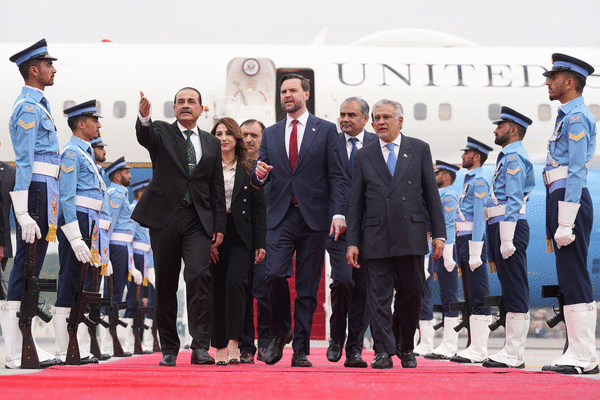
WASHINGTON — President Donald Trump might have declared Vice President JD Vance did a “good job” in weekend talks that did not produce a peace pact with Iran, but there are scant signs his recent high-profile international setbacks improved his political prospects to be the next commander-in-chief.
The lack of a deal with the Islamic Republic government officials came before Hungarian Prime Minister Viktor Orbán on Sunday conceded defeat in that country’s election. Vance had campaigned with Orbán last week, appearing behind a podium ordained with the vice presidential seal.
As Trump’s No. 2 addressed reporters in Islamabad after the 21-hour negotiations with senior Iranian officials, another former senator and possible front-runner for the 2028 GOP presidential nomination, Secretary of State Marco Rubio, was at an ultimate fighting event alongside the president in Miami.
On Capitol Hill, House and Senate Democrats already have tried using the Islamabad talks to tie Vance to Trump’s escalating conflict, mentioning him by name in connection with the failed talks as they seek war powers votes that could curtail Trump’s war-making powers.
“Republicans were calling for hearings on a peace agreement that JD Vance failed to deliver but are now silent on holding hearings on this costly and extended conflict,” California Democratic Sen. Adam B. Schiff said in a Monday statement.
Trump did not directly address a question Monday about deploying Vance, a former Ohio GOP senator with no track record of brokering major deals, if another round of talks is scheduled.
Republican strategist Ford O’Connell said Vance’s role in the talks were “quality exposure” for Vance. And Democratic attacks could backfire because “seeing Vance on the world stage gave him some gravitas.”
“The person who’s going to be the Republican Party’s nominee is going to be Donald Trump’s pick. And whether it’s the war or this or that, Vance is doing what President Trump wants him to do,” O’Connell said. “The 21-hour talks were good for Vance, overall, because he’s out there on the world stage and everyone knew the Iranians would move the goalposts and we’d have more discussions later on.”
But Republican strategist Rick Tyler compared the negotiations to more successful foreign policy summits.
“When it came time to prove he could deliver, Vance gave us a mere 21 hours of drive-by diplomacy that produced no agreement,” Tyler said. “By the standards of Dayton, Camp David, Good Friday, or Oslo, it was a reminder that visibility is not the same as results.”
And Vance is “beginning to look like a neo-convert from his earlier no-more-dumb-wars, ‘America First’ persona,” Tyler said.
“The vice president came home with three losses: Orbán’s defeat, no Iran deal and his own ability to stand on the world stage and be taken seriously lessened — including among Republicans who once saw him as a corrective to the GOP’s old foreign-policy failures,” Tyler said.
There also is the Trump factor. The president still has high poll numbers among GOP voters, including a 95 percent approval rating from respondents to a YouGov-The Economist poll conducted April 10-13 identifying as part of the “Make America Great Again” movement. The MAGA base will play a major role in selecting the party’s 2028 nominee.
A YouGov survey of Republicans and independents who lean right conducted April 8-13 found 63% would prefer Vance as the party’s nominee, with 42% picking Rubio. The secretary of State gained 3 percentage points since a January incarnation of the same survey, when Vance garnered 66% and the former Florida senator got 39%.
“Trump realizes what he wants is the ticket of these two, with Vance on the top of the ticket and Rubio as his running mate. And this is still the era of Donald Trump,” O’Connell said.
Recent polling has shown Vance losing ground with GOP voters. For instance, the VP won last month’s straw poll at the Conservative Political Action Conference, with 53% of respondents fingering him as their preferred 2028 nominee. But that was down from the 61% Vance secured in winning the same survey last year.
Rubio garnered 35% of respondents in the same straw poll last month, up significantly from the 3% he garnered in 2025.
Kyle Kondik, an analyst at the University of Virginia’s Center for Politics, said he didn’t know if Vance’s stock is falling, “but anyone who works for Trump is inherently in an unstable position.”
“You’re in his good graces up until the point you are not,” Kondik said.
GOP strategist Doug Heye said in a Monday email that “there’s too much ‘JD vs. Marco’ speculation, especially before the primary.”
“On Iran, we just have to wait and see,” Heye added. “On Hungary, it doesn’t matter one ounce. No Republican voter is going to care or think Vance had anything to do with Orbán’s lopsided loss.”
‘Done a good job’
So far, the U.S. commander in chief has not issued any public criticism over how Vance handled the Saturday negotiations, in which he was backed up by White House Middle East envoy Steve Witkoff and Trump son-in-law Jared Kushner.
“Well, he’s done a good job, and Steve and Jared. They’ve all done a very good job,” Trump said during an unplanned exchange with reporters Monday at the White House. “And I can tell you that we’ve been called by the other side. They’d like to make a deal very badly, very badly.”
Trump suggested some progress was made during the lengthy session, saying, “we agreed to a lot of things.” But when pressed on the biggest sticking point, he replied: “It was over nuclear. … If they don’t agree, there’s no deal.”
For his part, Vance emerged from the talks for a brief press conference — about three-and-a-half minutes — in which he looked and sounded the part.
“We’ve had a number of substantive discussions with the Iranians. That’s the good news,” the vice president said. “The bad news is that we have not reached an agreement — and I think that’s bad news for Iran much more than it’s bad news for the United States of America.”
Vance also disclosed Iran’s desire to obtain some of its frozen assets and said issues “beyond that” also were discussed.
“The simple fact is that we need to see an affirmative commitment that they will not seek a nuclear weapon, and they will not seek the tools that would enable them to quickly achieve a nuclear weapon,” Vance said.
_____
©2026 CQ-Roll Call, Inc., All Rights Reserved. Visit cqrollcall.com. Distributed by Tribune Content Agency, LLC.



Comments