Appeals court reverses temporary ban on immigration agents retaliating against protesters and observers
Published in News & Features
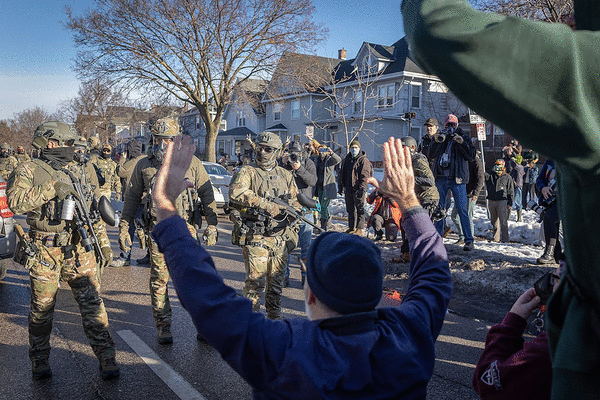
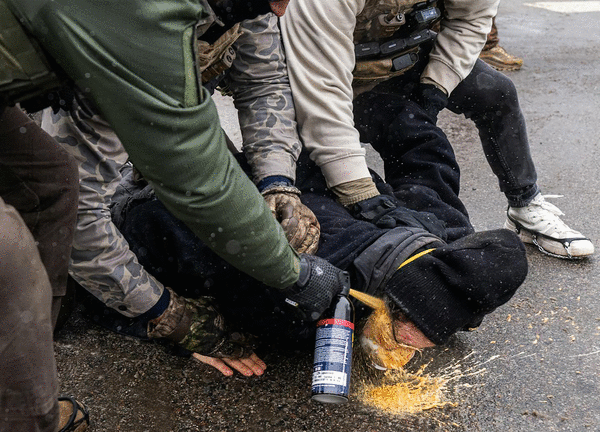
An appeals court has paused a temporary order blocking immigration agents from retaliating against peaceful protestors.
The U.S. Court of Appeals for the Eighth Circuit sided with the federal government in a terse decision Wednesday, Jan. 21, that did not explain its reasoning.
On Friday, U.S. District Judge Katherine Menendez issued a temporary injunction limiting the force federal law enforcement officers could use against demonstrators and observers relating to Operation Metro Surge, the name given to the immigration enforcement operation in Minnesota.
Menendez blocked federal agents from retaliating, arresting, detaining and using force against peaceful protesters and observers while a lawsuit filed by the ACLU of Minnesota remained pending. Her order also specifically stated that drivers who safely follow federal agents at appropriate distances do not create reasonable suspicion to justify a stop.
The order came after the ACLU of Minnesota filed a lawsuit Dec. 17 on behalf of five residents who claim federal authorities violated their constitutional rights while they were observing Immigration and Customs Enforcement actions.
In an emergency appeal filed Tuesday, lawyers for the U.S. Department of Homeland Security argued that Menendez’s injunction unfairly limited the government’s efforts to enforce immigration laws “based on a handful of contested allegations of wrongdoing by federal officers.”
The government’s attorneys argued the injunction harms “officers’ ability to protect themselves and the public in very dangerous circumstances.”
“Since the onset of Operation Metro Surge,” the government’s filing said, “ICE officers have been confronted with increased threats and violent attacks; vehicle block-ins, vandalism, and crashes; and obstruction of immigration-enforcement operations.”
Kyle Wislocky, an attorney assisting the ACLU of Minnesota, said in a statement he anticipates filing in opposition of Wednesday’s decision this week and will ask the court to rule quickly “so that protesters and observers can again be protected by the district court’s injunction immediately.”
“In the meantime, even though (Menendez’ decision) has been temporarily paused, the constitutional rights of observers, protesters and journalists remain in full effect,” Wislocky said. “We will continue to document any violations of those constitutional rights to hold the government to account going forward.”
Thousands of federal agents have fanned out across the Twin Cities and Minnesota in the last month, at times using aggressive tactics to make arrests and keep protesters and observers at bay. Federal agencies have received a storm of criticism from local officials, who have demanded agents leave the state.
Menendez found the Department of Homeland Security (DHS) and U.S. Immigration and Customs Enforcement (ICE) agents likely violated First Amendment rights of protesters by deploying chemical irritants. In her ruling Friday she found the agency also likely violated the Fourth Amendment rights of observers following agents in vehicles by stopping them without a reasonable and articulable suspicion of criminal activity, the judge wrote.
DHS spokesperson Tricia McLaughlin said at the time that “our law enforcement has followed their training and used the minimum amount of force necessary to protect themselves, the public and federal property.”
Iowa Attorney General Brenna Bird penned an amicus brief joined by 20 other Republican attorneys general in support of the federal government’s request to pause the injunction.
“Like illegal immigrants entering our country, disruptive protests and disorder do not stay contained to one city or state,” Bird wrote. “Protesters have taken increasingly aggressive tactics to interfere with ... federal law enforcement activities.”
_____
©2026 The Minnesota Star Tribune. Visit startribune.com. Distributed by Tribune Content Agency, LLC






Comments