New alcohol advice emerged from competing forces, Capitol Hill pushback
Published in News & Features
WASHINGTON — Tucked into the Trump administration’s new dietary guidelines is a small but significant change to the federal recommendation for alcohol intake — “consume less alcohol for overall better health.”
It’s a departure from the longstanding advice of limiting consumption to one drink a day for women and two for men, and the result of a winding history involving competing interests of various administrations, Capitol Hill and the alcohol industry.
The change is prompting some concerns that the message on alcohol is being muddled as studies show a greater connection to a variety of health problems.
The previous drink limits had been the recommendation since 1990, but disagreements had emerged amid growing evidence of health risks associated with drinking.
When officials announced the guidelines last week, they emphasized alcohol’s social effects.
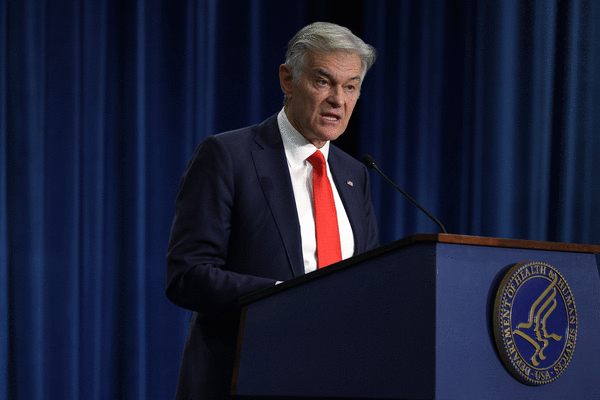
“Alcohol is a social lubricant that brings people together,” Centers for Medicare and Medicaid Services Administrator Mehmet Oz told reporters after the announcement. “In the best-case scenario, I don’t think you should drink alcohol. But it does allow people an excuse to bond and socialize.”
Oz said there was never good data to back up the drink limits. Health and addiction experts, however, say there’s evidence that even stricter warnings are appropriate. The World Health Organization, for example, in 2022 issued an advisory that no amount of alcohol is safe to drink, citing the increased risk of cancer.
Vivek Murthy, surgeon general during the Biden administration, expanded on that warning in early 2025, highlighting that the risk of seven types of cancer increased with even moderate alcohol consumption.
Some some health advocates say the less-specific recommendation, drafted by Agriculture Department in conjunction with the Department of Health and Human Services, downplays those risks.
Marion Nestle, a professor at New York University and a former nutrition policy adviser at HHS, said in an interview that it’s tough for the public to define “less.” She said someone who gets drunk three times a week would satisfy that by getting drunk twice a week.
In an emailed statement, HHS spokesperson Andrew Nixon pointed out that the first version of dietary guidelines, released in 1980, advised “if you drink alcohol, do so in moderation.”
Nixon said a study released last year by the National Academies of Sciences, Engineering and Medicine, which informed the guidelines, supports returning to something closer to the original recommendation.
That report concluded that moderate drinking was associated with lower risk of death from all causes. The researchers came to that conclusion with “moderate certainty,” meaning that there’s a chance the association could be attributed to other causes.
The report also concluded with moderate certainty that moderate drinking was associated with an increased risk of female breast cancer compared to never consuming alcohol.
“The result was similar, drinking less alcohol is better for overall health,” Nixon said. “And that specific populations (i.e. pregnant women, those susceptible to addiction) should completely avoid it.”
View from the Hill
As the new dietary guidelines were being drafted, the alcohol recommendation was a major question mark.
The Biden administration HHS took a controversial approach to examining the effect of alcohol on health in 2024, when it enlisted the help of the Interagency Coordinating Committee on the Prevention of Underage Drinking to conduct its own study.
The alcohol industry had concerns that the committee had a built-in bias against the industry and its inclusion wasn’t necessary given the study being carried out by the National Academies of Sciences, Engineering and Medicine.
Congress had similar concerns.
Reps. Mike Thompson, D-Calif., and Dan Newhouse, R-Wash., who serve districts with large vineyard presences and have been co-chairs of the Congressional Wine Caucus, led a letter in October 2024 calling for the committee’s study to be suspended. Signed by 100 lawmakers, the letter asserted that the underage drinking committee’s efforts were duplicative and fell outside the committee’s jurisdiction of underage drinking.
A draft version of that study published in January 2025 found that even drinking within the recommended limits at the time could be associated with risks like liver disease and cancer.
It’s unlikely that the final version will be completed, as Congress wants to defund the underage drinking committee altogether. The House Labor-HHS-Education Appropriations Subcommittee, in a report accompanying their fiscal 2026 bill, urged HHS in its bill report to completely defund the panel.
“The Committee is concerned that under the Biden Administration, funding for ICCPUD was diverted for purposes unrelated to preventing underage drinking,” the House report said. “The Committee notes concern that ICCPUD carried out research on adult alcohol consumption and used those findings as input for the 2025 Dietary Guidelines for Americans.”
The Senate’s version did not go so far, but said in the accompanying report that the funding is meant to be used for “preventing or reducing underage drinking and not for any other purpose.”
Rep. James R. Comer, R-Ky., is still slamming the Biden administration over how it handled the study. The House Oversight and Government Reform chair — a staunch advocate for the bourbon industry in his district and across the Bluegrass State — earlier this month published a report asserting that the prior administration’s move was illegal.
“The Biden Administration violated federal law and ignored Congress in order to push an agenda on the American people,” Comer said in a statement. “After the House Oversight Committee uncovered evidence that the Biden Administration wasted taxpayer dollars on an unnecessary and duplicative study, the administration wasted no time obstructing the Committee’s requests and hiding evidence of the study’s obvious bias.”
In a statement, Thompson welcomed the updated alcohol recommendation.
“I have long believed that alcohol consumption guidelines should be grounded in the best available science,” he said. “I welcome the science-based approach in the newly released guidelines and I recommend any American who has questions speak with their doctor.”
Effects
The Distilled Spirits Council, the lobby group representing the alcohol industry, doesn’t view the new guidelines as a major change.
Amanda Berger, the group’s senior vice president of science and research, pointed out in a statement that the National Academies’ report still defined moderate alcohol consumption as one drink per day for women and two for men.
She underscored that the previous guidelines also advised that “drinking less is better for health than drinking more” and that “there are also some people who should not drink at all,” similar to the new guideline.
Some experts said that the new recommendation weakens federal health advice and downplays the public health risks associated with drinking.
Nestle, who worked on the alcohol recommendations when the guidelines were updated in 1995, underscored that increased drinking is associated with public health issues like drunk driving and violence. She said public health and the alcohol industry have conflicting objectives.
“I thought this was a huge win for the alcohol industry,” she said of the guideline change.
Mariell Jessup, the chief science and medical officer at the American Heart Association, said there has previously been a notion that some amount of drinking is good for the heart. But that idea is largely being put to rest, she said, pointing to a 2025 paper from the American Heart Association that found neither a definitive benefit, nor ill effect.
The recommendation comes as alcohol use among Americans is on a downward trend. A Gallup poll found that the percentage of adults who reported consuming alcohol fell from 62% in 2023 to 54% in 2025.
Jessup said it’s still too early to tell whether that trajectory will hold.
“It’s not a very strong recommendation,” she said of the new guidelines. “So if people are really following it carefully, maybe they will take that into consideration and decrease their drinking, and I hope that’s true, but it’s hard to know.”
©2026 CQ-Roll Call, Inc., All Rights Reserved. Visit cqrollcall.com. Distributed by Tribune Content Agency, LLC.





Comments