Even with high gas prices, EV sales in California are flat
Published in Business News
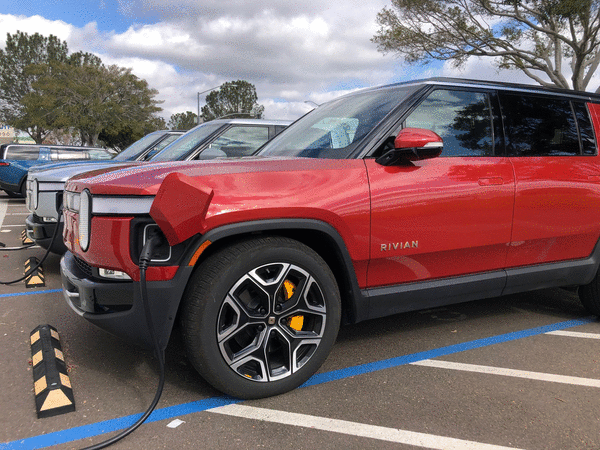
Despite soaring gasoline prices and the re-introduction of a statewide rebate program for zero-emission vehicles, sales of EVs and plug-in hybrids in California stalled in the third quarter of this year.
All-electrics accounted for a 17.3% share of new cars and pickup trucks sold in the California from July through September, down from 17.9% in the second quarter, according to a report released Thursday by the California New Car Dealers Association.
Plug-in hybrids fared only slightly better, with a 2.9% share of the market between July and September, compared to 2.5% in Q2 of this year.
EVs and plug-ins combined to account for 20.2% of new passenger vehicle registrations in the Golden State in the third quarter, according to the data collected by Experian Automotive. In the second quarter, they combined to make up 20.4%.
In the third quarter of 2025, EVs and plug-ins combined to make up 28.7% of new car sales across the state, as many consumers raced to buy zero-emissions vehicles before federal tax credits disappeared.
The numbers did not surprise some auto analysts.
“Even with seven, eight months of elevated gas prices, we are not seeing a big change in purchasing behavior toward electric vehicles,” said Karl Brauer, executive analyst at iseecars.com. “And I think that just further confirms that even more expensive oil and gas is not enough, certainly without (federal tax) incentives also in place, to inspire a lot of people to buy electric cars — at least not in the U.S.”
Since hostilities with Iran started on Feb. 28, international crude oil prices have hit $100 per barrel on multiple occasions, leading to a prolonged spike in gasoline prices.
Even before the war, California had the highest price for a gallon of gas of any state, and the pain at the pump has only intensified. According to AAA, the average price in San Diego on Friday stood at $6.27 — an increase of $1.58 since joint airstrikes by U.S. and Israeli forces first hit Iran.
“People absolutely are interested in saving money on fuel right now,” Brauer said. “But many are not willing to put up with the massive shift in lifestyle and driving approach that an EV requires — whether it’s utilizing the infrastructure that may not be adequate for a lot of people in terms of public charging, whether it’s the increased cost that EVs typically represent versus the equivalent non-EV.”
Earlier this week, Kelley Blue Book reported the average transaction price for a new vehicle in the U.S. came to $50,562, while the average new EV cost $55,879.
The California Energy Commission on Friday released its own set of third-quarter numbers. The data closely tracked with that from the New Car Dealers Association, with registrations of EVs, plug-in hybrids and hydrogen fuel-cell vehicles accounting for 19.1% of vehicles sold across the state from July through September.
“Despite the Trump administration’s continued attack on clean vehicles, California drivers continue to go electric, choosing EVs for a great driving experience and no more trips to the gas station,” CEC Commissioner Nancy Skinner said in a statement.
In July, Gov. Gavin Newsom signed legislation rolling out the MyFirstEV rebate program. The initiative offers $3,500 for first-time buyers of EVs that cost $50,000 or less. There’s also a rebate of $1,750 for first-time buyers who purchase a used electric vehicle with an MSRP of up to $25,000.
The program came in reaction to the “One Big Beautiful Bill” passed by Republicans on Capitol Hill and signed into law by President Donald Trump. It included provisions that eliminated the federal tax credit of up to $7,500 on the purchase or lease of a new EV and $4,000 for a used one.
Newsom’s office on Friday said nearly 12,000 consumers have taken advantage of MyFirstEV so far, adding that the 19.1% share of third-quarter sales showed that “ZEVs held strong.”
“Twelve thousand Californians bought their first electric car and said goodbye to the gas pump,” Newsom said in a news release. “That’s nearly twelve thousand drivers who no longer pay the price of Donald Trump’s reckless Iran war every time they fill up.”
California used to offer a rebate program called the Clean Vehicle Rebate Project, but it was discontinued in late 2023.
The MyFirstEV program includes a provision for “California-headquartered zero-emission vehicle companies regardless of the vehicle manufacturer’s suggested retail price or sales price.”
That means Rivian and Lucid cars and trucks qualify for the $3,500 rebates, even though the least expensive models from both automakers exceed $50,000 by a healthy margin. Rivian is based in Irvine and Lucid’s headquarters are in Silicon Valley.
While third-quarter EV and plug-in hybrid sales sputtered, the sale of what the auto industry calls “traditional hybrids” keeps zooming.
The California New Car Dealers report touted that registrations of hybrids without plug-ins have increased each quarter this year, rising to 24.1% in Q3.
“Most of these cars now, compact SUVs and midsize sedans, get 40, 50 miles per gallon,” said Joseph Yoon, consumer insights analyst at Edmunds. “So if you’re coming from a car that was getting mid- to low-20 miles per gallon, with these gas prices, it’s kind of a no-brainer.”
Traditional hybrids rely on the car’s electric motor when operating at low speeds and then shift to the internal combustion engine when additional power is needed. Drivers get better gas mileage and don’t have to worry about searching for a charging station.
However, California officials do not consider traditional hybrids as zero-emission vehicles because they consume gasoline.
Regardless of powertrain, though, it’s been a sluggish year for car sales.
Registrations for all new vehicles in California are down 4.2% so far this year compared to 2025, and the national numbers are off 1.6%.
An up-and-down economy is mostly to blame, as households struggle to keep pace with inflation. Rising interest rates also have a major impact on car sales, as consumers are hard-pressed to obtain financing at favorable terms.
“For a lot of people, even if you have great credit, the dealer will probably tell you, ‘6.5%, 7%,’ and that’s a terrible number to be financing” a $50,000 car, Yoon said. “So I think that has a huge effect on who ultimately ends up pulling the trigger on a new vehicle.”
Top selling models in California
2026 registrations, through September
1. Tesla Model Y: 86,099
2. Toyota Camry: 52,224
3. Honda Civic: 42,238
4. Honda CR-V: 41,809
5. Toyota RAV4: 37,801
6. Toyota Tacoma: 36,330
7. Toyota Corolla: 31,937
8. Ford F-Series: 28,507
9. Tesla Model: 3 27,303
10. Honda Accord: 25,057
Source: Experian Automotive/CNCDA
©2026 The San Diego Union-Tribune. Visit sandiegouniontribune.com. Distributed by Tribune Content Agency, LLC.







Comments